

Dendrochronology
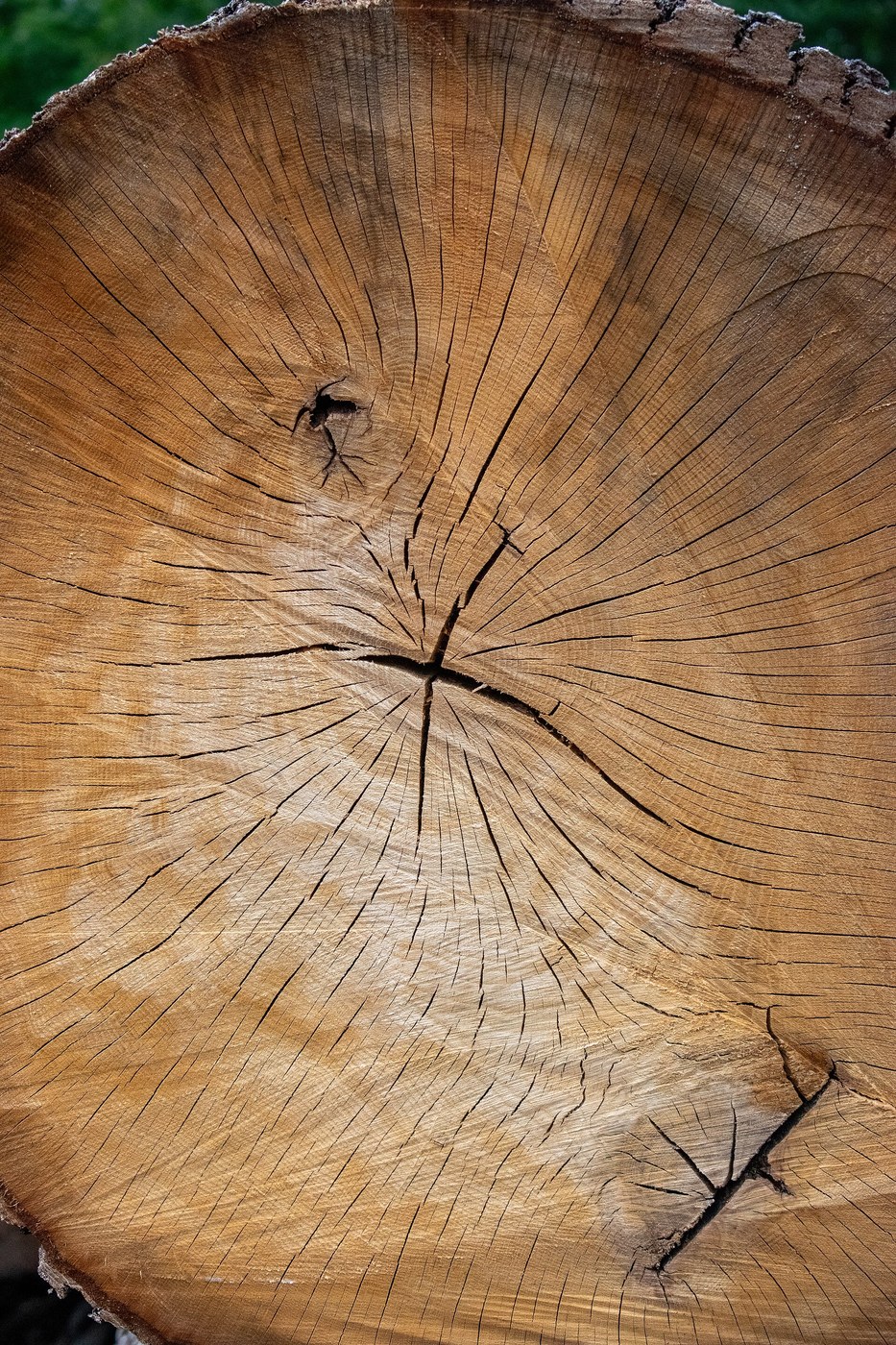
A tree ring is one year. Count the rings and you get the age of the tree — that much most people know, and on its own it is nearly useless for dating anything, because you do not know which years they were.
The real method is crossdating. Rings are not uniform: a drought year is narrow, a good year is wide, and every tree in a region records the same pattern of good and bad years. That pattern is a fingerprint. Match the pattern in a piece of wood of unknown age against a master chronology built from trees of known age, and you can say which calendar year each of its rings grew — not approximately, exactly.
This is a measure-it-yourself project. You will build a skeleton plot, the graph-paper technique A. E. Douglass invented for exactly this, and date an unknown sample against a known one.
手順
Get two wood cross-sections
Get two wood cross-sections
Get two cross-sections from the same region and species with overlapping lifetimes — a log slice and a piece of older timber. A firewood pile is a good source.
このステップの材料:
 木材の横断面2 個
Sand one radius smooth
Sand one radius smooth
Sand a strip from pith to bark through 120, 220 then 400 grit. Rings are invisible on a saw-cut face; on a properly sanded face they are sharp.
必要な工具:
 紙やすり
紙やすりLearn to see one year
Learn to see one year
Under a hand lens find the boundary: pale wide earlywood grown in spring, then dark dense latewood grown late in the season, then an abrupt edge into the next spring. Earlywood plus latewood is one year.
必要な工具:
 手持ちルーペ 10倍
Date the known sample from the bark inward
Date the known sample from the bark inward
On the sample with bark intact, the outermost ring is the year the tree was cut. Number backwards from it toward the pith. This is your master.
Mark only the narrow rings
Mark only the narrow rings
Go along the master and mark each conspicuously narrow ring. Ignore the average ones entirely — the signal is in the extremes, not in every measurement.
Draw the skeleton plot
Draw the skeleton plot
On graph paper, one column per year, draw a vertical line down for each narrow ring — longer line for narrower ring. Leave average years blank. This spiky barcode is the skeleton plot.
このステップの材料:
 方眼紙1 枚
Make a skeleton plot of the unknown
Make a skeleton plot of the unknown
Repeat on the undated sample, numbering its rings 1, 2, 3 from the pith — arbitrary numbers, because you do not yet know the years.
Slide one plot along the other
Slide one plot along the other
Hold the unknown plot over the master and slide it left and right until the spikes line up. Only one position will fit if the samples genuinely overlap — this is crossdating, and it is a pattern match, not a count.
Read off the calendar years
Read off the calendar years
At the matching position, transfer the master's dates to the unknown's rings. Every ring now has a calendar year, including the outermost — which dates the wood.
Test the match against a wrong one
Test the match against a wrong one
Slide the plot two years off and look again. A false position matches a few spikes by chance but fails on the rest. Convince yourself the true fit is qualitatively better — that judgement is the skill.
Look for what can go wrong
Look for what can go wrong
Check for a missing ring, where a year was so poor the tree grew none, and a false ring, where drought mid-season mimics a boundary. Both shift every date after them, and both are why counting alone fails.
必要な工具:
手持ちルーペ 10倍History & Context
History & Context
Douglass and the method. Crossdating was developed by A. E. Douglass in the early 1900s, aided by scoring the narrowness of each ring and transferring that to graph paper — the skeleton plot. Douglass was an astronomer looking for sunspot cycles in tree growth; the dating method was a by-product that turned out to matter far more. He and his team built a master sequence for the US Southwest reaching back to AD 700, and dendrochronologists have since extended chronologies to around 6700 BC.
Why counting rings is not dating. A count gives you a duration, not a position in time. Worse, counts are wrong more often than people expect: a tree under severe stress can fail to add a ring at all in a given year, and a mid-season drought can create a false ring that looks like a boundary. Crossdating catches both, because a missing or extra ring throws the pattern out of alignment and the mismatch is visible.
Absolute, not relative. This is what makes dendrochronology unusual. Stratigraphy gives you order. Radiocarbon gives you a date with an error range of decades. A crossdated tree ring gives you an exact calendar year, and where the bark is present, often the season of felling. It is the most precise dating method in archaeology, and it is used to calibrate radiocarbon dating itself — the radiocarbon curve is anchored on tree rings of known age.
What it dates. Timber in buildings, ships, panel paintings, musical instruments, waterlogged piles, coffins. It has settled art-historical disputes by showing that a panel could not have been painted before the tree was cut. It also has a limit worth stating: it dates the wood, not the object. Timber is reused, stored and traded, so a felling date is a date after which the thing was made — not necessarily when.
Climate in the rings. Because ring width responds to growing conditions, long chronologies are also climate records. A sequence stretching back thousands of years carries a year-by-year account of droughts and cold periods across a region. The same spiky barcode you drew on graph paper is, at scale, one of the highest-resolution climate archives that exists.
CC0 パブリックドメイン
このブループリントはCC0で公開されています。許可を求めずに、自由にコピー、修正、配布、あらゆる目的で使用できます。
メイカーを応援するには、ブループリント経由で製品を購入してください。メイカーには メイカーコミッション がベンダーにより設定されています。または、このブループリントの新しいイテレーションを作成し、自分のブループリントにコネクションとして含めて収益を共有できます。