
Edison Electric Lamp
Making something glow with electricity was easy and had been done for decades. Making it still glow tomorrow was the problem. Every filament burned out in minutes, because a hot conductor in air simply oxidises away.
Edison's patent is really about two numbers: no oxygen, and high resistance. The vacuum stops the filament burning. The high resistance is the commercial insight — a lamp that draws little current can be fed by thin, affordable copper wiring, and hundreds of them can hang off one circuit. A low-resistance lamp works perfectly well and would have needed copper mains nobody could pay for.
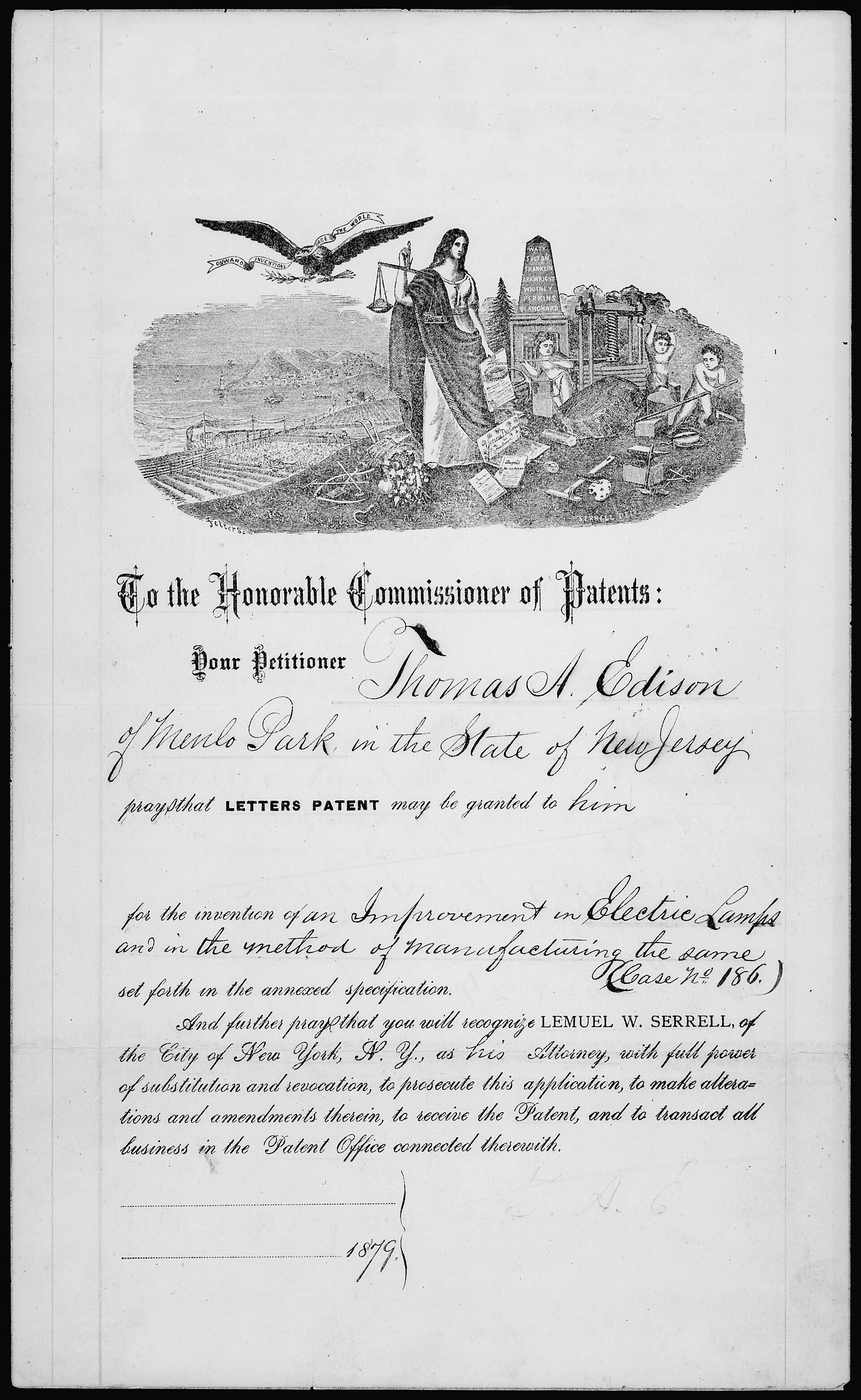
US Patent 223,898, "Electric Lamp", granted 27 January 1880, claims a carbon filament of high resistance in a sealed glass vessel from which the air has been exhausted. This blueprint builds a working demonstration and measures both numbers.
手順
An evacuated glass vessel can implode
An evacuated glass vessel can implode
Use thick-walled glass, keep it shielded while under vacuum, and wear eye protection. Treat the electrical side as live at all times.
Read US 223,898 and find the word 'high resistance'
Read US 223,898 and find the word 'high resistance'
The claim is a carbon filament of high resistance in an exhausted glass globe. The resistance is not incidental — it is the part that made electric light a business.
Burn a filament in open air first
Burn a filament in open air first
Pass current through a thin carbon strand in the open. It glows briefly and is gone. That is oxidation, not melting, and the vacuum is the fix.
Carbonise a cotton or bamboo fibre
Carbonise a cotton or bamboo fibre
Seal a fibre in a closed crucible with no air and heat it hard. The organic material chars to nearly pure carbon while keeping its shape.
このステップの材料:
 木綿糸1 メートル
必要な工具:
 鋳鉄坩堝
鋳鉄坩堝Exclude air during carbonisation or you get ash
Exclude air during carbonisation or you get ash
Any oxygen in the crucible burns the fibre instead of charring it. Pack it in sand or seal the lid with clay.
Measure the filament's cold resistance
Measure the filament's cold resistance
Record it before assembly. Aim for a filament that is long and thin — resistance rises with length and falls with cross-section.
必要な工具:
 マルチメーター
Work out the current your filament will draw
Work out the current your filament will draw
Compute I = V/R at your supply voltage. A 100-ohm filament at 100 V draws 1 A; a 1-ohm filament draws 100 A and needs cable as thick as your thumb.
Clamp the filament to two lead-in wires
Clamp the filament to two lead-in wires
Support it at both ends on stiff wires that will pass through the glass. Carbon is brittle — every handling step risks snapping it.
このステップの材料:
 銅線1 メートル
Seal the lead-ins through the glass
Seal the lead-ins through the glass
Fuse the glass around the wires. This joint is the hardest part of the whole build — glass and metal expand at different rates and the seal cracks as it cools.
このステップの材料:
 ガラス毛細管1 個
Evacuate the bulb as far as you can
Evacuate the bulb as far as you can
Pump it down with a vacuum pump. Edison used a Sprengel mercury pump; a modern pump reaches the same pressure without handling mercury at all.
必要な工具:
 真空ポンプ
真空ポンプSeal off the pump stem while still under vacuum
Seal off the pump stem while still under vacuum
Melt the neck closed with the pump running. Let air back in first and the filament oxidises the moment it heats.
Bring the voltage up slowly
Bring the voltage up slowly
Raise supply gradually and watch the filament go dull red, then orange, then white. Straight to full voltage snaps a cold brittle filament.
Measure hot resistance and compare with cold
Measure hot resistance and compare with cold
Carbon's resistance FALLS as it heats — the opposite of a metal filament. Record both figures; the difference explains the inrush behaviour.
Run it to failure and inspect the glass
Run it to failure and inspect the glass
Note the lifetime and look for blackening inside the bulb. That deposit is filament material that evaporated and condensed — the real limit on carbon lamps.
Compendium — the resistance was the business model
Compendium — the resistance was the business model
The patent. US 223,898, "Electric Lamp", granted 27 January 1880 to Thomas Alva Edison, describing a carbon filament of high resistance in an evacuated glass globe. Edison did not invent the incandescent lamp; incandescent lighting had been demonstrated for decades, and Joseph Swan in England developed a working carbon lamp in parallel and had genuinely strong priority claims. Swan and Edison eventually merged their British interests as Ediswan rather than litigate to exhaustion. Presenting Edison as the sole inventor misstates a well-documented dispute.
Why high resistance mattered more than the filament. Power delivered is I²R in the conductors, and copper cost scales with cross-section. A low-resistance lamp draws heavy current, so feeding a street of them needs enormous copper mains. Making each lamp high-resistance and low-current lets many run in parallel from thin, affordable wiring. Edison's team worked the economics backwards from the price of copper, which is why the patent claim specifies high resistance rather than simply a carbon filament. The lamp is the visible part of a system that also required dynamos, meters, fuses and distribution mains — and Edison patented those too.
Two failure modes, not one. In air a hot filament oxidises and is consumed in seconds. In vacuum it cannot burn, but it still slowly evaporates, and the vapour condenses on the cooler glass — that is the blackening you see in an old bulb, and it thins the filament until it breaks. Later lamps replaced the vacuum with an inert argon-nitrogen fill, which suppresses evaporation by raising the pressure over the filament, and switched from carbon to tungsten, which has a far higher melting point.
An honest note on carbon's behaviour. Carbon has a NEGATIVE temperature coefficient: hotter means less resistance, so a carbon lamp draws more current as it warms and can run away if the supply allows. Metal filaments behave the opposite way and are self-limiting, which is one of several reasons tungsten won. The Sprengel mercury pump that made Edison's vacuum possible is also worth naming — it was borrowed from laboratory chemistry, and better vacuum, not a better filament, is what turned a demonstration into a product.
この設計図で作るもの

関連ブループリント
これらのブループリントは知識を共有しています — 技術、材料、原理



CC0 パブリックドメイン
このブループリントはCC0で公開されています。許可を求めずに、自由にコピー、修正、配布、あらゆる目的で使用できます。
メイカーを応援するには、ブループリント経由で製品を購入してください。メイカーには メイカーコミッション がベンダーにより設定されています。または、このブループリントの新しいイテレーションを作成し、自分のブループリントにコネクションとして含めて収益を共有できます。