
Kinetoscope
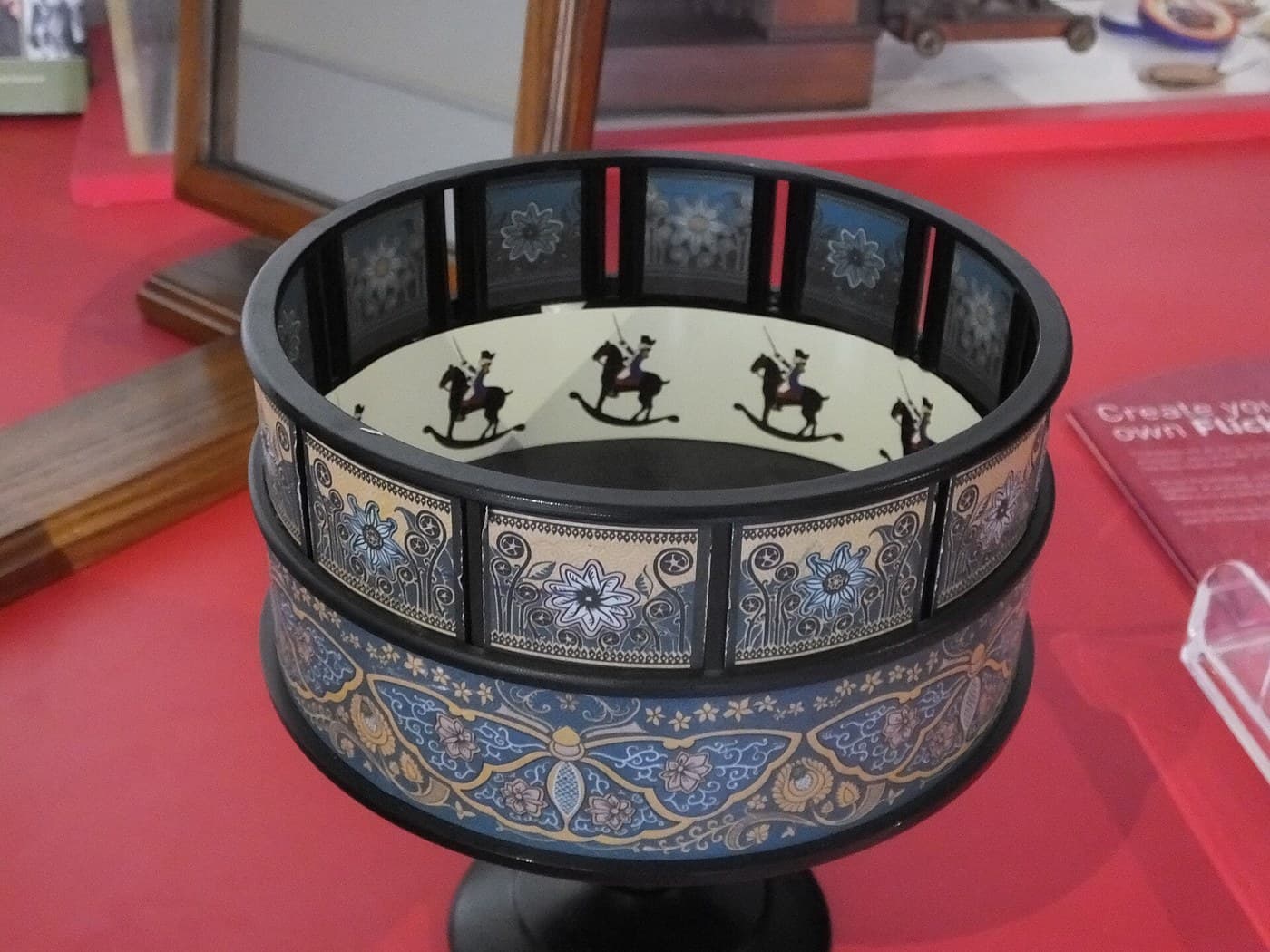
A zoetrope holds about a dozen drawings and shows a loop lasting a second. To show a real scene for half a minute you need hundreds of photographs, and no drum is big enough — the pictures have to live on something long and flexible that can be fed past the eye continuously.
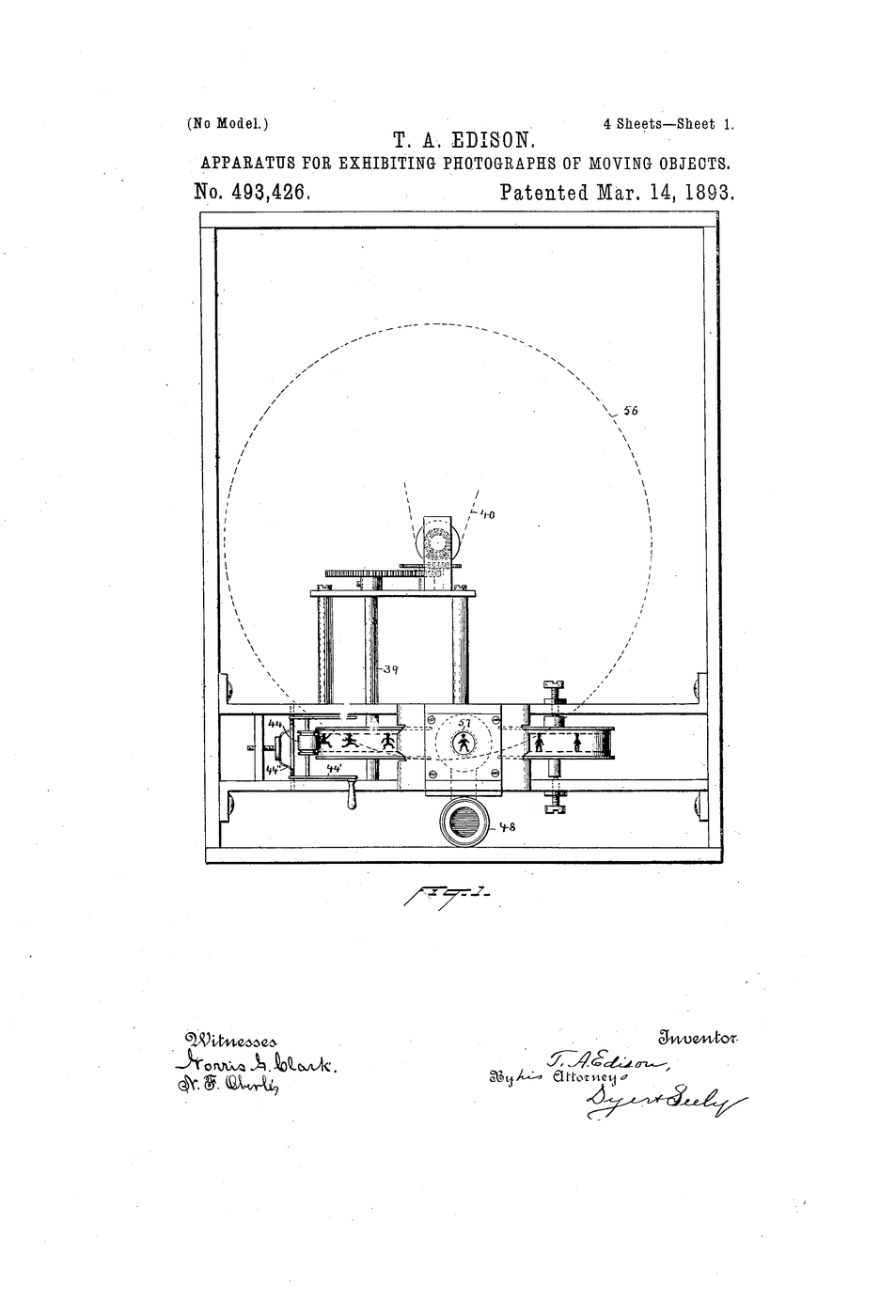
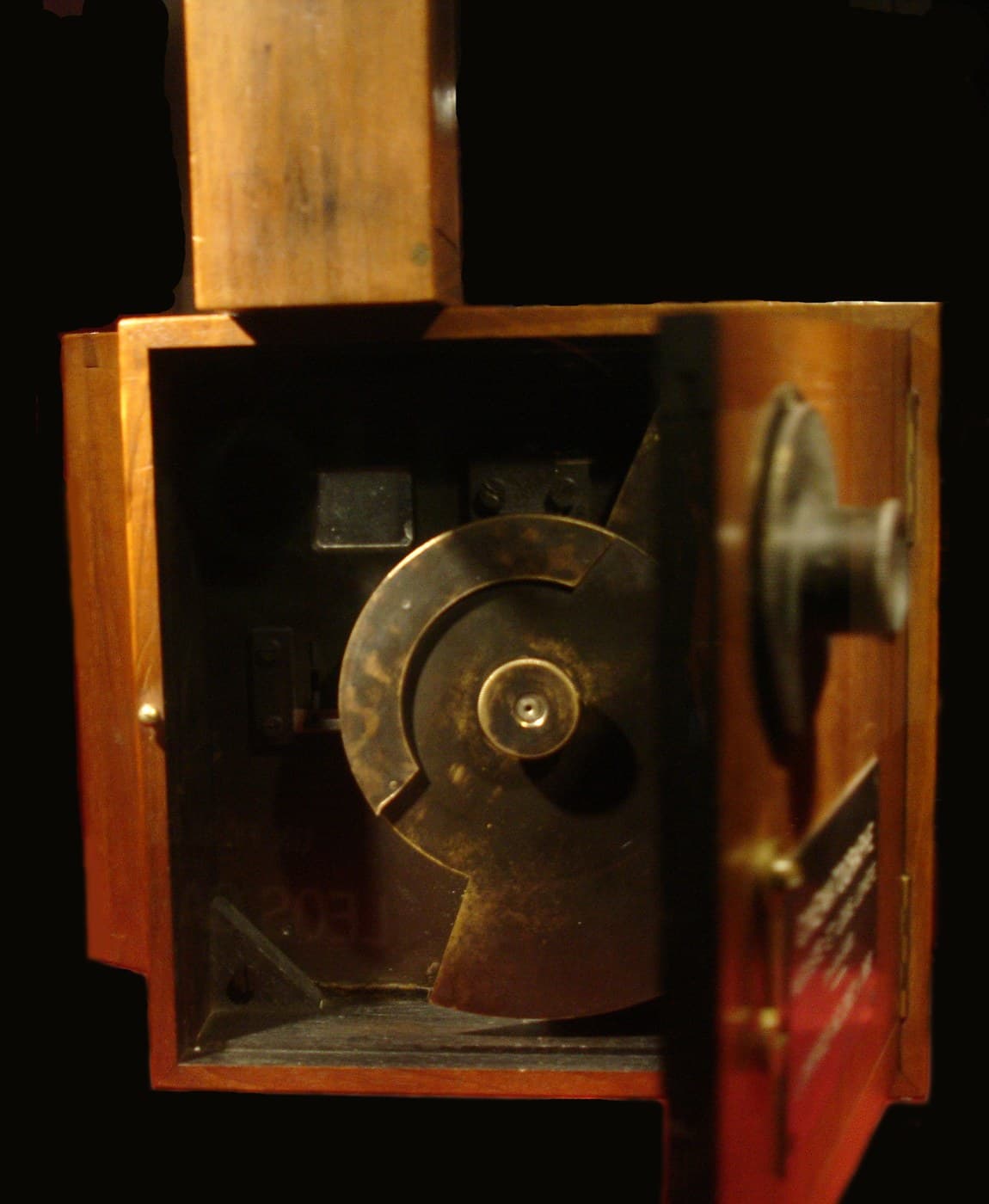
The Kinetoscope runs an endless band of film in a cabinet and you look down into it. The strip never stops; a shutter with a narrow slit passes over it, exposing each frame to the eye for an instant and hiding the movement between frames. Persistence of vision does the rest, and a lamp underneath supplies the light.
It shows the film to exactly one person. There is no screen and no projection — you put your money in, bend over the eyepiece, and watch alone. That was a deliberate commercial choice, and it was the wrong one.
US Patent 493,426, "Apparatus for Exhibiting Photographs of Moving Objects", filed 24 August 1891 and granted 14 March 1893 to Thomas A. Edison.
手順
Read US 493,426 and note there is no screen
Read US 493,426 and note there is no screen
Edison claims an apparatus for exhibiting photographs to a viewer through an aperture and lens. Nothing in it projects an image onto anything.
Draw a 12-frame walk cycle
Draw a 12-frame walk cycle
Make twelve small sequential drawings of one simple motion. Keep the changes tiny and even — uneven spacing reads as a limp.
Join them into an endless band
Join them into an endless band
Mount the frames along a paper strip and glue the ends into a loop. Endless is in the patent — the show has no beginning and no end.
このステップの材料:
 型紙用トレーシングペーパーのロール1 巻
Build the cabinet and the eyepiece
Build the cabinet and the eyepiece
Make a light-tight box with a small viewing hole in the top. Everything else happens in darkness inside it.
このステップの材料:
 合板1 枚
合板1 枚Fit rollers to carry the loop
Fit rollers to carry the loop
Mount two dowel rollers so the band runs smoothly past a window below the eyepiece, under light, even tension.
このステップの材料:
 木ダボ棒1 個
Light the film from below
Light the film from below
Put a lamp under the window so each frame is lit from behind. Edison specifies heat-absorbing elements — film and heat are a bad combination.
Run the loop with no shutter and look
Run the loop with no shutter and look
Drive the rollers steadily and watch through the hole. You see a continuous smear. Continuous film alone gives no picture at all.
Cut a slitted shutter disc
Cut a slitted shutter disc
Cut a disc with one narrow radial slit and mount it to spin between the film and the eyepiece.
Synchronise the slit to the frames
Synchronise the slit to the frames
Gear the shutter so the slit passes once per frame. Now the eye sees each frame for a moment and is blind while the film moves on.
Look again and find the motion
Look again and find the motion
Run it. The smear resolves into a moving figure. The shutter, not the film, is what makes it an image.
Widen the slit and watch it blur
Widen the slit and watch it blur
Cut the slit twice as wide and re-run. Each frame is now visible while it is still moving, and sharpness collapses. Narrow means dim but crisp.
Slow the film until the illusion breaks
Slow the film until the illusion breaks
Reduce speed until you see separate pictures flicking. Note the rate at which motion appears — below roughly 10-12 frames a second it falls apart.
Ask a second person to watch at the same time
Ask a second person to watch at the same time
They cannot. There is one eyepiece and one viewer. Sit with that limitation for a moment — it decided who made money from cinema.
History & Context — one customer at a time
History & Context — one customer at a time
The patent. US 493,426, "Apparatus for Exhibiting Photographs of Moving Objects", filed 24 August 1891 and granted 14 March 1893 to Thomas A. Edison. Note the granted title never says kinetoscope — that was the trade name.
⚠ Edison's name is on it; W. K. L. Dickson did most of the work. William Kennedy Laurie Dickson was the Edison laboratory employee who actually developed the camera and viewer through 1889-1892, and his role is well documented. Edison's laboratory operated on the principle that inventions belonged to the laboratory, so patents issued in Edison's name regardless of whose hands did the building. That is not fraud and it was standard practice, but "Edison invented the movies" flattens a team into one man, and Dickson is the name most often flattened out.
The commercial misjudgement is the interesting part. Edison could have pursued projection and chose not to. The reasoning was straightforward: a peep-show cabinet takes one coin from one customer, so a parlour full of cabinets takes many coins, whereas a projector shows one film to a whole room for a single admission. He concluded there was more money in machines than in screenings. He was wrong, and the Lumière brothers proved it within two years — their Cinématographe of 1895 projected to a paying audience, was also a camera, and was portable enough to tour. Cinema became a mass, shared experience almost immediately, and Edison had to buy his way into projection afterwards. It is a clean case of a correct machine attached to a wrong theory of the market.
Why continuous film needs a shutter, and what that costs. Steps 7 and 10 are the whole optical argument. A moving image is only sharp if the eye sees it while it is effectively still, so either the film stops for each frame or the eye is blinded while it moves. Edison's machine keeps the film moving and blinds the eye with a slit — mechanically simple, but the slit is narrow so very little light gets through, which is survivable when you are peering into a lit box and hopeless when you are trying to fill a screen. Projection therefore went the other way, with intermittent film movement: hold each frame still, open a wide shutter, then yank the film on. That difference — continuous with a narrow slit versus intermittent with a wide shutter — is the real technical divide between this machine and the Cinématographe.
What it left behind. The 35 mm film width with four perforations per frame, established for the Kinetoscope, became the film standard for over a century. The machine that lost the format war set the gauge for the one that won.
関連ブループリント
これらのブループリントは知識を共有しています — 技術、材料、原理


CC0 パブリックドメイン
このブループリントはCC0で公開されています。許可を求めずに、自由にコピー、修正、配布、あらゆる目的で使用できます。
メイカーを応援するには、ブループリント経由で製品を購入してください。メイカーには メイカーコミッション がベンダーにより設定されています。または、このブループリントの新しいイテレーションを作成し、自分のブループリントにコネクションとして含めて収益を共有できます。