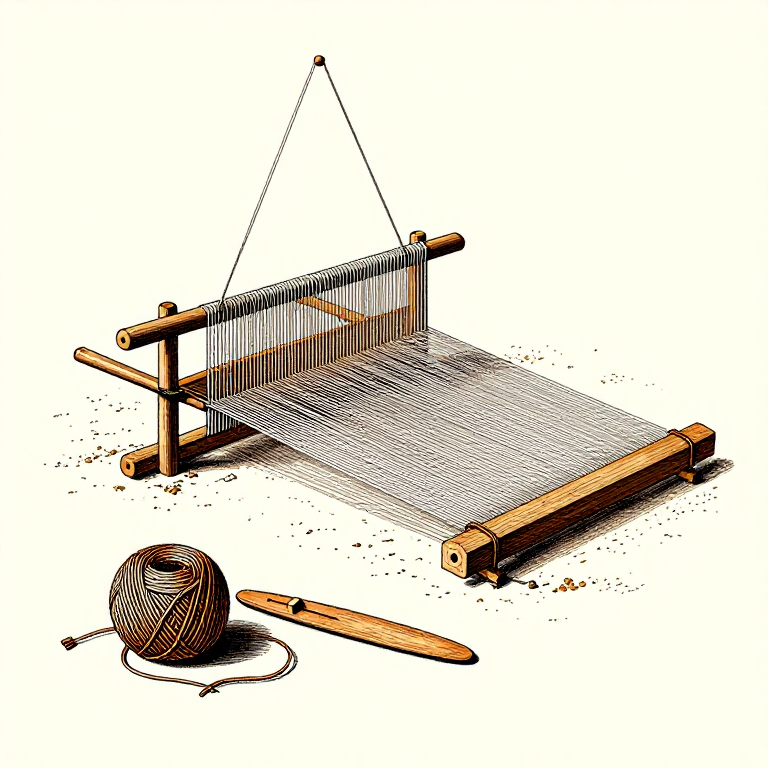


Egyptian Linen Weaving — Weaving Fine Linen on a Horizontal Loom
手順
Set Up the Horizontal Ground Loom
Set Up the Horizontal Ground Loom
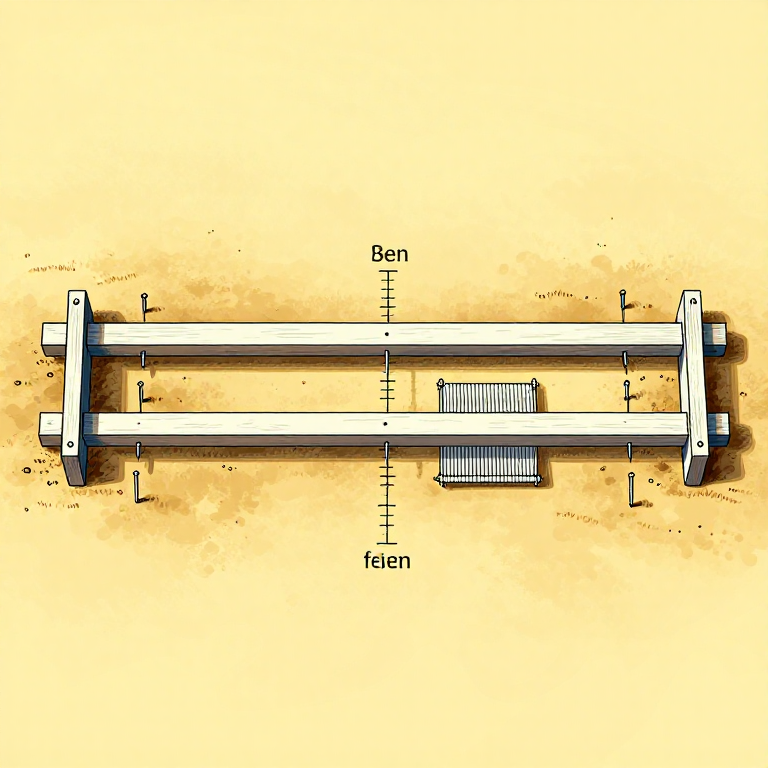
Drive four sturdy pegs into the ground forming a rectangle, approximately 1 meter wide and as long as the desired fabric. Lash two loom beams horizontally across the short ends, secured firmly to the pegs. These beams must be taut and parallel — any slack or misalignment produces uneven fabric. The horizontal ground loom was standard in Egypt from the Predynastic period through the Middle Kingdom, depicted in tomb paintings at Beni Hasan and in wooden models. The loom sits flat on the ground, with the weaver squatting or kneeling beside it. This design is simple but effective, and versions are still used in parts of North Africa today.
このステップの材料:
 亜麻糸200-500 g depending on fabric size g
 木栓4-6 for securing loom beams 個
必要な工具:
 織機の巻き具 二本
 リジッドヘドル織機
 木ダボ棒
木ダボ棒 杼(ひ)
杼(ひ) 織り用の櫛
織り用の櫛Warp the Loom
Warp the Loom
Wind warp threads onto the loom by tying the starting end to one beam and winding back and forth between the two beams, keeping each pass parallel and evenly spaced. For fine linen comparable to Egyptian medium-grade cloth, space threads approximately 2-3 mm apart (10-12 threads per centimeter). For finest royal-grade linen, density could exceed 40 threads per centimeter. Maintain consistent tension across all warp threads by adjusting beam pegs — uneven tension causes puckered fabric. Ancient linen samples from Tutankhamun's tomb show S-spun warp threads (spun clockwise), characteristic of Egyptian spinning technique.
Install the Heddle and Shed Rods
Install the Heddle and Shed Rods
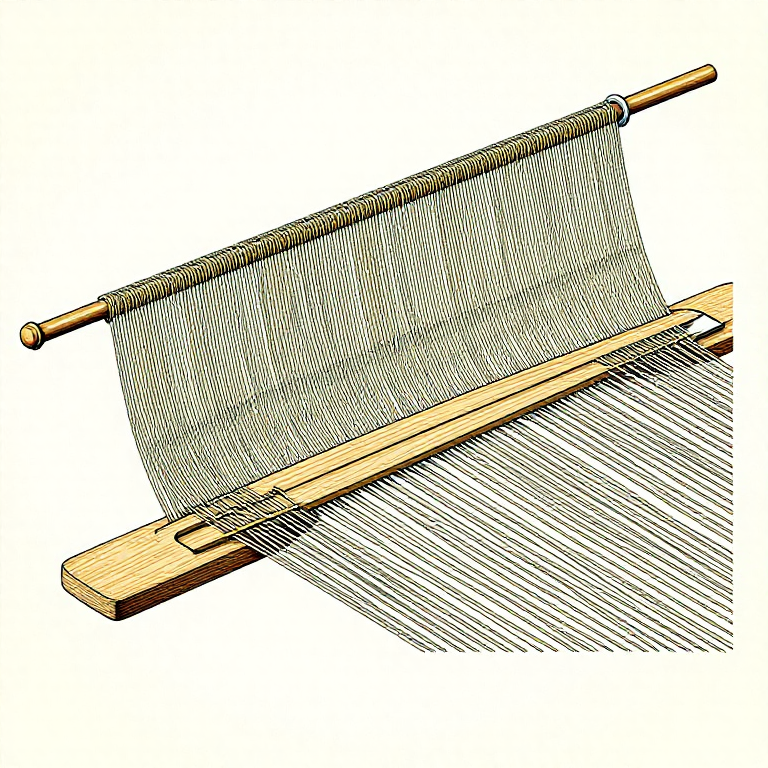
Install a heddle rod and shed rod to create the two alternating sheds through which the weft passes. The shed rod is a smooth stick inserted under alternate warp threads, resting on top of the remaining threads. When tilted on edge, it lifts its set of threads, creating the natural shed. The heddle rod has small string loops tied around it, each encircling one warp thread NOT controlled by the shed rod. When pulled upward, it lifts the second set, creating the counter-shed. This alternating mechanism is the fundamental principle of all weaving, allowing the weft to pass over and under alternate warps for a plain weave (tabby) — the most common Egyptian weave structure.
Weave the Weft Threads
Weave the Weft Threads
Wind linen thread onto a shuttle. Open the first shed by tilting the shed rod on edge, and pass the shuttle through from one side to the other. Beat the weft firmly against the previous row using a flat weaving comb — this compacts the weave for dense, even fabric. Open the counter-shed by pulling up the heddle rod, pass the shuttle back. Beat again. Continue alternating sheds and passing weft. Maintain consistent tension — too tight and the fabric draws in at the selvages; too loose and the weft creates loops. Egyptian weavers achieved remarkable consistency, producing cloth with perfectly even spacing across widths of up to 2 meters.
Finish and Remove the Cloth
Finish and Remove the Cloth
When the woven area reaches the far beam, cut the warp threads at both beams, leaving enough length to tie off or fringe the ends. The cut warp ends can be knotted in small groups to prevent unraveling, or left as decorative fringe. Finished linen should be smooth, evenly woven, and translucent when held to light — a hallmark of quality Egyptian linen. It was typically left in natural pale cream or bleached white by repeated washing and sun exposure. Herodotus noted Egyptian priests wore exclusively white linen, considered ritually pure. The finest surviving Egyptian linen, from the tomb of Kha at Deir el-Medina, is comparable in fineness to modern high-thread-count cotton sheeting.
この設計図で作るもの
CC0 パブリックドメイン
このブループリントはCC0で公開されています。許可を求めずに、自由にコピー、修正、配布、あらゆる目的で使用できます。
メイカーを応援するには、ブループリント経由で製品を購入してください。メイカーには メイカーコミッション がベンダーにより設定されています。または、このブループリントの新しいイテレーションを作成し、自分のブループリントにコネクションとして含めて収益を共有できます。