
Electric Tele-Thermoscope
Warren Johnson taught at a college in Whitewater, Wisconsin, where a janitor walked from room to room to check thermometers and adjust dampers. The information existed; it just took a man and a staircase to collect it.
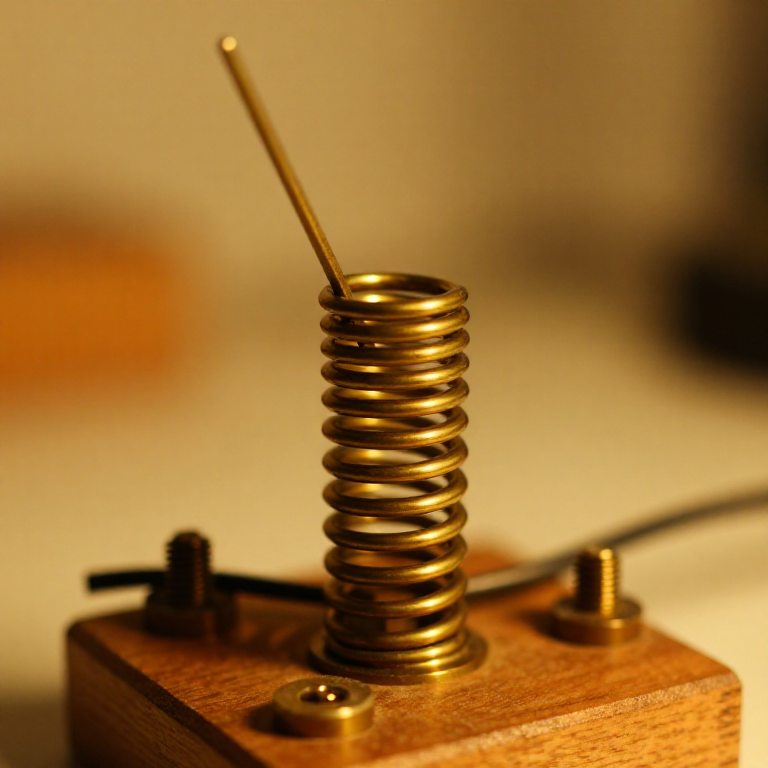
His device sends the reading down a wire instead. A coil of two bonded metals with different expansion rates bends as temperature changes, and at the ends of its travel it closes one of two contacts — too warm, or too cold. A signal appears on an indicator board somewhere else in the building.
Read the title carefully: it is a tele-THERMOSCOPE. US Patent 281,884, granted 24 July 1883, INDICATES temperature remotely. It does not regulate anything. Johnson later founded the company that became Johnson Controls and is popularly credited with the electric room thermostat — but that is a different device, and this patent is the honest starting point.
手順
Read US 281,884 and note what it does NOT do
Read US 281,884 and note what it does NOT do
Johnson claims a device that signals whether conditions are too warm or too cold. It indicates. It does not open a damper or command a boiler. Indicating and regulating are different jobs.
Bond two metals with different expansion rates
Bond two metals with different expansion rates
Rivet or braze a brass strip to a steel strip along their length. Brass expands roughly twice as much as steel per degree, and that mismatch is the entire sensor.
このステップの材料:
 真鍮 260 板 24 ゲージ1 枚
 軟鋼板1 枚
Join them along the WHOLE length, not at the ends
Join them along the WHOLE length, not at the ends
The two strips must be bonded continuously. Fastened only at the ends they slide past each other and the strip stays flat instead of bending.
Heat the flat strip and watch it curve
Heat the flat strip and watch it curve
Warm it with a hot-air gun. It bows towards the steel side, because the brass has grown longer and the pair must curve to accommodate the difference.
Coil the strip into a spiral to amplify the movement
Coil the strip into a spiral to amplify the movement
Wind it into a spiral. Deflection scales with the SQUARE of length, so coiling a long strip into a small space turns a barely visible bow into a large rotation.
Anchor the outer end and let the inner end move
Anchor the outer end and let the inner end move
Fix one end rigidly and attach a pointer to the other. All the accumulated bending now appears as angular travel at the free end.
Calibrate the pointer against a real thermometer
Calibrate the pointer against a real thermometer
Mark the scale at known temperatures using a reference thermometer. An uncalibrated bimetallic coil indicates change, not temperature.
必要な工具:
 室温計
室温計Set two contacts, one each side of the pointer
Set two contacts, one each side of the pointer
Place an adjustable contact above and below the rest position. Touching one means too warm, the other too cold — and the gap between them is the dead band.
Make the dead band adjustable and understand why
Make the dead band adjustable and understand why
Move the contacts closer and the device becomes twitchy, chattering on tiny fluctuations. Wider is calmer but less responsive — this trade-off never goes away.
必要な工具:
 定規
定規Wire each contact to its own indicator at the far end
Wire each contact to its own indicator at the far end
Run wires to two lamps or an annunciator on a board. This is the tele- part: the reading is now available somewhere the room is not.
このステップの材料:
 銅線20 メートル
Run several rooms onto one board
Run several rooms onto one board
Add a second sensor on its own pair of wires. One person now sees the whole building — which is exactly the labour Johnson was trying to eliminate.
Verify the contacts actually make cleanly
Verify the contacts actually make cleanly
Watch with a meter as the pointer arrives. A bimetallic strip moves slowly, so contacts touch lightly and can arc or bounce.
必要な工具:
 マルチメーター
Add snap action and see the difference
Add snap action and see the difference
Fit a small magnet near the contact so the pointer is pulled through the last of its travel. It now snaps closed and open — the fix for slow, dirty switching.
このステップの材料:
 ネオジム磁石詰め合わせ1 個
Now make it a regulator, and notice what you added
Now make it a regulator, and notice what you added
Wire a contact to a relay driving a damper motor. The moment the signal acts on the heat source, you have crossed from indication to regulation — and that step is not in this patent.
Compendium — indicating is not regulating
Compendium — indicating is not regulating
The patent, precisely. US 281,884, "Electric tele-thermoscope", granted 24 July 1883 to Warren S. Johnson of Whitewater, Wisconsin. It describes a coiled spring of two or more metals of different expansibility that moves with temperature and closes electrical contacts to signal too warm or too cold at a remote point. It is a remote INDICATOR. Johnson is very widely described as the inventor of the electric room thermostat, and he did found the Johnson Electric Service Company — later Johnson Controls — but this particular number is not a thermostat, and it is worth getting right rather than repeating the shorthand.
Why two metals bend. Every metal has a coefficient of thermal expansion; brass is roughly twice steel's. Bond them face to face and heat them, and the brass tries to become longer than the steel it is stuck to. The only shape that accommodates both is a curve, with the brass on the outside. Deflection is proportional to the temperature change, to the difference in expansion coefficients, and to the SQUARE of the strip's length — which is why the practical form is a long strip coiled into a spiral, converting a tiny differential into a visible rotation.
The dead band is a design parameter, not a defect. Two contacts either side of neutral define a range in which nothing is reported. Narrow it and the device chatters on every draught; widen it and the building drifts further before anyone knows. Every on-off controller since has the same parameter — it is the hysteresis in a modern thermostat, and the reason your heating does not cycle every thirty seconds.
Where the distinction leads. A sensor plus an indicator is an open loop: it informs a human, who decides. Connect the same contacts to an actuator on the heat source and you have closed the loop, and the system regulates itself. That is the step from Johnson's tele-thermoscope to the pneumatic room thermostats his company later built and installed across American schools and offices. Bimetallic strips remain everywhere — in thermal circuit breakers, kettle cut-outs, oven thermostats and old car flashers — and every one of them is doing what this coil does: turning a difference in expansion into a mechanical decision.
関連ブループリント
これらのブループリントは知識を共有しています — 技術、材料、原理

CC0 パブリックドメイン
このブループリントはCC0で公開されています。許可を求めずに、自由にコピー、修正、配布、あらゆる目的で使用できます。
メイカーを応援するには、ブループリント経由で製品を購入してください。メイカーには メイカーコミッション がベンダーにより設定されています。または、このブループリントの新しいイテレーションを作成し、自分のブループリントにコネクションとして含めて収益を共有できます。