
Extracting Tungsten from Wolframite — The Heaviest Practical Metal
Tungsten (W, element 74) has the highest melting point of any metal — 3422 °C, over a thousand degrees higher than platinum and nearly twice that of iron. Its name in most languages, wolfram, comes from the German Wolframit, which in turn derives from Wolf Rahm ('wolf's froth' or 'wolf's cream'). Medieval tin miners in the Erzgebirge found that the presence of wolframite in tin ore caused the tin to form a slag ('froth') during smelting, reducing the yield — as if a wolf had eaten the tin. The English name 'tungsten' comes from Swedish tung sten ('heavy stone'), originally referring to the mineral scheelite (CaWO₄).
Spanish chemists Juan José and Fausto Elhuyar first isolated metallic tungsten in 1783 by reducing tungstic acid (H₂WO₄) — obtained from wolframite — with charcoal. Carl Wilhelm Scheele had independently identified tungstic acid in scheelite two years earlier, but did not complete the reduction to metal.
Wolframite ((Fe,Mn)WO₄) is a series between ferberite (FeWO₄, iron tungstate) and hübnerite (MnWO₄, manganese tungstate). It contains approximately 60–61% WO₃ (47–48% tungsten metal). Wolframite and scheelite are the only commercially important tungsten minerals. Reducing tungsten oxide with carbon requires extremely high temperatures — among the highest in all of metallurgy.
HAZARD: Tungsten metal and tungsten carbide dust are respiratory irritants with potential for pulmonary fibrosis (hard metal disease) with chronic exposure. Use respiratory protection when handling powdered tungsten or tungsten ores. The reduction process produces carbon monoxide — work outdoors only.
手順
Understand tungsten chemistry and extreme properties
Understand tungsten chemistry and extreme properties
Tungsten (W, element 74) holds several records among the elements. It has the highest melting point of any element (3422 °C), the highest boiling point of any metal (5555 °C), the highest tensile strength of any pure metal at temperatures above 1650 °C, and one of the highest densities (19.25 g/cm³ — nearly identical to gold). A tungsten cube the size of a golf ball weighs approximately 1.2 kg.
Tungsten's extreme melting point made it invaluable for incandescent light bulb filaments — no other affordable metal can survive the 2500–3000 °C operating temperature of a glowing filament without melting. Thomas Edison initially used carbonized bamboo filaments, but tungsten filaments (introduced around 1910 by William Coolidge) were far superior: brighter, more efficient, and longer-lasting. For over a century, virtually every incandescent bulb used drawn tungsten wire.
The element's chemical symbol W comes from wolfram, its name in German, Swedish, and most other European languages. The IUPAC officially recognizes both names ('tungsten' and 'wolfram') — one of the few elements with two sanctioned names. Tungsten is a member of Group 6 alongside chromium and molybdenum, and its chemistry is dominated by the +6 oxidation state, particularly in the tungstate ion (WO₄²⁻).
Identify wolframite and scheelite
Identify wolframite and scheelite
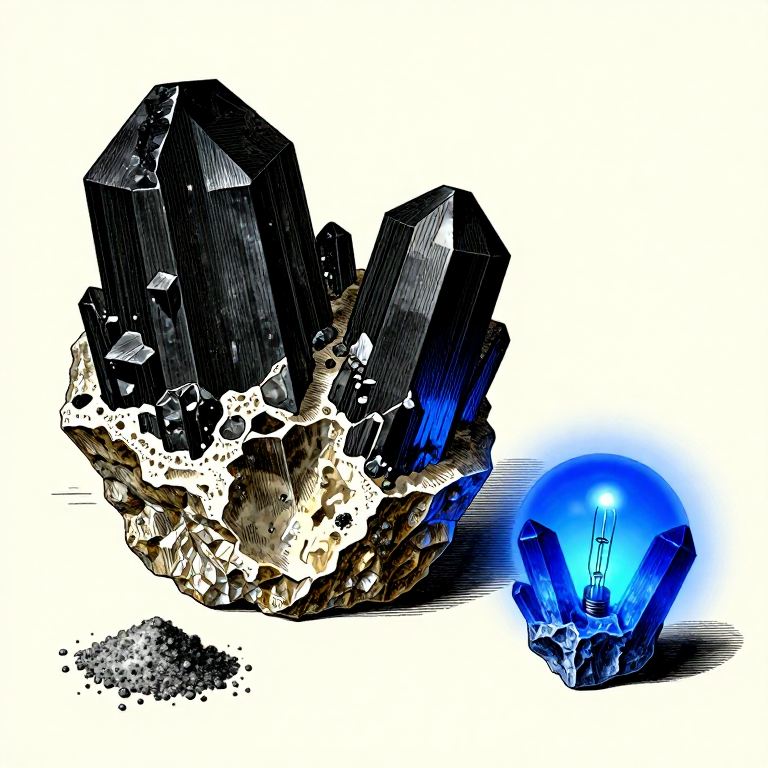
Wolframite ((Fe,Mn)WO₄) is a black to dark brown mineral with a submetallic luster. It forms tabular or prismatic crystals, often in bladed or columnar aggregates. Key identification features: Mohs hardness 4–4.5, specific gravity 7.1–7.5 (extremely heavy for a dark mineral — the high density is immediately noticeable by heft), one perfect cleavage direction, and a dark reddish-brown to black streak.
Scheelite (CaWO₄) is the other major tungsten mineral — a pale yellow to white, glassy mineral with Mohs hardness 4.5–5 and specific gravity 5.9–6.1. Scheelite has a diagnostic property: it fluoresces bright bluish-white under short-wave ultraviolet (254 nm) light. This fluorescence is one of the most reliable field tests in mineralogy — a UV lamp is standard prospecting equipment in tungsten-mining regions.
Both minerals occur in high-temperature hydrothermal veins and greisen (altered granite) deposits, typically associated with tin, molybdenum, and bismuth mineralization. Major deposits include Panasqueira (Portugal), Hemerdon (England), Sangdong (South Korea), and numerous deposits across China (which produces over 80% of the world's tungsten). Wolframite is more common than scheelite in most tin-tungsten vein deposits.
必要な工具:
 地質ハンマー
 手持ちルーペ 10倍
 条痕板(無釉磁器)
Crush and prepare the wolframite ore
Crush and prepare the wolframite ore
Crush wolframite specimens into fragments under 5 mm using a geological hammer on a steel anvil. Wolframite has moderate hardness (4–4.5) and perfect cleavage in one direction, so it tends to split into flat, tabular fragments along the cleavage. Hand-sort to remove quartz and other gangue — wolframite's exceptionally high density (7.1–7.5 g/cm³) makes it feel much heavier than the surrounding rock and is the easiest sorting criterion.
Gravity concentration is highly effective for wolframite due to its extreme density. If processing a large quantity, simple panning in a gold pan separates wolframite from lighter minerals very efficiently — the same technique used for gold, but even more effective because wolframite is denser than most common minerals.
Weigh 300–500 grams of sorted ore. Wolframite contains approximately 60–61% WO₃ (47–48% tungsten metal by mass). Wear a dust mask and gloves — tungsten ore dust is a mild respiratory irritant and should not be inhaled.
このステップの材料:
 鉄マンガン重石(鉄マンガンのタングステン酸塩)500 grams
必要な工具:
地質ハンマー 防じんマスク
 ニトリルゴム手袋
Understand the reduction challenge
Understand the reduction challenge
Reducing tungsten oxide to metal is among the most difficult carbon reductions in all of metallurgy. The reaction WO₃ + 3C → W + 3CO requires temperatures above approximately 1050 °C to begin, and does not proceed rapidly until 1200–1400 °C. Even then, the product is tungsten powder — not a molten metal button, because tungsten's melting point (3422 °C) is far above what any charcoal furnace can achieve.
The Elhuyars' original 1783 experiment produced tungsten as a grey metallic powder, not a coherent metal piece. They confirmed its metallic nature by its density, luster, and chemical behavior. Producing a solid, coherent tungsten piece requires either powder metallurgy (pressing and sintering tungsten powder at 2000+ °C in a hydrogen atmosphere) or electric arc melting — both impossible before the 20th century.
For this experiment, the realistic goal is to produce tungsten metal powder by carbon reduction of the ore, and to verify the product's identity by its extreme density and characteristic properties. A direct reduction of wolframite with carbon at 1200–1400 °C should produce a mixture of metallic tungsten, iron, and manganese (from the wolframite's iron and manganese content) as a sintered grey powder or loosely consolidated metallic mass.
Reduce the ore with carbon at maximum temperature
Reduce the ore with carbon at maximum temperature
OUTDOORS ONLY — produces carbon monoxide. Mix the crushed wolframite with finely powdered charcoal at approximately 1:0.5 by weight. Pack the mixture tightly into a graphite crucible (essential — clay crucibles may not withstand the required temperatures, and graphite contributes additional carbon). Cover the top with a layer of charcoal powder to create a reducing atmosphere within the crucible.
Place the crucible in a forced-air charcoal furnace and heat to the absolute maximum achievable temperature. Use a deep charcoal bed with continuous, vigorous bellows work. Target at least 1300 °C — preferably higher. Maintain this temperature for 3–4 hours. The reaction is slow at these temperatures and benefits from extended heating.
Unlike the bright metallic buttons produced by copper, lead, or tin smelting, the tungsten reduction product will not form a molten pool. Instead, look for the charge to sinter into a grey, dense, metallic-looking mass at the bottom of the crucible. The iron and manganese components of wolframite reduce more easily and may form small metallic prills within the sintered mass.
このステップの材料:
 木炭250 grams木炭8 kg
必要な工具:
 深型の粘土るつぼ
 木炭炉
木炭炉 ふいご
ふいご P100 防じんマスク
 革製ガントレット手袋
Extract and identify the reduction product
Extract and identify the reduction product
Allow the crucible to cool completely, then break it open. The product should be a dense, grey metallic powder or sintered mass at the bottom. If reduction was successful, the material will be noticeably heavier than the original ore — tungsten metal (19.25 g/cm³) is far denser than wolframite (7.1–7.5 g/cm³). Even partially reduced material will feel unusually dense.
The most reliable field test for tungsten is density. Weigh a small sample of the product and estimate its volume by water displacement — if the apparent density exceeds 10 g/cm³, significant tungsten metal is present. Pure tungsten powder that has been sintered has a density approaching 19 g/cm³, but loosely consolidated powder may have apparent density of 8–12 g/cm³ due to porosity.
Tungsten metal powder is a dark grey to silvery color, and individual particles under magnification show metallic luster. Tungsten is not magnetic (it is paramagnetic), which helps distinguish it from iron particles in the product. The product may also contain iron-tungsten alloy particles and unreduced tungsten oxide — complete reduction is difficult to achieve in a charcoal furnace.
必要な工具:
手持ちルーペ 10倍 小さな磁石
小さな磁石 ガラス製標本瓶
Understand tungsten's impact on modern technology
Understand tungsten's impact on modern technology
Tungsten's extreme properties made it essential for three transformative technologies. First, incandescent lighting: tungsten filaments operated at 2500–3000 °C, producing white light efficiently. For over a century, tungsten filaments lit the world. Second, high-speed steel (HSS): Frederick Winslow Taylor and Maunsel White discovered in 1900 that steel alloyed with 14–18% tungsten retained its hardness at red heat, allowing cutting tools to operate at speeds impossible with carbon steel. This discovery approximately doubled the productive capacity of every machine shop in the world. Third, tungsten carbide (WC): cemented tungsten carbide, developed in the 1920s, is second only to diamond in hardness and is the dominant material for cutting tools, drill bits, and mining equipment worldwide.
Today, tungsten is classified as a critical raw material by the EU, US, and Japan because of its irreplaceability in these applications and the geographic concentration of supply (China produces over 80% of world output). There is no satisfactory substitute for tungsten in high-speed steel or cemented carbide applications — its combination of extreme hardness, high melting point, and density is unique among the elements.
Clean up and document results
Clean up and document results
Tungsten ore and metal powder should be cleaned up with damp cloths to prevent dust from becoming airborne. Tungsten dust is a respiratory irritant and chronic exposure is associated with hard metal disease (pulmonary fibrosis), though this is primarily a risk with tungsten carbide dust in industrial settings. Dispose of residues responsibly — tungsten compounds are not acutely toxic but should not be released into waterways.
The graphite crucible may survive intact if temperatures were not extreme — it can be reused. Tools used for crushing can be cleaned with water and reused normally.
Document the complete experiment: ore weight, charcoal ratio, estimated furnace temperature and duration, product weight, estimated density, magnetic properties, and visual appearance under magnification. From 500 grams of wolframite (approximately 48% W), theoretical tungsten yield is 240 grams. Practical yield as identifiable metal powder from a charcoal furnace reduction will be much less — even obtaining a few grams of dense, metallic-looking tungsten powder is a significant achievement. You have replicated the essential chemistry of the Elhuyar brothers' 1783 discovery, though they had the advantage of starting with purified tungstic acid rather than raw ore.
この設計図で作るもの
CC0 パブリックドメイン
このブループリントはCC0で公開されています。許可を求めずに、自由にコピー、修正、配布、あらゆる目的で使用できます。
メイカーを応援するには、ブループリント経由で製品を購入してください。メイカーには メイカーコミッション がベンダーにより設定されています。または、このブループリントの新しいイテレーションを作成し、自分のブループリントにコネクションとして含めて収益を共有できます。