

Gothic Blackletter Calligraphy — Textura Quadrata
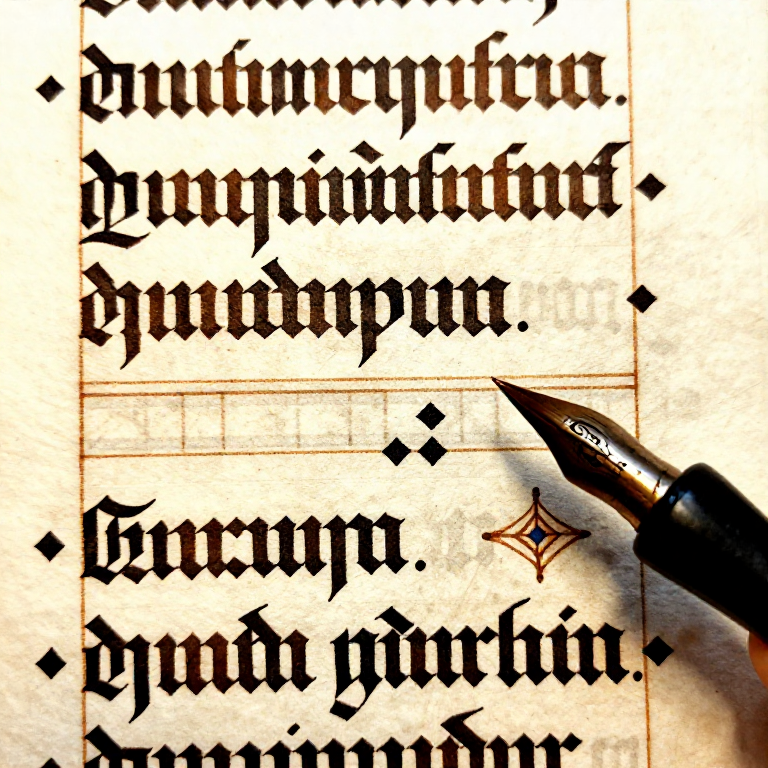
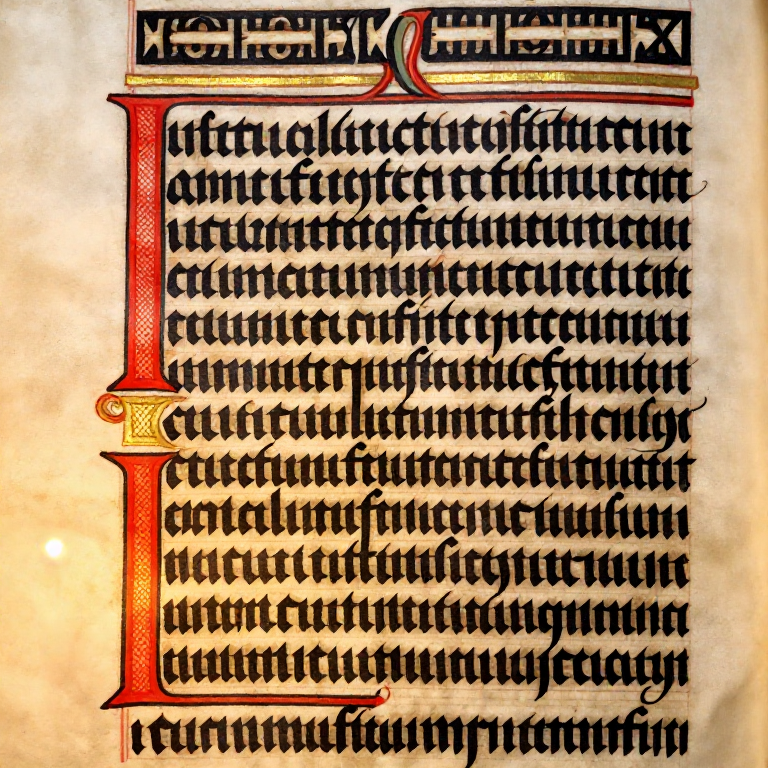
Learn Textura Quadrata, the most formal and structured of the Gothic Blackletter hands, used throughout medieval Europe from the 12th to 15th centuries and famously employed by Johannes Gutenberg for his 42-line Bible (1455). Textura (from the Latin texere, "to weave") gets its name from the woven-fence appearance of the text on the page — the dense, regular vertical strokes create an even texture of black and white. The letters are constructed with a broad-edge nib held at approximately 40 degrees, producing tall, narrow, angular forms with characteristic diamond-shaped serifs at the top and bottom of each stroke.
手順
Draw Textura Guidelines
Textura Quadrata uses strict proportions based on the nib width. For a 2mm nib: the x-height is 5 nib-widths (10mm) — turn the nib sideways and stack 5 nib-width squares to measure this precisely. Ascenders and descenders are short in Textura — only 2-3 nib-widths above or below the x-height (not the generous extensions of italic). Draw your baseline, waist line (5 nib-widths up), ascender line (2-3 nib-widths above waist), and descender line (2-3 nib-widths below baseline). The inter-line spacing (baseline of one line to waist line of the next) should be minimal — Textura was designed for dense, space-efficient pages in an era when parchment was expensive. Draw vertical guidelines too: the width of each letter stroke plus the space between strokes should be approximately 1.5 nib-widths.
Establish the 40-Degree Pen Angle
Hold the broad-edge nib at approximately 40 degrees to the baseline — this is slightly flatter than the 45 degrees used in italic, which makes the vertical strokes slightly thicker and the horizontal strokes thinner, contributing to Textura's dense, heavy appearance. The 40-degree angle is maintained for all strokes except the diamond serifs, which require a brief angle change. Unlike italic calligraphy where letter shapes vary widely, Textura is dominated by repetition of near-identical vertical strokes — the discipline of maintaining an absolutely consistent pen angle is paramount. Practice making parallel vertical strokes: each one should be identical in width and angle to the last.
Master the Diamond Serif
The diamond serif is the signature element of Textura Quadrata (the "quadrata" refers to these squared-off diamond endings). To make an entry diamond: place the nib at the waist line at 40 degrees, make a tiny horizontal movement to the right (creating a thin line), then pivot smoothly to 40 degrees and pull straight down. This creates a diamond-shaped beginning to the stroke. For an exit diamond at the baseline: end the downstroke, then add a small horizontal-to-diagonal movement that forms a matching diamond. In the most formal Textura, these diamonds are precisely defined — each one should be a clean parallelogram shape. Practice rows of single strokes with entry and exit diamonds until every diamond is consistent in size and shape.

Build the Letters i, l, and the Minim Stroke
The minim is the fundamental building block of Textura — a single vertical stroke with diamond serifs at top and bottom, spanning from the waist line to the baseline. The letter i is one minim plus a diamond-shaped dot above (not a round dot — it is made by touching the nib to the paper at 40 degrees to leave a diamond mark). The letter l is a minim extended upward to the ascender line, with an entry diamond at the ascender height. In Textura, the space between minims within a word should equal the width of a minim stroke — this creates the even "picket fence" rhythm that defines the script. Write the word "minimum" (7 minims plus dots and serifs) — if your spacing is correct, the minims should appear as a perfectly even row of identical strokes.
Build the Letters n, m, h, u — Minim Combinations
The letter n is two minims connected at the top by a fine hairline or overlapping diamond serifs. In strict Textura, there is no curved arch between the minims (unlike italic n) — the connection is angular: the exit of the first minim meets the entry of the second at the waist line. The letter m is three connected minims. The letter h has an ascender minim whose foot connects angularly to a second minim at the waist line. The letter u is two minims connected at the bottom by an angular foot stroke. Notice how similar these all look — n, m, h, u are distinguished mainly by their height and position of the connecting strokes, not by fundamentally different shapes. This uniformity is deliberate: it creates the woven-texture appearance, though it also makes Textura notoriously difficult to read at speed.
Build Angular Round Letters — o, c, e, d, b, p, q
In Textura Quadrata, round letters are NOT round — they are constructed from angular strokes that only suggest roundness. The letter o is made from two curved strokes that meet at sharp points at the top and bottom, forming a hexagonal or angular oval. Each curve is essentially a slightly bowed minim. The letter c is the left half of the angular o, with a small hairline serif at the opening. The letter e is a c with a horizontal hairline bar at the midpoint. The letters d, b, p, q combine the angular bowl shape with ascender or descender minims. The angular treatment of curves is what makes Textura look so different from italic or Copperplate — there are virtually no true curves in the most formal versions. Each "round" letter maintains the same vertical rhythm as the minim-based letters.
Build the Remaining Lowercase Alphabet
Complete the Textura lowercase: the letter a is an angular o with a small connecting stroke on the right side (forming the characteristic Textura a shape). The letter f has a tall ascender stroke that curves slightly right at the top, with a crossbar at the waist line. The letter g has an angular bowl with a short descender and a closing stroke. The letters r and s are distinctive: Textura r has a small angular shoulder stroke (much smaller than italic r); the long s (ſ) was standard in medieval texts — a tall stroke resembling f but without the crossbar. The letter s at word-endings uses the round form we know today. The letters w, x, y, z use combinations of diagonal strokes with diamond serifs. Complete the alphabet and practice each letter until the proportions and angles are consistent.
Practice Words and Text Blocks
Write complete words and short sentences in Textura Quadrata. The inter-letter spacing should be exactly one minim-width throughout — this is critical for the woven-fence texture effect. If you squint at a well-written Textura text block, the black strokes and white spaces should form an even, rhythmic pattern with no holes or dark spots. Common practice texts include the opening of the Lord's Prayer in Latin ("Pater noster, qui es in caelis") or any passage from a medieval source. Textura was designed to fill a page densely — margins were for illumination, not for generous white space. After writing a paragraph, step back and evaluate the overall texture before examining individual letters.
Learn Textura Versals (Decorative Capitals)
Textura capitals (versals) are dramatically different from the lowercase: they are large, ornate, and often based on Lombardic or Uncial forms rather than the angular minim system. Versals are typically drawn with multiple strokes and sometimes filled in, rather than written in a single pen movement. A simple approach for practice: use Roman capital letterforms scaled to approximately 7-8 nib-widths tall, drawn with the same broad-edge nib. Add small diamond-shaped serifs and angular decorations. In medieval manuscripts, versals were often written in red ink (rubrication) or elaborately decorated with gold leaf and painted ornament (illumination). For practice purposes, write the capital in the same black ink but leave generous space around it — a Textura capital needs visual breathing room because the lowercase is so dense.
Write a Finished Manuscript Page
Plan a complete practice page in the medieval manuscript style. Choose a text of 8-15 lines. Rule guidelines carefully in pencil. Write the text in Textura Quadrata with consistent spacing. Add a decorative versal capital at the beginning. If desired, leave space in the left margin for a simple decorative border. When the ink is completely dry (20-30 minutes), erase all pencil guidelines with a soft eraser. The finished piece should demonstrate the key qualities of Textura Quadrata: perfectly even vertical rhythm, consistent diamond serifs, angular round letters, dense text texture, and minimal inter-line spacing. This is the hand that defined the look of European books for three centuries — the same visual DNA that Gutenberg replicated in metal type.
材料
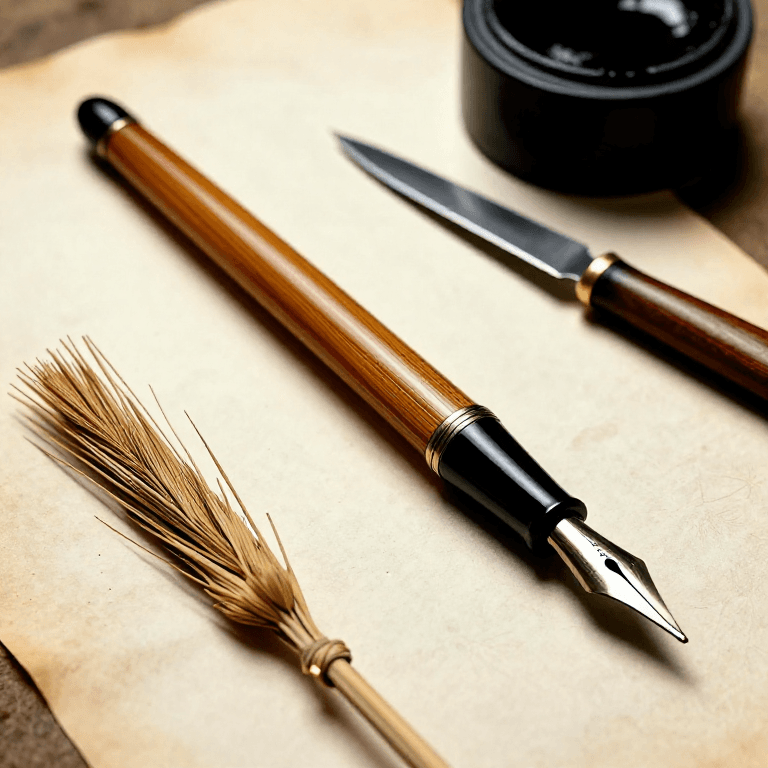
- •Broad-Edge Nib - 1-2 nibs pieceプレースホルダー
- •Straight Pen Holder - 1 pieceプレースホルダー
- •Black Ink - 1 bottle pieceプレースホルダー
- •Calligraphy Practice Paper - 1 pad pieceプレースホルダー
- •Graphite Pencil Set - 1 each pieceプレースホルダー
CC0 パブリックドメイン
このブループリントはCC0で公開されています。許可を求めずに、自由にコピー、修正、配布、あらゆる目的で使用できます。
メイカーを応援するには、ブループリント経由で製品を購入してください。メイカーには メイカーコミッション がベンダーにより設定されています。または、このブループリントの新しいイテレーションを作成し、自分のブループリントにコネクションとして含めて収益を共有できます。