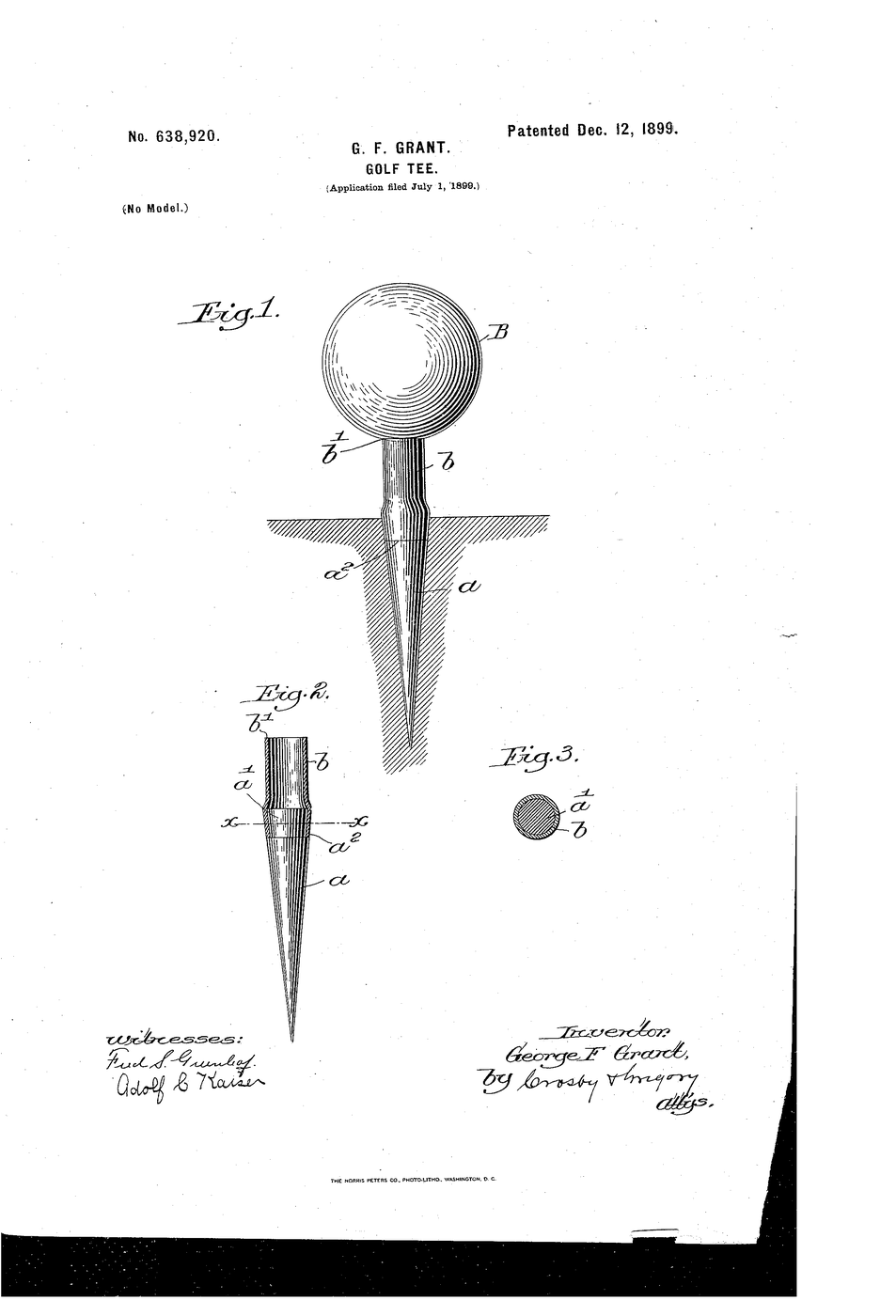


Golf Tee
For the first few centuries of golf, a player teed the ball on a small cone of wet sand, moulded by hand before every drive. It works, and it is slow, filthy and never the same twice — and since the height of the ball changes how the club meets it, the shot changes with it. Golfers carried sand and a bucket of water, and knelt in the dirt on every tee.
A peg fixes the height. The problem is what the peg does to the shot. Drive a rigid post into the ground and the clubhead strikes it, which slows the club, throws the ball off line and eventually breaks something.
Grant's answer is a rigid base with a flexible head. A tapered wooden spike goes into the turf; a rubber tube on top holds the ball. When the club arrives, the rubber "will yield in the direction of travel of the ball, offering no obstruction to its flight" — it lies down and gets out of the way.
US Patent 638,920, "Golf-tee", filed 1 July 1899 and granted 12 December 1899 to George F. Grant, a Boston dentist.
手順
Read US 638,920 and note the two materials
Read US 638,920 and note the two materials
Grant claims "a rigid base portion a and an attached flexible head b". Two materials doing opposite jobs — one must hold still, the other must give way.
Build ten sand tees and measure them
Build ten sand tees and measure them
Mould ten cones of damp sand by hand and measure the height of the ball on each. Record the spread — that variation is the problem.
このステップの材料:
 細砂1 個
細砂1 個Time how long ten of them took
Time how long ten of them took
Note the total time, and that you needed sand, water and both hands. On a course this happens on every tee, for every player.
Turn a tapered wooden base
Turn a tapered wooden base
Shape a hardwood peg about 60 mm long, tapering to a point at one end so it pushes into turf without splitting it.
このステップの材料:
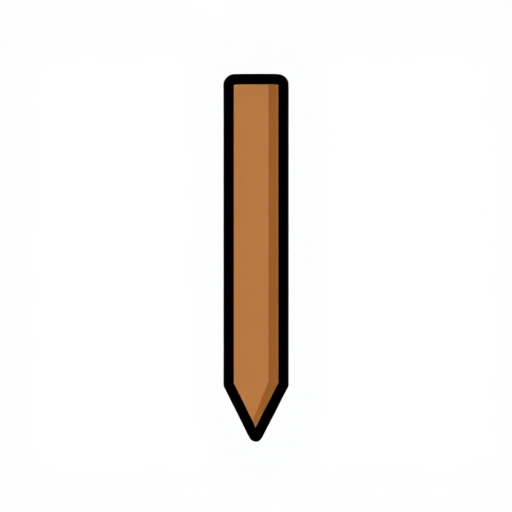 木ダボ棒1 個
必要な工具:
 クラフトナイフ
Reduce the diameter at the top
Reduce the diameter at the top
Turn a shoulder down near the head so the rubber tube can be pushed on and seat against it. The patent specifies this reduced section.
Fit the rubber head
Fit the rubber head
Push a short length of rubber tube onto the reduced top so it stands proud and forms a small cup for the ball.
このステップの材料:
 ゴム管1 パック
Make a second tee entirely rigid
Make a second tee entirely rigid
Build a control with a solid wooden head instead of the rubber. You now have the two designs the patent distinguishes.
Set both and measure ball height
Set both and measure ball height
Push each into turf and measure the ball's height ten times. Compare the spread against step 2. Repeatability is the first gain.
Sweep a club past the rigid tee
Sweep a club past the rigid tee
Take a slow, controlled swing across the rigid tee at model scale. The head strikes the post and the post fights back — note the deflection and the mark on the club.
Repeat past the flexible tee
Repeat past the flexible tee
Same swing, flexible head. The rubber folds over in the direction of travel and springs back. The club passes as if the tee were not there.
Check where the tee ends up
Check where the tee ends up
After the flexible strike, the base is still in the ground and the head is upright again. A tee that survives is a tee you do not replace every shot.
Vary the insertion depth
Vary the insertion depth
Push the tee in at three depths and measure ball height for each. Height is now a decision the player controls, not an accident of how the sand piled.
History & Context — the dentist whose tee nobody sold
History & Context — the dentist whose tee nobody sold
The patent. US 638,920, "Golf-tee", filed 1 July 1899 and granted 12 December 1899 to George Franklin Grant of Boston.
Grant was not a golf professional; he was a dentist, and a notable one. He graduated from Harvard Dental School in 1870 as one of its first African American graduates, became Harvard's first African American faculty member, and specialised in treating cleft palate, for which he designed a prosthetic appliance. Golf was a hobby, and the tee was a hobbyist's fix for an irritation — he had them made and gave them to friends.
⚠ He never commercialised it, and that matters for how the story is told. Grant's tee did not take the market. The tee that did was the "Reddy Tee", patented by another dentist, William Lowell, in the 1920s — a simple painted wooden peg, aggressively marketed by paying touring professionals to use it. Grant's priority went largely unrecognised for most of a century; the United States Golf Association publicly acknowledged him only in 1991. Saying Grant "invented the golf tee" is fair on the patent record. Saying his invention swept the game is not — the honest version is that he was first and Lowell was successful, and those are different achievements.
Why the flexible head is the actual claim. A rigid peg solves the height problem and creates a worse one. A clubhead at speed meeting a fixed post loses energy, twists off line, and takes damage. Grant's rubber head is a deliberate weak link in the direction of travel only: stiff enough vertically to support a ball, compliant enough horizontally to lie flat when struck. Steps 9 and 10 are the whole patent, and they take a minute. Modern plastic and wooden tees achieve the same thing differently, by being cheap and frangible enough to be knocked out of the ground and replaced without anyone caring.
What the sand tee tells you about the old game. A player carried a box of damp sand, knelt, and built a cone by hand before each drive — which is why early caddies carried a sand bucket, and why teeing grounds were placed near the previous green where the sand box was. When the peg arrived, that whole small ritual, and the equipment and course layout that supported it, disappeared within a generation.
この設計図で作るもの
関連ブループリント
これらのブループリントは知識を共有しています — 技術、材料、原理

CC0 パブリックドメイン
このブループリントはCC0で公開されています。許可を求めずに、自由にコピー、修正、配布、あらゆる目的で使用できます。
メイカーを応援するには、ブループリント経由で製品を購入してください。メイカーには メイカーコミッション がベンダーにより設定されています。または、このブループリントの新しいイテレーションを作成し、自分のブループリントにコネクションとして含めて収益を共有できます。