

Eraser-Tipped Pencil
A draughtsman works with two hands and two objects. The pencil draws; a separate lump of india-rubber corrects. The rubber is loose, so it gets lost, it gets dirty, and it picks up graphite from the last correction and smears it into the next one. Worse, a lump has no point — and a drawing has lines a millimetre apart.
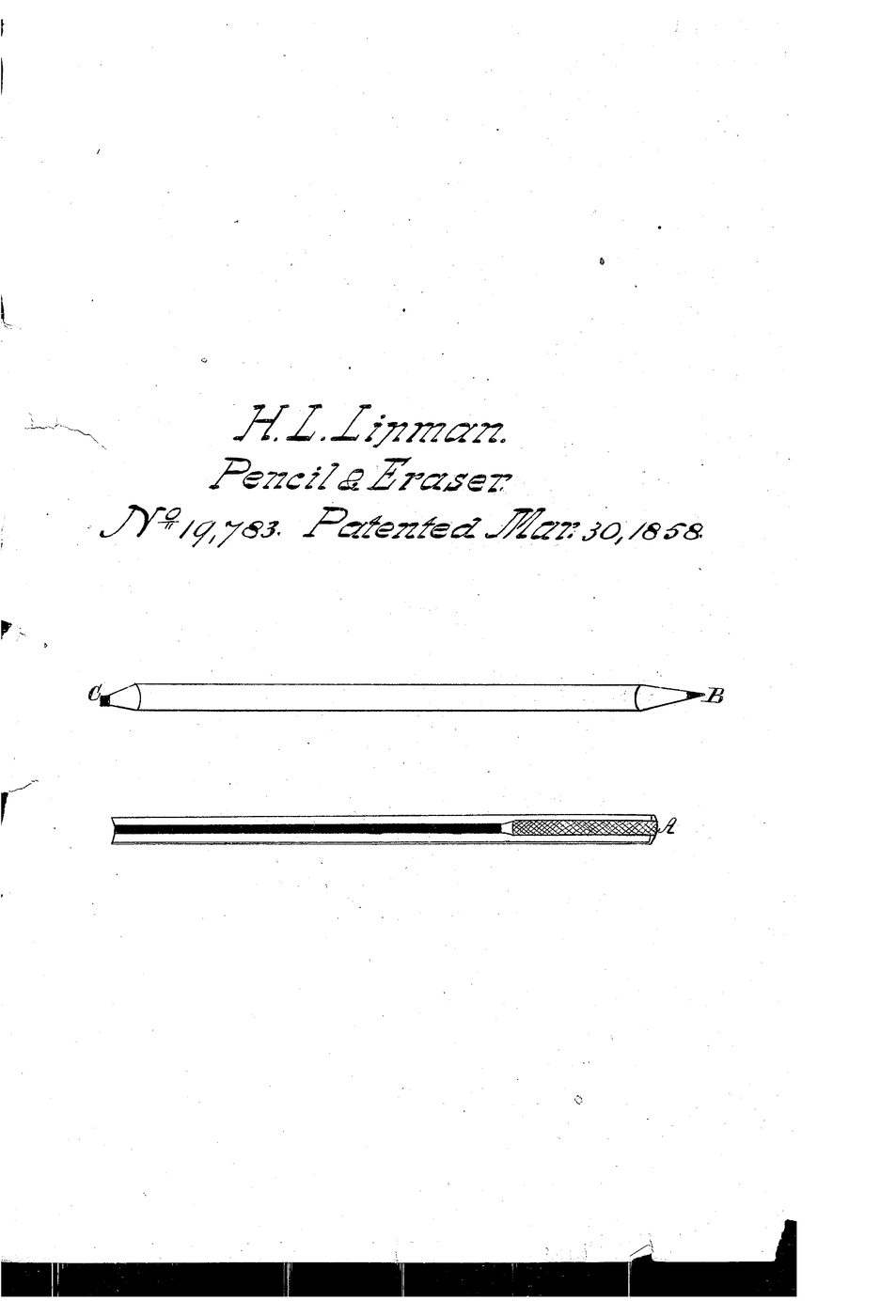
Lipman's idea is to cut a groove in the pencil and glue the rubber into it. Sharpen one end and you have a lead; sharpen the other and you have a pointed eraser. One object, never mislaid, and precise enough to take out a single mark from between two ruled lines.
US Patent 19,783, "Combination of lead-pencil and eraser", granted 30 March 1858 to Hymen L. Lipman. He names the users plainly: people doing technical drawing, who need to "erase any marks between the lines".
Seventeen years later the Supreme Court threw the patent out. That story is the last step.
手順
Read US 19,783 and note the fraction
Read US 19,783 and note the fraction
Lipman grooves about one quarter of the pencil's length and glues in "a piece of prepared india-rubber". Both ends are then cut — lead at one, eraser at the other.
Rule two lines 2 mm apart and mark between them
Rule two lines 2 mm apart and mark between them
Draw a pair of close parallel lines and put a stray pencil mark in the gap. This is the job the invention exists for.
Try to remove it with a loose block eraser
Try to remove it with a loose block eraser
Rub it out with an ordinary rectangular eraser. Note how much of the two ruled lines you destroy along with the stray mark.
必要な工具:
 消しゴム(ブロック)
Cut the groove
Cut the groove
Take a plain wooden pencil and cut a flat-bottomed groove about 40 mm long into one end, deep enough to seat the rubber but not to reach the graphite core.
このステップの材料:
 鉛筆セット(黒鉛)1 セット
必要な工具:
 クラフトナイフ
Cut the rubber to a press fit
Cut the rubber to a press fit
Trim a strip of eraser rubber so it sits in the groove without forcing. A rubber under compression will creep out again as the glue cures.
Glue it in and clamp
Glue it in and clamp
Glue the rubber into the groove and clamp until set. The bond carries the sharpening load later, so it must be continuous along the whole strip.
このステップの材料:
 木工用ボンド(PVA)1 個
Sharpen the lead end
Sharpen the lead end
Sharpen normally and check the point is central. An off-centre core means the groove was cut too deep on one side.
Sharpen the rubber end to a point
Sharpen the rubber end to a point
Cut the other end back with a blade to expose the rubber and taper it. This is the whole invention — an eraser you can bring to a point.
Repeat the step 2 test with the pointed end
Repeat the step 2 test with the pointed end
Make a fresh pair of lines and a fresh stray mark, and remove it with the pointed rubber. Compare the damage against step 3.
Measure the erased width
Measure the erased width
Measure how wide a band each method cleared. Record both numbers — precision, not convenience, is what the patent actually claims.
Time twenty corrections with each
Time twenty corrections with each
Make twenty small corrections using a loose eraser, then twenty with the combined pencil. The saving is in never putting anything down.
Erase, then draw over the same spot
Erase, then draw over the same spot
Rub out a line and immediately draw across it. Note whether the surface still takes graphite cleanly — over-rubbing burnishes paper and it stops accepting a line.
Work out where the rubber goes
Work out where the rubber goes
Inspect the tip. Erasing works by the rubber tearing away and carrying graphite with it, so the eraser is consumed — it is a supply, not a tool.
History & Context — the patent the Supreme Court cancelled
History & Context — the patent the Supreme Court cancelled
The patent. US 19,783, "Combination of lead-pencil and eraser", granted 30 March 1858 to Hymen L. Lipman of Philadelphia. Application and grant carry the same date, so only the grant is cited.
🔴 It was later declared invalid, and the reasoning is worth understanding. Lipman sold the patent to Joseph Reckendorfer, reportedly for around $100,000 — an enormous sum in the 1860s. Reckendorfer sued the pencil maker Faber for infringement, and in Reckendorfer v. Faber (1875) the Supreme Court held the patent void. Its logic: a pencil was known, an eraser was known, and putting one on the end of the other produced no new result — each part went on doing exactly what it had always done. That is an aggregation, not a patentable combination, which requires the parts to act together to produce something neither achieves alone. Reckendorfer lost his investment entirely.
Whether the court was right is a real question, not a settled one. Step 9 and step 10 exist to let you form your own view. A block eraser genuinely cannot do what a pointed one does — the new capability is precision, and precision arrives only because the rubber is constrained inside a narrow wooden shaft that lets it be sharpened. On that reading the parts do act together. The counter-argument is that this is just a smaller eraser, and you could always cut a small eraser. The case is still taught in patent law for exactly this reason, and it is one of the clearest examples of the line between combining and merely collecting.
Two things this pairs with in this collection. Drinker's iron lung patent was also struck down in full, and for a related reason — every element already existed. Together they make the point that a granted patent is a claim, not a verdict: it can be undone by a court decades later, and the invention itself carries on being used regardless. Nobody stopped making eraser-tipped pencils in 1875; the ruling only meant nobody could own the idea.
The design's own quiet limitation. Fixing the eraser to the pencil ties two consumables together that wear at completely different rates. Sharpen a pencil twenty times and the wood is half gone while the eraser is barely touched; use the eraser heavily and it disappears while the pencil is still long. Every later refinement — the crimped metal ferrule, the push-fit replaceable plug, the separate stick eraser — is an attempt to fix that mismatch, and it is why draughtsmen kept a loose eraser on the desk anyway.
この設計図で作るもの
CC0 パブリックドメイン
このブループリントはCC0で公開されています。許可を求めずに、自由にコピー、修正、配布、あらゆる目的で使用できます。
メイカーを応援するには、ブループリント経由で製品を購入してください。メイカーには メイカーコミッション がベンダーにより設定されています。または、このブループリントの新しいイテレーションを作成し、自分のブループリントにコネクションとして含めて収益を共有できます。