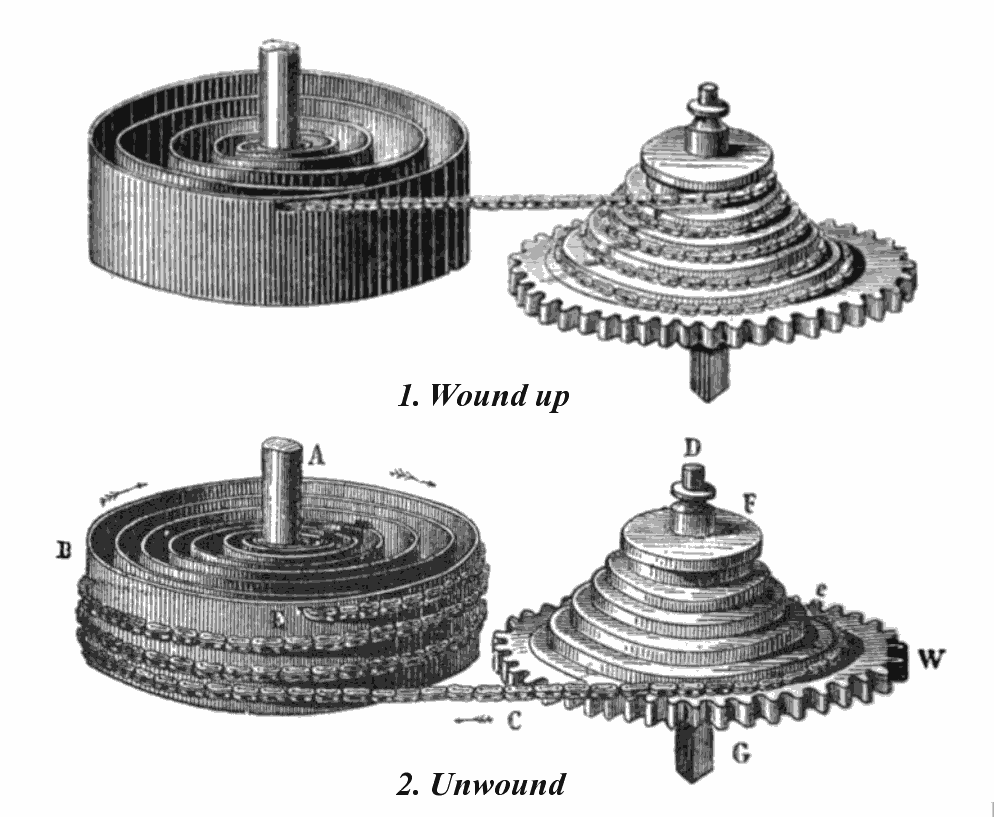


Mainspring and Fusee
When the first spring-driven clocks appeared in the 15th century they brought a problem with them. A coiled mainspring is a wonderful power source — compact, portable, no hanging weights — but its torque is not constant. Fully wound it pulls hard; nearly run down it barely pulls at all. A clock driven directly by one runs fast in the morning and slow by evening.
The fusee is the fix, and it is a beautiful piece of mechanical reasoning. It is a cone with a spiral groove. A chain runs from the mainspring barrel to the cone, and as the spring unwinds the chain walks from the cone's small radius to its large radius. The lever arm grows at exactly the rate the driving force shrinks, and the torque delivered onward stays flat.
It is the same principle as the gears on a bicycle: you cannot change how hard the source pushes, so you change the radius it pushes through. This blueprint builds a working demonstration you can measure.
手順
Cut the barrel disc and wall
Cut the barrel disc and wall
Cut a 50 mm brass disc and a strip to form a 12 mm deep wall. This is the barrel — the drum the mainspring lives inside.
このステップの材料:
 真鍮板1 枚
必要な工具:
 糸のこ(宝飾用)
Fit the barrel arbor
Fit the barrel arbor
Drill the disc centrally and fit a 4 mm brass arbor. Cut a slot across the arbor to catch the inner end of the spring.
このステップの材料:
 真鍮棒1 個
必要な工具:
 精密ヤスリ(針ヤスリ)セット
Cut and shape the mainspring
Cut and shape the mainspring
Cut 600 mm of 10 mm wide spring steel strip. Round both ends and remove every burr along the edges — a nick in a tensioned spring is where it will eventually snap.
このステップの材料:
 ばね鋼帯1 個
必要な工具:
精密ヤスリ(針ヤスリ)セットCoil the spring into the barrel
Coil the spring into the barrel
Hook the inner end into the arbor slot and wind the spring in, anchoring the outer end to the barrel wall. Wear eye protection — a spring that escapes during winding moves fast.
必要な工具:
 透明保護メガネ
 彫金用プライヤーセット
Measure the torque curve first
Measure the torque curve first
Before building the fusee, hang a light cord and weight from the barrel and measure the turning force at full wind, half wind and nearly run down. Record all three. This is the problem you are about to solve, in numbers.
必要な工具:
 定規
定規Turn the fusee cone
Turn the fusee cone
Turn or file a brass cone 45 mm long, 15 mm at the small end and 35 mm at the large end. That roughly 1:2.3 radius ratio is what will compensate the spring.
このステップの材料:
真鍮棒1 個必要な工具:
精密ヤスリ(針ヤスリ)セットCut the spiral groove
Cut the spiral groove
Cut a continuous spiral groove along the cone, 2 mm pitch, deep enough to seat the chain. The groove must run unbroken from small end to large — a break lets the chain jump and the compensation fails at that point.
必要な工具:
精密ヤスリ(針ヤスリ)セットMount barrel and fusee on a plate
Mount barrel and fusee on a plate
Mount both on a brass base plate with their axes parallel, 70 mm apart, each free to turn. Misaligned axes make the chain climb out of the groove.
このステップの材料:
真鍮板1 枚Fit the chain
Fit the chain
Anchor a fine chain to the barrel and to the large end of the fusee. Wind it so that when the spring is fully wound the chain sits on the small radius of the cone.
このステップの材料:
 細い鋼の鎖0.5 メートル
Check the direction of travel
Check the direction of travel
Wind and release slowly. The chain must walk from the small radius toward the large radius as the spring unwinds. If it goes the other way the compensation is inverted and the output gets worse, not better — reverse the chain routing.
Measure the output torque curve
Measure the output torque curve
Repeat the step 5 measurement, now at the fusee arbor, at full, half and low wind. Compare the two curves. A well-cut cone gives a noticeably flatter output than the bare barrel.
必要な工具:
定規Adjust the cone profile
Adjust the cone profile
If the output still falls off at the end, the large radius is too small — file the cone's large end wider and re-measure. The correct profile is found by iteration; it is not a formula you get right first time.
必要な工具:
精密ヤスリ(針ヤスリ)セットHistory & Context
History & Context
The problem the spring created. Weight-driven clocks deliver perfectly constant torque — a hanging weight pulls the same whatever height it is at. Springs traded that away for portability. When spring drive arrived in the 15th century, constant force became one of horology's long-running holy grails, and it is still pursued in high-end watchmaking today.
How the cone does it. Torque is force times radius. The mainspring's force falls as it unwinds, so the fusee increases the radius at which that force acts. Fully wound, the chain pulls on the smallest radius: a large force through a small lever arm. Run down, the chain has walked to the largest radius: a small force through a large lever arm. The product stays roughly constant. It is mechanical gearing that varies continuously — the same reasoning as a bicycle's gears, arrived at four centuries before bicycles.
Gut before chain. The first fusees used cord made from animal gut — flexible, cheap, and prone to wear and sudden failure. Metal chains became standard by the mid-1600s and are what the mechanism is now named for. A fusee chain is a miniature roller chain, and making one is a specialist trade in itself; historically much of it was outsourced piecework.
Why it disappeared, mostly. The fusee is bulky, fiddly and expensive. Two later developments made it largely unnecessary: better spring steel with a flatter torque curve, and the going barrel used with an escapement less sensitive to torque variation — plus the practice of only using the middle portion of a spring's travel, where its output is naturally flattest. The fusee survives in marine chronometers, where accuracy justified any complexity, and in a handful of modern luxury watches as a demonstration of craft.
What it bought. A clock is only as steady as its power supply. Before the pendulum, drive regularity was the dominant error source, and the fusee was the main defence against it. Its long persistence in marine chronometers is the giveaway: when a clock error meant a longitude error meant a shipwreck, the extra parts were worth it.
CC0 パブリックドメイン
このブループリントはCC0で公開されています。許可を求めずに、自由にコピー、修正、配布、あらゆる目的で使用できます。
メイカーを応援するには、ブループリント経由で製品を購入してください。メイカーには メイカーコミッション がベンダーにより設定されています。または、このブループリントの新しいイテレーションを作成し、自分のブループリントにコネクションとして含めて収益を共有できます。