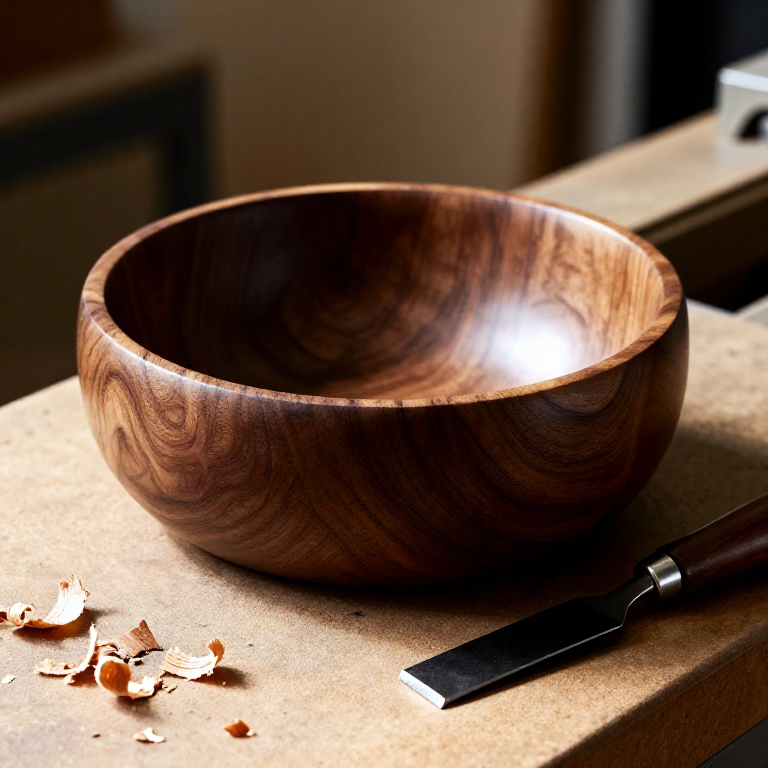


Turning a Wooden Bowl on a Lathe — Faceplate Turning
手順
Mount the Blank and Turn the Outside
Mount the Blank and Turn the Outside
Attach the bowl blank to a faceplate using screws driven into what will become the bottom of the bowl. Mount the faceplate on the lathe headstock. Set the lathe to a low speed appropriate for the blank diameter — as a guideline, a 20cm diameter blank should start at approximately 600-800 RPM. Stand to the side (not in line with the spinning blank) when first starting the lathe in case the blank is unbalanced. Using a bowl gouge, round the outside of the blank by cutting from larger diameter toward smaller, riding the bevel of the gouge against the wood. Shape the exterior profile — a gentle curve from the rim down to the foot. Form a tenon (a short cylindrical projection) on the base that will fit your scroll chuck jaws.
このステップの材料:
 堅木のブロック1 piece 個
 クルミ油50-100ml ml
必要な工具:
 木工旋盤
木工旋盤 丸のみ
丸のみ 旋盤のフェースプレート
 旋盤チャック - 四つ爪スクロール
 フェイスシールド
 デジタルノギス 6インチ
 紙やすり
紙やすりReverse-Mount and Hollow the Interior
Reverse-Mount and Hollow the Interior
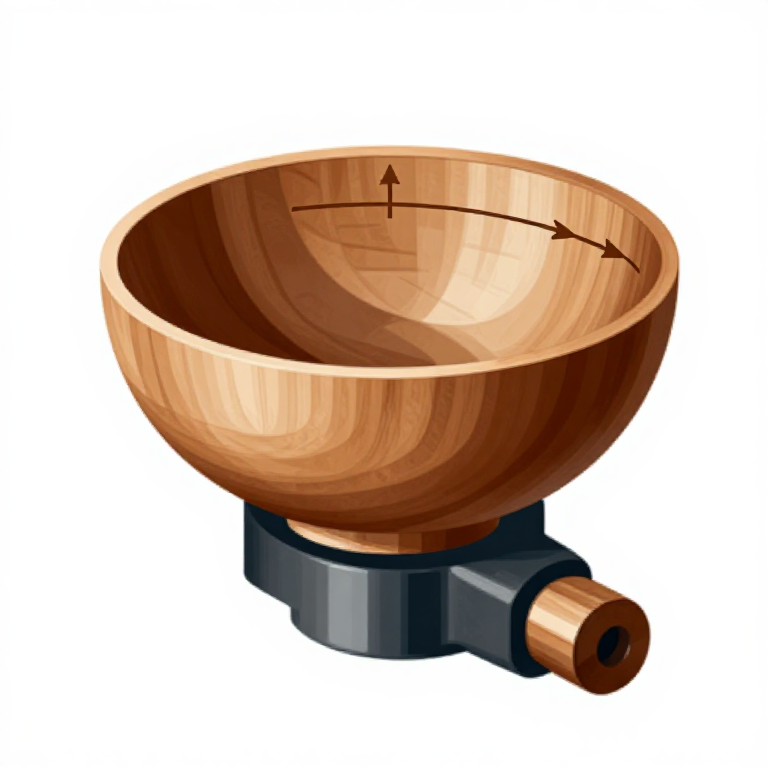
Remove the faceplate, grip the tenon in a four-jaw scroll chuck, and remount the bowl with the open face toward the tailstock. Begin hollowing from the centre outward using the bowl gouge. Cut from the centre toward the rim in a sweeping arc, riding the bevel. The wall thickness should be approximately 8-10mm initially — measure frequently with calipers. Never reach over the spinning bowl to cut the far side — always cut on the near side (between you and the centre) to maintain control. As the interior deepens, reduce lathe speed to maintain safe peripheral speed. Hollowing the bottom flat last provides maximum support during wall cutting.
Refine the Wall Thickness
Refine the Wall Thickness
Make finishing cuts with a freshly sharpened gouge, taking light passes to achieve the final wall thickness of approximately 5-8mm (thinner for decorative bowls, thicker for functional kitchen bowls). Uniform wall thickness is important: thick spots dry at a different rate than thin spots, causing warping. Check thickness by holding a light source inside the bowl — light transmission through thin areas reveals thickness variations. The interior curve should be a smooth, continuous arc with no ridges, bumps, or flat spots. A sharp gouge produces a surface that requires minimal sanding. Tool marks indicate the gouge needs sharpening or the cutting technique needs adjustment.
Sand on the Lathe
Sand on the Lathe
With the lathe running at moderate speed, sand the bowl progressively through grits: 80 (to remove tool marks), 120, 180, 220, and 320 or 400 (for a smooth finish). Sand the interior first, then the exterior. Sand across the grain direction as well as with the rotation to avoid circular scratch patterns. Between each grit, stop the lathe and sand briefly by hand with the grain to remove any circular scratches. Remove all sanding dust between grits with a clean cloth — residual coarse particles will scratch the surface during finer sanding. End grain areas require extra attention as they resist sanding and show scratches more prominently.
Apply Finish and Part Off
Apply Finish and Part Off
Apply finish while the bowl is still mounted on the lathe. For food-contact bowls, use food-safe mineral oil, walnut oil, or a friction polish made from shellac and oil. Apply the finish with the lathe spinning slowly, distributing it evenly over the surface, then increase speed and buff with a clean cloth to build shine from friction heat. For decorative bowls, lacquer or oil-wax blends provide more durable protection. After finishing the interior and exterior, remove the bowl from the chuck and address the foot. Either turn a decorative recess in the base using a jam chuck (a waste block turned to friction-fit the bowl rim), or simply sand the chuck marks smooth by hand and sign the base. The finished bowl should be thin, symmetrical, and smoothly curved with an even finish that highlights the wood's natural beauty.
この設計図で作るもの

CC0 パブリックドメイン
このブループリントはCC0で公開されています。許可を求めずに、自由にコピー、修正、配布、あらゆる目的で使用できます。
メイカーを応援するには、ブループリント経由で製品を購入してください。メイカーには メイカーコミッション がベンダーにより設定されています。または、このブループリントの新しいイテレーションを作成し、自分のブループリントにコネクションとして含めて収益を共有できます。