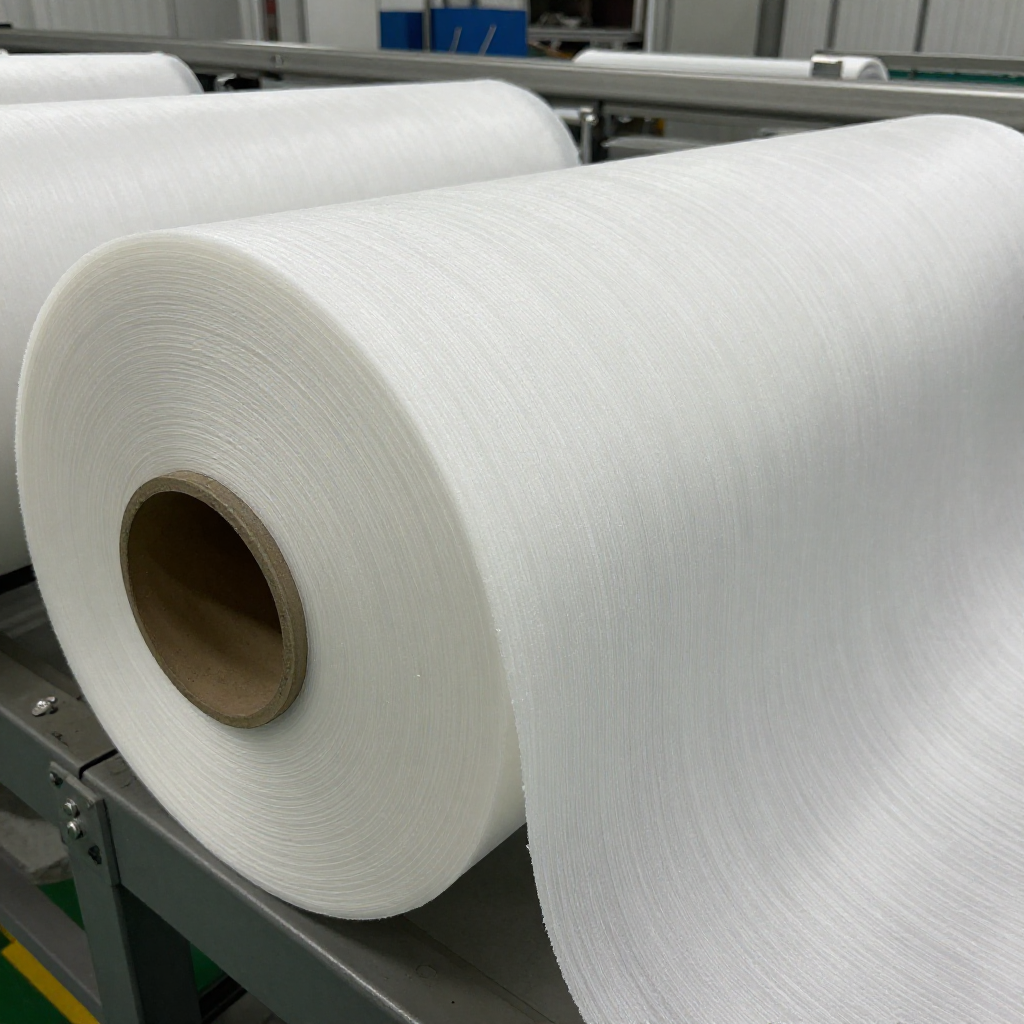


Nonwoven Spunbond Fabric — Fiber-to-Fabric in One Step Without Spinning or Weaving
In the 1960s and 1970s, DuPont, Freudenberg, and Reifenhäuser developed and commercialized spunbond technology — a process that converts polymer pellets directly into a flat fabric in a single continuous operation, bypassing every traditional textile step: fiber spinning onto bobbins, yarn formation, warping, and weaving or knitting. Polymer is melted, extruded through thousands of spinneret holes, the filaments are stretched by high-velocity air, deposited randomly onto a moving belt, and bonded together — all in one machine, in seconds. The result is a nonwoven fabric.
DuPont's Tyvek (spunbonded high-density polyethylene, 1967) and Reifenhäuser's polypropylene spunbond systems became the foundation of an industry that now produces over 10 million tonnes of nonwoven fabric per year. Spunbond polypropylene is the material behind surgical face masks, disposable hospital gowns, agricultural crop covers, geotextiles, roofing underlayment, reusable shopping bags, and the inner linings of disposable diapers. During the COVID-19 pandemic, global demand for meltblown and spunbond polypropylene (the two layers in N95 respirators) surged by over 300%.
The economics are compelling. A spunbond line converts polypropylene pellets into finished fabric at speeds of 200–600 meters per minute — a single machine can produce over 30,000 tonnes of fabric per year. There is no yarn, no bobbin, no loom, no knitting machine. The capital cost per tonne of output is a fraction of conventional textile production. Spunbond fabric costs $0.50–2.00 per square meter, versus $3–10 for equivalent woven fabric. This cost advantage, combined with the ability to engineer specific properties (barrier, filtration, strength, softness) through fiber diameter, bonding pattern, and polymer selection, has made nonwovens the fastest-growing sector of the textile industry.
手順
Understand what 'nonwoven' means
Understand what 'nonwoven' means
A nonwoven fabric is a sheet of fibers held together by bonding rather than by interlacing (weaving) or interlooping (knitting). The fibers may be laid in random orientations, parallel arrays, or cross-lapped patterns — but they are never individually manipulated into a structured textile construction. This fundamental difference — bonded sheet versus interlaced structure — is why nonwovens can be produced at speeds and costs impossible for woven or knitted fabrics. The trade-off is that most nonwovens have lower tear strength and drape than woven fabrics, making them suited to disposable or technical applications rather than apparel.
Melt the polymer
Melt the polymer
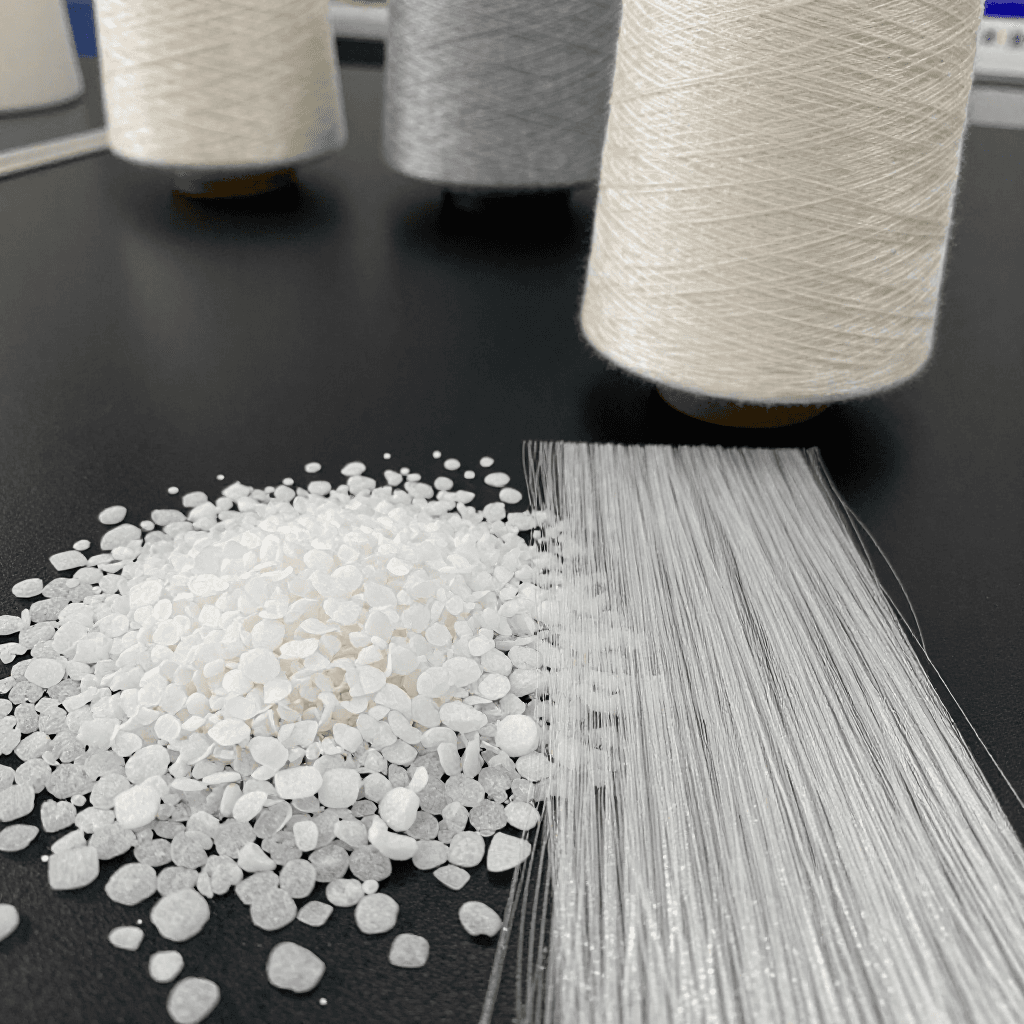
Feed polypropylene pellets (the most common spunbond polymer, accounting for over 60% of global nonwoven production) into an extruder. The extruder heats the pellets to 220–260°C while a rotating screw pushes the melt forward. Polypropylene is ideal for spunbond because it melts cleanly, has a wide processing window, and is the lightest common thermoplastic (density 0.91 g/cm³). Polyester, polyethylene, and nylon are also used for specific applications requiring different properties.
このステップの材料:
 ポリプロピレンのペレット500 g
Extrude through a wide spinneret
Extrude through a wide spinneret
Pump the molten polymer through a wide spinneret — a long, flat die plate spanning the full width of the fabric (typically 1.6–5.2 meters) and containing 3,000–6,000 holes per meter of width. Each hole is 0.3–0.6 mm in diameter. The melt emerges as thousands of continuous filaments simultaneously — a curtain of molten polymer streams falling from the spinneret face. A typical spunbond spinneret produces 15,000–30,000 filaments across its full width.
Attenuate the filaments with high-velocity air
Attenuate the filaments with high-velocity air
Immediately below the spinneret, the molten filaments enter an air-drawing system — a slot or venturi through which compressed air flows at high velocity (3,000–8,000 meters per minute). The aerodynamic drag of the air stream stretches the solidifying filaments to 10–50 times their extruded diameter, reducing them to 15–40 micrometers (1.5–4 denier). This air-drawing simultaneously cools and orients the polymer chains, producing filaments with moderate strength and crystallinity. The process is continuous — there are no bobbins, no winding, no intermediate storage.
Deposit the filaments onto a moving belt
Deposit the filaments onto a moving belt
The air-drawn filaments exit the attenuator and are deposited onto a moving porous conveyor belt (the forming belt). A vacuum beneath the belt pulls air through and holds the filaments flat against the surface. The filaments land in a random, overlapping arrangement — creating a uniform, isotropic web of continuous filaments. The web weight (basis weight) is controlled by the ratio of polymer throughput to belt speed: faster belt = lighter fabric, slower belt = heavier fabric. Typical spunbond fabrics range from 10 to 200 grams per square meter.
Bond the web by thermal calendering
Bond the web by thermal calendering
The unbonded web is fragile — the filaments are merely lying on top of each other. Pass the web between a pair of heated calender rolls: one smooth steel roll and one engraved roll with a pattern of raised points. At each point, the heated roll melts the polypropylene filaments together, creating a discrete bond site. The bond pattern typically covers 15–25% of the fabric area — enough to hold the fabric together while leaving 75–85% of the surface unbonded and soft. The pattern shape (diamond, oval, cross) and size affect the fabric's strength, drape, and hand-feel.
Wind the finished fabric
Wind the finished fabric
The bonded spunbond fabric — now a coherent, strong sheet — is wound onto a large roll at the end of the production line. A single spunbond line running at 400 meters per minute and 3.2 meters wide produces approximately 77,000 square meters of fabric per hour. The roll is slit to customer width, rewound, and packaged. From polypropylene pellets entering the extruder to finished fabric on a roll, the entire process takes less than 10 seconds. No other textile manufacturing process approaches this speed or simplicity.
Understand meltblown — the filtration companion
Understand meltblown — the filtration companion
Meltblown is a related nonwoven process that produces ultra-fine fibers (1–5 micrometers diameter) by blowing hot air directly at the molten polymer streams as they exit the spinneret. The high-velocity hot air breaks the streams into very short, very fine fibers that are collected as a soft, self-bonding web. Meltblown fabric has low strength but exceptional filtration efficiency — the fine fibers create a tortuous path that traps airborne particles. In N95 respirators, a meltblown layer (the filtration medium) is sandwiched between two spunbond layers (the structural shell) — the SMS composite.
Explore DuPont Tyvek — spunbonded HDPE
Explore DuPont Tyvek — spunbonded HDPE
DuPont's Tyvek (1967) is a spunbonded fabric made from high-density polyethylene by a unique flash-spinning process. HDPE is dissolved in a solvent under pressure; when the solution is extruded through a spinneret and the pressure drops, the solvent flash-evaporates, leaving behind a web of extremely fine, interconnected polyethylene fibrils. The resulting fabric is tear-resistant, water-resistant, breathable to moisture vapor, and printable — making it ideal for house wrap (building construction moisture barrier), envelopes (FedEx/UPS Tyvek mailers), and protective clothing. Tyvek is one of the most commercially successful nonwoven products ever created.
Apply spunbond in medical and hygiene products
Apply spunbond in medical and hygiene products
Spunbond polypropylene is the dominant material in single-use medical and hygiene products. Surgical masks use SMS (spunbond-meltblown-spunbond) composites: the spunbond layers provide structure and the meltblown layer provides filtration. Disposable surgical gowns and drapes use spunbond or SMS fabric treated with a fluid-repellent finish. Baby diapers use spunbond as the topsheet (the layer against the skin) because it is soft, porous, and wicks moisture away. Agricultural crop covers use lightweight spunbond (17–30 g/m²) to protect plants from frost while allowing light and moisture through.
Consider the environmental trade-offs
Consider the environmental trade-offs
Spunbond's strength is also its environmental weakness: the same low cost and high-speed production that makes disposable products economical also generates enormous volumes of single-use waste. A single disposable face mask contains approximately 3–4 grams of polypropylene that takes decades to centuries to degrade. During the COVID-19 pandemic, an estimated 129 billion disposable face masks were used per month globally. The industry is responding with biodegradable polymers (polylactic acid spunbond), recycled content, and reusable alternatives — but the convenience and cost advantage of disposable spunbond remains dominant.
Understand nonwovens' place in textile history
Understand nonwovens' place in textile history
Nonwoven spunbond technology represents a fundamental departure from 10,000 years of textile production based on fiber → yarn → fabric. By eliminating yarn formation entirely, spunbond broke the assumption that useful textiles must be constructed from interlaced threads. The technology created an entirely new category of materials — engineered fabrics designed for function rather than aesthetics — that now accounts for over 10 million tonnes of production annually, roughly 10% of all textile output. Nonwovens did not replace woven or knitted textiles; they created new markets that woven fabrics could never serve economically: disposable medical products, geotechnical engineering, agricultural protection, and filtration media. The spunbond line is the textile industry's answer to the paper machine — high-speed, continuous, and optimized for function over form.
材料
1- 500 gプレースホルダー
接続ブループリントの材料
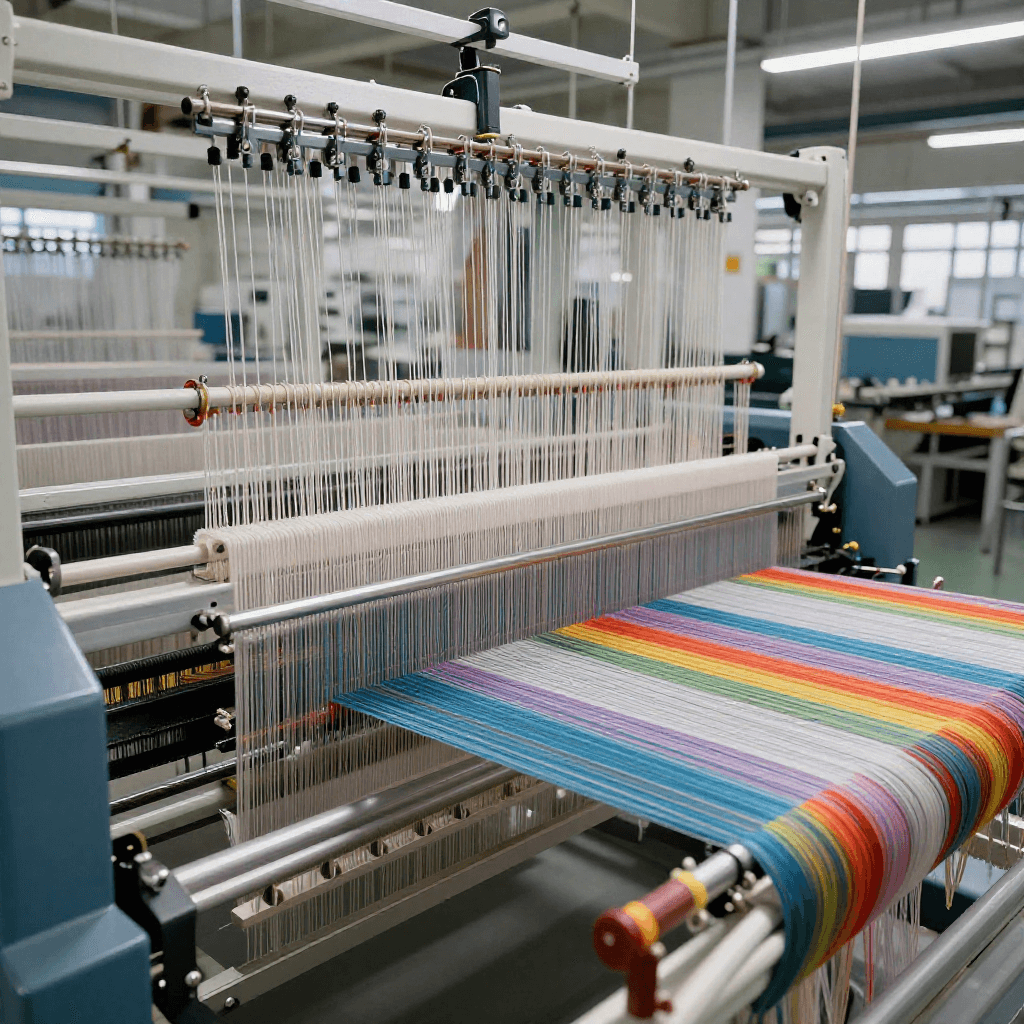
この設計図で作るもの
関連ブループリント
これらのブループリントは知識を共有しています — 技術、材料、原理
CC0 パブリックドメイン
このブループリントはCC0で公開されています。許可を求めずに、自由にコピー、修正、配布、あらゆる目的で使用できます。
メイカーを応援するには、ブループリント経由で製品を購入してください。メイカーには メイカーコミッション がベンダーにより設定されています。または、このブループリントの新しいイテレーションを作成し、自分のブループリントにコネクションとして含めて収益を共有できます。