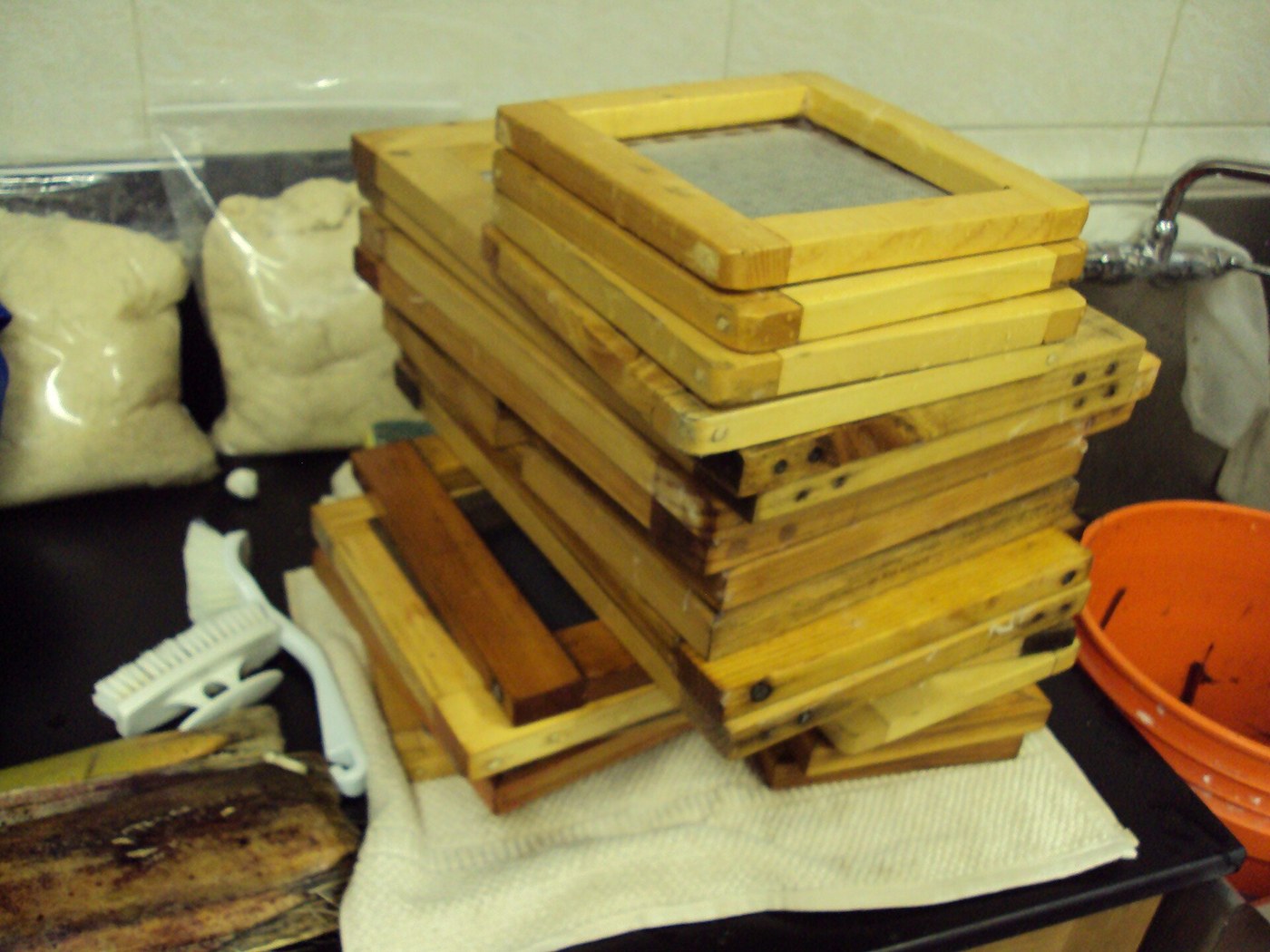


Paper Mould and Deckle
Two frames that make every sheet of handmade paper in the Western tradition. The mould is a rigid frame with a fine screen stretched over it. The deckle is a separate open frame that sits on top and acts as a wall, holding the pulp on the screen while the water drains through.
That is the whole division of labour: the mould decides the surface of the paper, the deckle decides its edge. The soft feathered edge of handmade paper is called a deckle edge for exactly this reason — a little pulp creeps under the frame, and the tapering it leaves is the fingerprint of the tool.
Two things decide whether yours works. The screen must be drum tight, or the sheet forms thick in the sag. And the deckle must seat flat all round, or pulp escapes and you get a wedge instead of a sheet.
手順
Cut four rails for the mould
Cut four rails for the mould
Cut four hardwood rails 30 x 20 mm to make a frame of your target sheet size — A5 is a sensible start. The frame must be stiff; it takes real tension from the screen.
このステップの材料:
 堅木のブロック1 個
必要な工具:
 手のこぎり
手のこぎりJoin the corners squarely
Join the corners squarely
Join the corners with half-laps or mortise and tenon and check both diagonals are equal. An out-of-square mould makes out-of-square paper, permanently.
必要な工具:
 木工のみセット
Add support ribs
Add support ribs
Fit two or three ribs across the frame, their top edges level with the rails. Ribs stop the screen sagging in the middle — the traditional mould is reinforced exactly this way.
Bevel the rib tops
Bevel the rib tops
Round or bevel the top of each rib so it touches the screen along a narrow line. A flat rib pressed against the screen prints a visible pale stripe into every sheet.
必要な工具:
 精密ヤスリ(針ヤスリ)セット
Seal the wood
Seal the wood
Give the whole frame several coats of varnish or oil. It will spend its life wet, and unsealed wood swells, moves out of square and eventually rots.
このステップの材料:
 ボイル亜麻仁油100 ml
Stretch the screen drum tight
Stretch the screen drum tight
Stretch fine mesh over the frame, pulling from opposite sides alternately, and staple it down all round. Tightness decides sheet evenness — a slack screen forms a thick patch wherever it dips.
このステップの材料:
 青銅の網1 個
Trim and cover the staples
Trim and cover the staples
Trim the surplus mesh and cover the fixings with a thin batten or tape. Exposed staples snag the wet sheet as you lift it off.
Build the deckle to match
Build the deckle to match
Make a second open frame the same outside size as the mould, with no screen. This is the deckle, and it is entirely separate — not hinged, not fixed.
Make the deckle sit flat
Make the deckle sit flat
Plane the deckle's underside dead flat and test it on the mould. Any gap lets pulp escape under the frame, and that corner of the sheet comes out thin.
Pull a test sheet
Pull a test sheet
Hold the deckle on the mould, dip vertically into the pulp vat, level out and lift straight up. Shake gently fore-and-aft and side-to-side while the water drains — that shake is what interlocks the fibres in two directions and gives the sheet its strength.
Lift the deckle before couching
Lift the deckle before couching
Once the water has drained, lift the deckle straight off, then press the mould face-down onto a damp felt and roll it away to release the sheet. That transfer is called couching.
Judge the sheet against the tool
Judge the sheet against the tool
Hold the dry sheet to the light. Thick patches mean a slack screen; pale stripes mean flat rib tops; a thin edge means the deckle was not seating. Every fault in the paper points at a specific fault in the mould.
History & Context
History & Context
Two frames, two jobs. In the Western tradition the toolset is a mould carrying a permanently fixed stiff mesh, plus an entirely separate open frame — the deckle — that fits over it to contain the sheet being formed. The mould is built as a rectangular wooden frame reinforced with ribs, over which a coarse backing wire is mounted and a finer screen stretched tightly and secured all round.
Laid and wove. Two screen types. A laid screen is made of closely spaced parallel wires and prints faint lines into the sheet — hold old paper to the light and you can count them. A wove screen is woven in a plain square weave, typically around 40 wires per inch each way, and gives an even surface with no lines. Wove paper is the later invention, and the difference is visible enough that it helps date documents.
The deckle edge. A small amount of pulp always creeps under the deckle frame, thinning toward the edge. The resulting soft feathered border is the deckle edge — the physical signature of hand papermaking, and so desirable that machine papers are sometimes made to imitate it artificially.
Why the shake matters. Fibres in the vat drift with the flow. Shaking the mould in two directions as the water drains lays fibres across each other rather than all one way, and that random interlocking is what makes paper strong in both directions. A sheet formed without the shake tears easily along one axis. It is a two-second movement carrying most of the mechanical properties of the product.
Bronze, and then synthetics. Traditional screens are fine bronze wire, which does not corrode at neutral pH. Synthetic mesh later brought large savings — it lasts longer, is easier to keep clean, and its tighter weave retains more fibre in the sheet and loses less back to the vat. A rare case where the modern substitute is better on almost every axis, which is why most working papermakers now use it.
この設計図で作るもの
CC0 パブリックドメイン
このブループリントはCC0で公開されています。許可を求めずに、自由にコピー、修正、配布、あらゆる目的で使用できます。
メイカーを応援するには、ブループリント経由で製品を購入してください。メイカーには メイカーコミッション がベンダーにより設定されています。または、このブループリントの新しいイテレーションを作成し、自分のブループリントにコネクションとして含めて収益を共有できます。