アート
美容とウェルネス
工芸
文化と歴史
エンターテインメント
環境
食品と飲料
リバースエンジニアリング
科学
スポーツ
テクノロジー
ウェアラブル
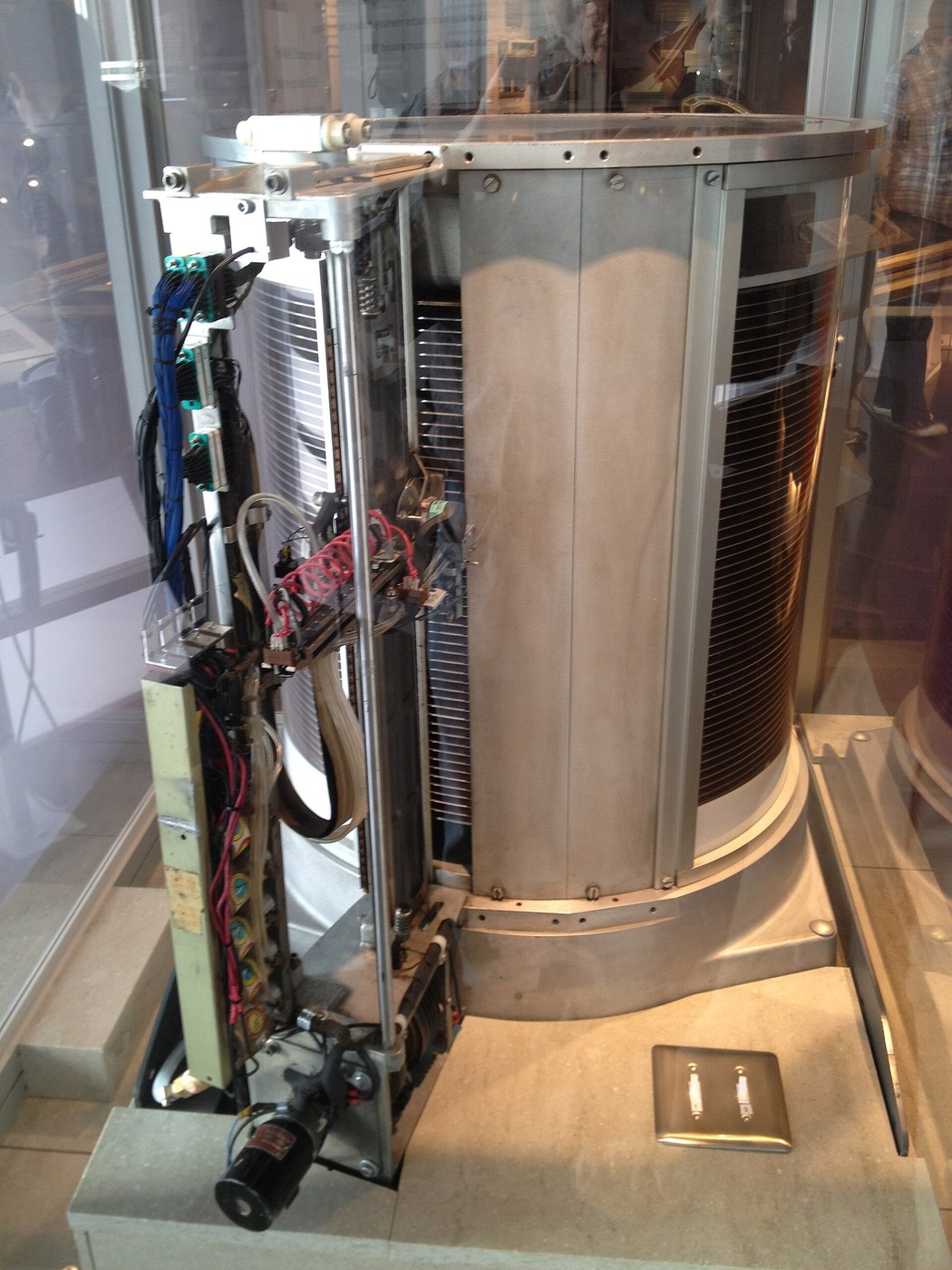


RAMAC and the Air Bearing
In 1956 IBM shipped the 350 Disk Storage Unit with the 305 RAMAC — Random Access Method of Accounting and Control. Fifty aluminium discs two feet across, stacked on one spindle turning at 1200 rpm, holding five million characters. It weighed about a tonne and was delivered by forklift.
The capacity was not the point. Tape already held more. What tape could not do was JUMP. To reach the ten-thousandth record on a tape you read the nine thousand nine hundred and ninety nine before it, and businesses had reorganised themselves around that limitation — everything was batched, sorted overnight, processed in one pass. RAMAC could reach any record in about six hundred milliseconds regardless of which one, and that changed what a computer was FOR.
The mechanical problem was one number: how close can you hold a head to a spinning disc without touching it? Blueprint 1 measured what spacing costs — 54.6 d over lambda decibels — so the answer decides how much you can store. RAMAC's answer was to pump compressed air through the head slider from a compressor built into the machine. Six years later the IBM 1301 did away with the compressor: tilt the slider slightly and the disc's own rotation drags a wedge of air underneath, which cannot escape sideways fast enough and holds the head up by itself. Every drive since has flown that way.
MEASURED, NOT FABRICATED. You will not build an air bearing to half a micrometre. What this blueprint does is open a dead drive, measure the real parts, and compute the flying — and the arithmetic that comes out ties fly height directly to bits per inch.
中級者
3 hours
手順
1
1
Open a dead drive and measure the real thing
Open a dead drive and measure the real thing
Get a scrap 3.5-inch drive — a failed one is free from any repair shop. Take the lid off with the Torx set. It will never work again; that is fine, and it is why you use a dead one.
Measure and write down: platter diameter and thickness with the caliper, the number of platters, the arm's pivot-to-head length, and the head slider's own dimensions under the loupe. A modern slider is around 1 by 0.7 millimetres and you will need the loupe to see that it is not flat — the air-bearing surface is etched into rails and a shallow step.
Weigh the whole arm assembly on the scale. That mass and that arm length are what the servo in blueprint 6 has to accelerate and stop within a few milliseconds.
Find the landing zone: an inner band with a visibly different texture. That is blueprint 5.
必要な工具:
 Torx ドライバーセット
 デジタルノギス 6インチ
 手持ちルーペ 10倍
 デジタルキッチンスケール
 ハードディスクドライブ(回収品)
2
2
See the wedge for yourself
See the wedge for yourself
An air bearing is hard to picture and easy to demonstrate. Cut a 40 mm square of thin card and lay it on the platter, off centre. Spin the platter by hand, fast.
The card lifts and skates. It is not being blown up by anything — it is being carried on air dragged under its leading edge by viscosity, which cannot escape sideways as fast as it arrives. Tilt the leading edge up slightly with a fold and it lifts more and sooner.
Now do the two controls that make it a measurement rather than a trick. Slow the platter and the card settles: the effect needs SPEED. Weight the card with a coin and it settles: the effect balances a LOAD. Those two dependencies are the whole of the Reynolds equation in the notebook, four orders of magnitude coarser.
このステップの材料:
 カードストック1 パック
必要な工具:
 デジタル回転計
 ストップウォッチ
3
3
Density, access time, and the bearing number
Density, access time, and the bearing number
Jupyter ノートブックを読み込み中…
必要な工具:
 デスクトップパソコン
4
4
Why a drive reads nothing
Why a drive reads nothing
The diagnostic tree, in the order a field engineer works it. Two branches are worth reading even if you never open a drive.
A WEAK signal that returns at low frequency is spacing, not amplitude — that is blueprint 1's exponent identifying itself in the field. And a drive that TICKS once per revolution has a head in contact at thirty metres a second: every further revolution grinds away more medium, so it gets powered down before anything else is diagnosed.
Flow
WHY A DRIVE READS NOTHING — the diagnostic order a field engineer actually uses.
Work top down and stop at the first branch that matches.

START: the drive spins but returns no data.

1. DOES IT SPIN UP AND STAY UP?
   - no spin -> spindle motor or its driver. Not a storage fault at all.
   - spins then stops -> the drive failed its own self-test. Almost always the
     servo could not lock (branch 3), because a drive with no servo lock does not
     know where it is and parks rather than risk a head crash.

2. IS THERE ANY READ SIGNAL AT ALL? (scope on the preamp output)
   NOTHING -> the head is not close enough to the medium, or is not there.
     - a repeating tick every revolution = the head is TOUCHING. Stop immediately;
       every further revolution grinds more of the medium away.
     - silence = an open head winding, a broken flexure lead, or a head still
       parked on the ramp.
   WEAK BUT PRESENT -> spacing. Blueprint 1's exponent is doing this to you:
     54.6 d/lambda dB, so a contaminant a twentieth of a micrometre thick costs
     14 dB at short wavelengths and nothing at long ones. TEST FOR IT: does the
     signal come back at low frequency? If yes, it is spacing, not amplitude.
   FULL AMPLITUDE, STILL NO DATA -> go to 4.

3. CAN IT FIND A TRACK?
   - reads the servo pattern but will not settle -> actuator, or a warm chassis
     that has moved the tracks under a servo written when it was cold.
   - no servo pattern anywhere -> the servo surface itself is damaged, or on an
     embedded-servo drive the whole surface is gone. This is usually terminal.

4. FULL SIGNAL, NO DATA. The analogue side is fine; the CHANNEL is not.
   - the clock will not lock -> the run-length code is being violated, so the PLL
     has nothing to lock to. Wrong data rate, wrong code, or wrong equalisation.
     See blueprints 3 and 7.
   - clock locks, ECC fails on every sector -> the format is not what the
     controller expects, or the interleave is wrong. See blueprint 9.
   - clock locks, ECC corrects a few sectors and fails others -> real media
     defects. Read what you can and stop; retries wear the surface further.

THE RULE THAT SAVES THE MOST DATA: a drive that is TICKING is destroying itself.
Power it down before you diagnose anything else. Everything on this tree can wait;
a head in contact at 30 m/s cannot.
必要な工具:
 デジタルオシロスコープ
5
5
Compendium: what random access actually bought
Compendium: what random access actually bought
WHAT RAMAC WAS. Fifty 24-inch discs, 1200 rpm, 100 tracks per surface, 20 TPI, 100 BPI, five million characters. ONE head assembly served all fifty: a pair of arms rode up the stack to the chosen disc, then in to the chosen track. That is why access took about 600 ms, and why the ARM was the engineering, not the disc.
THE TWO AIR BEARINGS, LABELLED. RAMAC's was EXTERNALLY PRESSURISED — a compressor fed air through the slider. The IBM 1301 of 1962 introduced the SELF-ACTING bearing: a tilted slider drags its own wedge and needs no supply. The difference matters because a self-acting bearing gets STIFFER as it gets thinner, so it resists being pushed onto the disc, and that self-correction is what made sub-micron flying possible.
AGAINST THE RECORD PLAYER. The microgroove LP is the same geometry reached by contact: zero spacing, no servo because the groove GUIDES the stylus, no coding, no error correction — and it wears out both itself and the record. Every advantage of the disk drive comes from not touching, and every difficulty in the rest of this batch comes from the same choice.
必要な工具
9- プレースホルダー
- プレースホルダー
- プレースホルダー
- プレースホルダー
- プレースホルダー
- プレースホルダー
- プレースホルダー
- プレースホルダー
- 1 vendor sell this, none ship to you yetプレースホルダー
関連ブループリント
これらのブループリントは知識を共有しています — 技術、材料、原理



CC0 パブリックドメイン
このブループリントはCC0で公開されています。許可を求めずに、自由にコピー、修正、配布、あらゆる目的で使用できます。
メイカーを応援するには、ブループリント経由で製品を購入してください。メイカーには メイカーコミッション がベンダーにより設定されています。または、このブループリントの新しいイテレーションを作成し、自分のブループリントにコネクションとして含めて収益を共有できます。