アート
美容とウェルネス
工芸
文化と歴史
エンターテインメント
環境
食品と飲料
リバースエンジニアリング
科学
スポーツ
テクノロジー
ウェアラブル
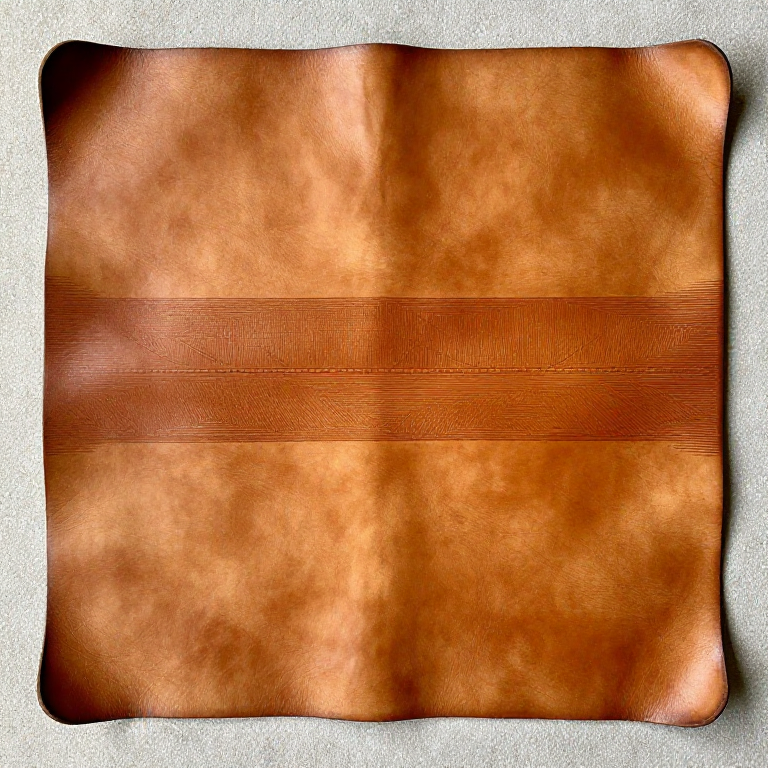


Reading a Hide: The Best Part Is Smaller Than You Think
A hide is not a uniform sheet. It is an animal, and it has a firm dense back, a loose stretchy belly, wrinkled shoulders and thin legs — and a strap cut from the wrong place will stretch out of shape within a month.
It also has two faces that behave completely differently, a thickness quoted in ounces that are not a weight, and a temper that decides whether it will mould, carve, drape or do none of those.
Choosing wrongly here cannot be corrected by any amount of skill afterwards. This rung is how to read what is in front of you before cutting into it.
初心者
2 hours
手順
1
1
Tannage: what the hide was turned into
Tannage: what the hide was turned into
**Vegetable tanned.** Tanned with tannins from bark, as in the oak bark and bark tanning blueprints. Firm, dense, pale tan when new, darkens with use and light. It is the only leather that **wet forms, tools and burnishes**, and the only one worth using for a belt, a holster, a sheath or a moulded piece. It absorbs water, so it stains and it can be shaped.
**Chrome tanned.** Tanned with chromium salts, a nineteenth-century invention. Soft, supple, stable, water resistant, usually dyed through and often finished with a coating. Most shoe uppers, garment leather and upholstery. It will not tool, will not burnish and will not hold a moulded shape.
**Brain tanned and buckskin.** Soft, stretchy, suede-like on both faces, smoke-cured to stay soft after wetting. Superb for clothing and bags, useless for anything that must hold a shape.
**Rawhide.** Not tanned at all — dehaired and dried. Hard, translucent, and it shrinks hard as it dries, which is the whole point for drum heads, lacing and a parfleche.
Telling them apart: a drop of water beads and sits on chrome tan and soaks straight into vegetable tan, darkening it. That test takes five seconds and is the one that matters most.
このステップの材料:
 植物タンニンなめし革1 個
 クロムなめし革1 個
 山羊革1 個
2
2
Ounces, parts and yield
Ounces, parts and yield
Jupyter ノートブックを読み込み中…
必要な工具:
 デスクトップパソコン
 デジタルノギス 6インチ
3
3
Grain and flesh: two faces, two jobs
Grain and flesh: two faces, two jobs
**The grain side** is the outside of the animal, where the hair was. It is smooth, dense, and the strongest part of the leather — the fibres are tightest just under the surface. It takes dye evenly, burnishes, and shows every scratch.
**The flesh side** is the inside. Fibrous, fuzzy, and much weaker on its own. It takes dye unevenly and drinks far more of it.
Three consequences for the maker:
**Never split away the grain if strength matters.** A piece sanded or split down from the grain side loses most of its strength for a small saving in thickness. "Genuine leather" and "bonded leather" are the flesh layers left over from exactly that operation.
**Glue to the flesh side.** Adhesive grips the fibrous side and slides off the grain. If two grain surfaces must be joined, roughen one first.
**Fold with the grain outside.** Leather bent grain-out is in tension on its strongest face. Bent the other way, the grain is in compression and wrinkles.
**Scars, brands and insect marks** are on the grain side and cannot be removed. Plan around them: a mark that would ruin a wallet front is invisible on a lining, and the hide's price already reflects them.
このステップの材料:
植物タンニンなめし革1 個 革1 個
革1 個必要な工具:
デジタルノギス 6インチ4
4
Temper, and testing a piece before committing to it
Temper, and testing a piece before committing to it
**Temper** is how firm or soft a leather is, independent of its thickness. The same 6 oz vegetable tan can be hard as board or as floppy as cloth, depending on how it was dried, rolled and stuffed with fat.
The shop names, from hardest: **firm** or **tooling** temper, **regular**, **soft**, **drummy**. A holster wants firm; a bag body wants regular; a garment wants soft.
Four tests, none of which cost anything:
**The drape test.** Hold a piece by one edge and see how far it falls. A firm temper stands out almost straight; a soft one hangs.
**The fold test.** Fold a scrap grain-out. Fine even wrinkles mean good tight grain; coarse deep creases mean loose, stretchy leather.
**The stretch test.** Pull a strip along its length and across it. Leather stretches far more ACROSS the backbone than along it, which is the other reason straps run along the spine.
**The water drop.** As above: soaks in and darkens on vegetable tan, beads on chrome tan or a finished surface.
Do all four on a scrap from the same hide before cutting the real piece. Every one of them tells you something no supplier's description will.
このステップの材料:
植物タンニンなめし革1 個クロムなめし革1 個必要な工具:
 定規デジタルノギス 6インチ
関連ブループリント
これらのブループリントは知識を共有しています — 技術、材料、原理

CC0 パブリックドメイン
このブループリントはCC0で公開されています。許可を求めずに、自由にコピー、修正、配布、あらゆる目的で使用できます。
メイカーを応援するには、ブループリント経由で製品を購入してください。メイカーには メイカーコミッション がベンダーにより設定されています。または、このブループリントの新しいイテレーションを作成し、自分のブループリントにコネクションとして含めて収益を共有できます。