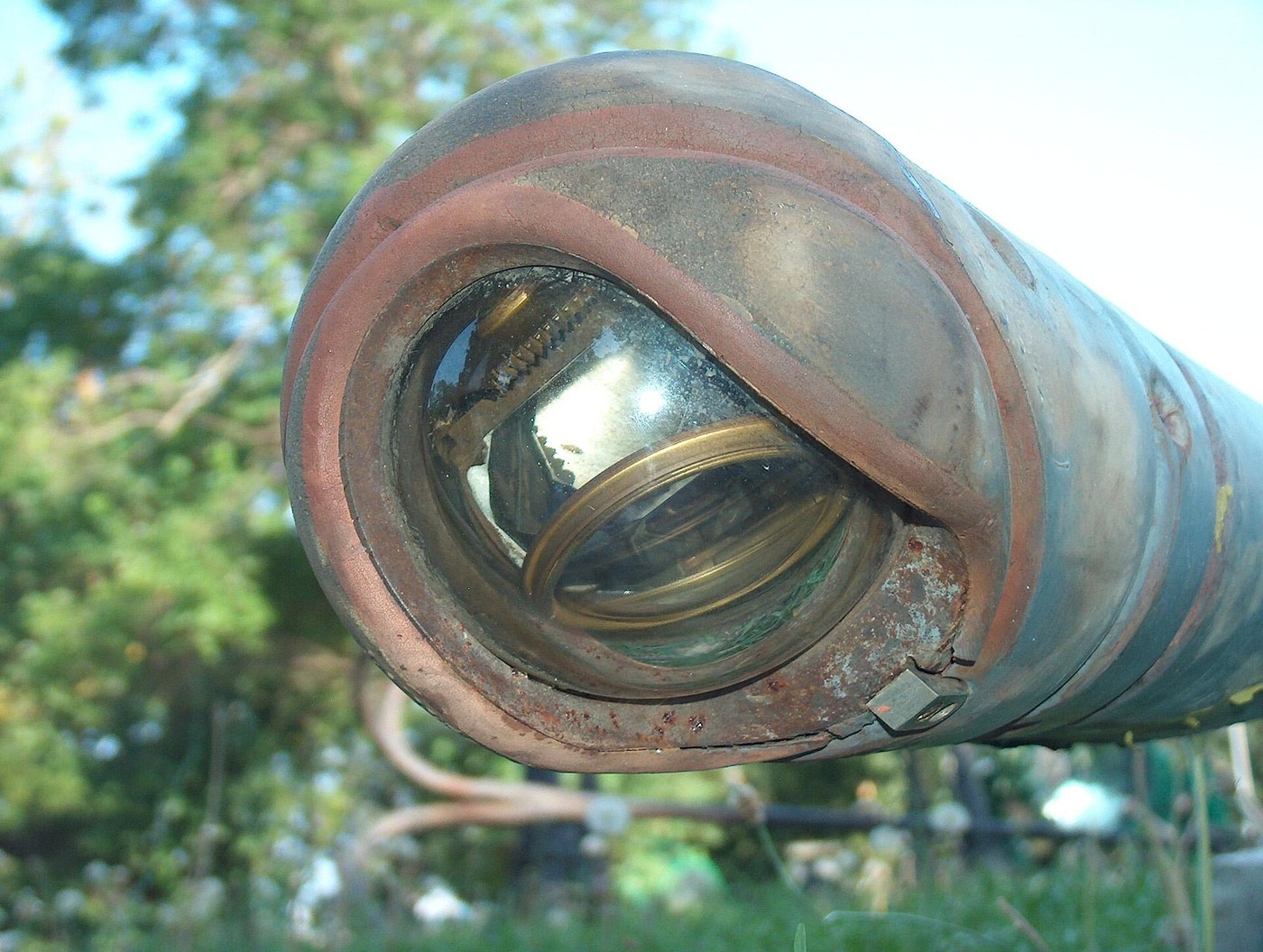

The Submarine Periscope
手順
Build the naive two-mirror periscope and find its limit
Build the naive two-mirror periscope and find its limit
Build the version everyone builds first, then find out exactly where it stops working.
- Mount two flat mirrors at 45° facing each other at the ends of a cardboard tube, about 300 mm apart.
- Look through it — it works well.
- Now extend the tube to 1 m, then 2 m, keeping the same mirrors, and look again.
- Record the apparent field of view and brightness at each length.
The field of view collapses as the tube lengthens. At 300 mm you see a useful scene; at 2 m you are looking down a straw. Nothing has changed except distance.
The reason is geometric rather than optical: the far mirror subtends a smaller and smaller angle as it recedes, so it collects an ever narrower cone of light. A plain tube's field of view is set by its length-to-diameter ratio, and a 9 m periscope of 180 mm diameter would show essentially nothing.
You could widen the tube instead — and a wide periscope leaves a bigger wake, is easier to spot, and is harder to make strong against sea pressure. The optical fix has to be lenses, because the mechanical fix makes the boat detectable.このステップの材料:
 紙管2 個
紙管2 個 表面反射鏡2 個
必要な工具:
 替刃付きホビーナイフ
 分度器
分度器 デジタルノギス 6インチ
 メジャー(巻尺)
Add a relay lens and prove it restores the field
Add a relay lens and prove it restores the field
Demonstrate the fix at bench scale, with a single lens in a long tube.
- Take the 2 m tube from step 1, where the view had collapsed to a pinhole.
- Place a long-focal-length converging lens midway along it.
- Adjust its position until the image at the eyepiece is sharp, and measure the field of view again.
- Note whether the image is upright or inverted.
One lens transforms the useless pinhole back into a usable scene — and the image is now upside down. Each relay stage inverts, so an even number of stages comes out upright and an odd number does not.
That is why relay counts are chosen with the final orientation in mind, and why some designs add a deliberate erecting element. An inverted horizon in a combat instrument is not a quirk, it is a hazard, so the optical train is designed backwards from the requirement that the operator sees the world the right way up.
Measure the brightness loss too. Every glass surface reflects a few percent unless coated, and a periscope has dozens of surfaces — which is why anti-reflection coating, invented in the 1930s, mattered so much to submarine optics that it was treated as sensitive technology.このステップの材料:
 凸レンズセット1 セット紙管1 個
必要な工具:
メジャー(巻尺)デジタルノギス 6インチ スローモーション撮影ができるスマートフォン
Measure range by the angle a known height subtends
Measure range by the angle a known height subtends
A periscope is also a rangefinder, using nothing but a graticule and known ship dimensions.
- Etch or print a graticule with angular divisions and fit it at the eyepiece focal plane.
- Calibrate it: view an object of known height at a measured distance and record the divisions it spans.
- Now view the same object at unknown distances and compute range from the angle it subtends.
- Repeat with the object's height deliberately misjudged by 20 percent and see what happens to the range.
Range comes out as height divided by the subtended angle, and it is only ever as good as your estimate of the height. That last test is the important one: a 20 percent error in assumed masthead height puts a 20 percent error straight into the range.
Which is why submarines carried recognition manuals listing masthead heights by ship class. Identifying the target correctly was not naval trivia — it was the measurement input, and misidentifying a ship meant mis-ranging it.
The stadimeter refined this by splitting the image and bringing waterline and masthead into coincidence, which turns a judgement about angle into a nulling task. Humans are far better at deciding when two things line up than at estimating how far apart they are — the same reason a direction-finder is aimed at a null rather than a peak, as in the antenna blueprint.このステップの材料:
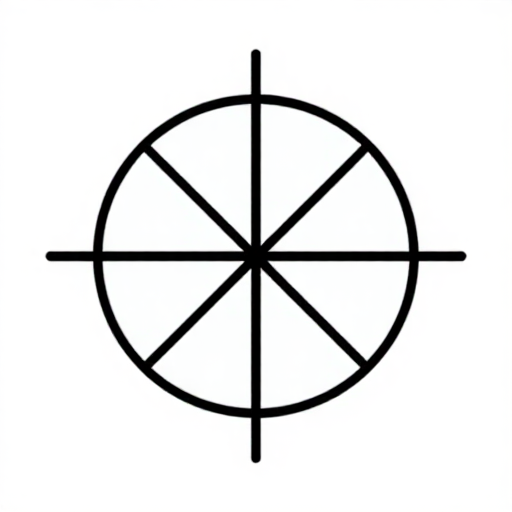 目盛レチクル(エッチングガラス)1 個
 方眼紙1 pad
必要な工具:
分度器メジャー(巻尺)デジタルノギス 6インチThe feather, and why the instrument is the vulnerability
The feather, and why the instrument is the vulnerability
The periscope is the only part of a hidden boat that is not hidden, and it announces itself twice.
- Draw a vertical rod through still water at a measured speed and photograph the surface disturbance.
- Repeat at double the speed and compare the wake.
- Note the length of the visible trail behind the rod in each case.
A raised periscope leaves a visible wake — the feather — and it grows dramatically with speed. A boat at periscope depth must therefore go slowly, which limits how quickly it can reposition, which is a tactical constraint imposed entirely by an optical instrument.
The second betrayal is radar: a thin vertical metal tube above the water is a small but perfectly detectable target, and airborne radar hunting periscopes was the single greatest threat to submarines by 1943.
So the whole design becomes a compromise about exposure. Minimum diameter, minimum time raised, radar-absorbent coatings, and eventually the attack periscope made deliberately thinner than the search periscope — accepting a dimmer, narrower view in exchange for being harder to see.
The modern answer abandons the tube entirely: a photonics mast carries cameras and sends signal down a cable, so no optical path passes through the hull. That removes the biggest hole in the pressure hull — recall from the hull blueprint what every penetration costs — and lets the mast be shaped for stealth rather than for optics.このステップの材料:
 軟鋼丸棒1 個
必要な工具:
スローモーション撮影ができるスマートフォンメジャー(巻尺) 手持ち風速計
材料
6- プレースホルダー
- 2 個プレースホルダー
- 1 セットプレースホルダー
- プレースホルダー
- 1 padプレースホルダー
- 1 個プレースホルダー
関連ブループリント
これらのブループリントは知識を共有しています — 技術、材料、原理


CC0 パブリックドメイン
このブループリントはCC0で公開されています。許可を求めずに、自由にコピー、修正、配布、あらゆる目的で使用できます。
メイカーを応援するには、ブループリント経由で製品を購入してください。メイカーには メイカーコミッション がベンダーにより設定されています。または、このブループリントの新しいイテレーションを作成し、自分のブループリントにコネクションとして含めて収益を共有できます。