アート
美容とウェルネス
工芸
文化と歴史
エンターテインメント
環境
食品と飲料
リバースエンジニアリング
科学
スポーツ
テクノロジー
ウェアラブル

The Bail-Opened Kettle Lid: Throw the Handle Down and the Cover Lifts Itself
Lifting the cover of a kettle on the fire puts the hand over the opening just as the steam comes out.
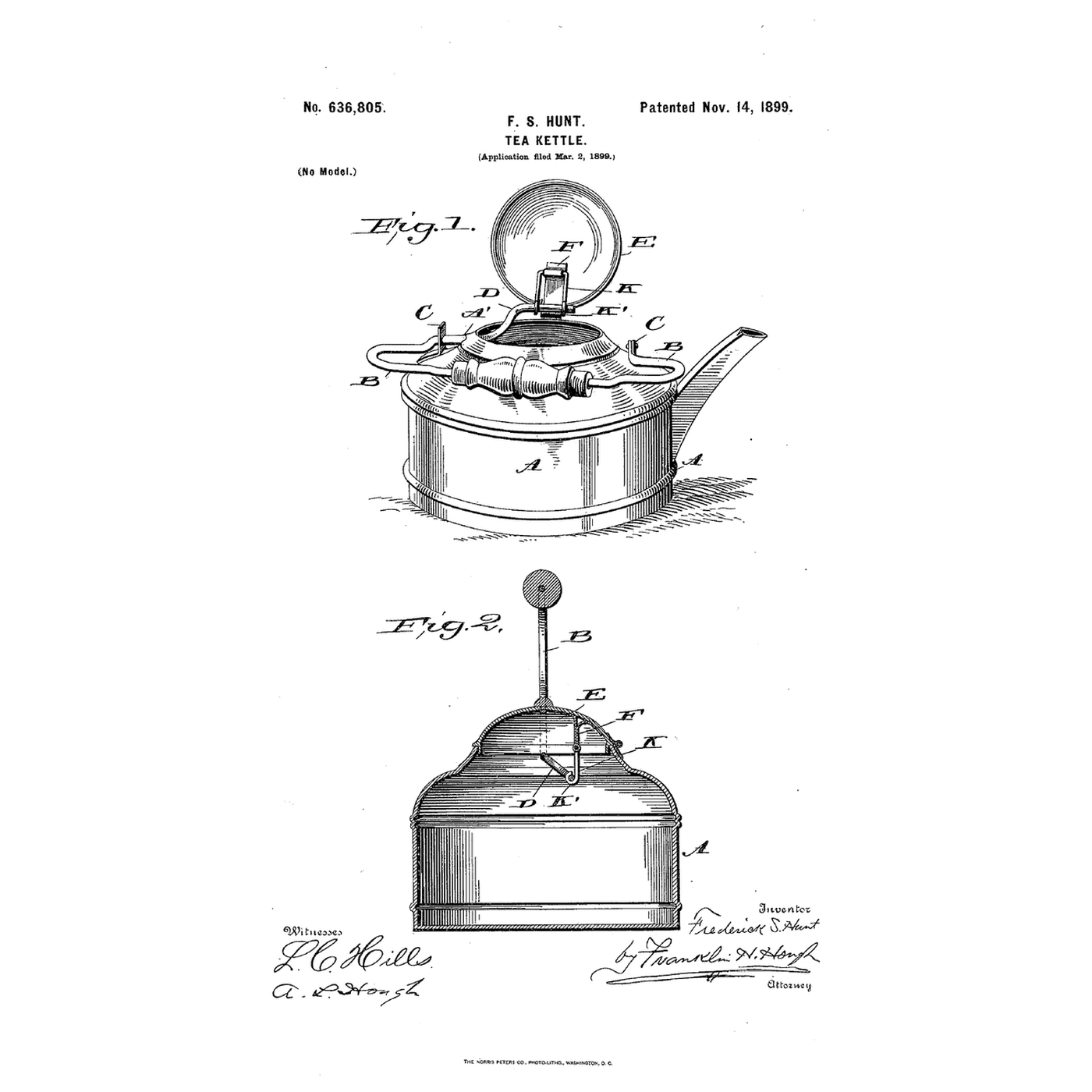
Frederick S. Hunt of Albany, Illinois, received US 636,805, dated 14 November 1899, for a tea-kettle whose hinged cover is opened and closed by its handle: one end of the bail passes through the kettle's wall and engages a yoke on a strap under the cover, so "the cover may be automatically opened and closed without danger of steam coming in contact with the hand of the operator."
This rung works out how far the lid opens for a given crank, then builds the bail, crank, yoke and hinged cover on a tin-can model and measures the lid's opening as the bail is thrown down.
中級者
About 4 hours
手順
1
1
Lid opening from the crank
Lid opening from the crank
Jupyter ノートブックを読み込み中…
2
2
A bail that works a lid before it
A bail that works a lid before it
The embedded blueprint closes a jar's lid with a wire bail and yoke. Hunt runs the kettle's bail through its wall so that swinging the handle opens and shuts the cover.
3
3
Read US 636,805
Read US 636,805
"A designates a tea-kettle of ordinary construction, and B is a handle, which is pivoted in the ears C. One end of said handle, as D, is extended through the wall of the kettle through the aperture A' and designed to engage with a hook or connection attached to the cover."
"By this construction it will be noted that when the handle of the tea-kettle is raised to a vertical position the inner end of the bail or handle will cause the cover to be closed, and the weight of the cover when closed will hold the handle normally in a vertical position, as shown in Fig. 1."
4
4
Build the model and time the lid
Build the model and time the lid
**Body.** Use a large tin can, open at the top, as the kettle. Cut a round cover of brass sheet to its mouth, hinge it at one side with two small tabs of brass sheet riveted to the rim and a pin of wire through their rolled ends, and rivet a strip of brass under the cover 4 cm from the hinge as the strap.
**Bail.** Rivet two ears of brass sheet to the can's sides just below the rim, each with a 3 mm hole, on the line across the can that passes 4 cm from the hinge. Bend galvanised wire into a bail that spans the can, with one end through its ear and on through a 4 mm hole in the wall beside it, then bend that end inside into a crank 2.5 cm long, pointing down when the bail stands upright.
**Yoke.** Bend a wire yoke that hangs from a loop in the strap and ends in a hook round the crank.
**Test.** Stand the bail upright and check that the cover is shut and holds it there. Throw the bail down to one side and measure how far the cover opens with a protractor; repeat with the crank bent 1.5 and 3.5 cm long.
このステップの材料:
 ブリキ缶1 個
 真鍮板1 個
 銅リベット1 個
 亜鉛めっき鋼線1 個
必要な工具:
 金切りばさみ
 リベット工具一式
 コードレスドリル
 ドリルビットセット
 平やっとこ
 丸口ペンチ
 ニッパー
 やすり(手やすり)
 分度器
 定規
 透明保護メガネ
 リベットハンマー
5
5
A lid that will not open, will not shut or drops the bail
A lid that will not open, will not shut or drops the bail
Bail-opened kettle lid troubleshooting.
Flow
Loading...
6
6
History and honest limits
History and honest limits
**Frederick S. Hunt** of Albany, Whiteside County, Illinois, filed US 636,805 on 2 March 1899; it is dated 14 November 1899. The cover E is hinged to the kettle beside the opening, and a strap F under it carries in its looped end the yoke K, whose end hooks K' engage the inner end of the handle. To open the cover the handle is thrown over on the side of the kettle, and it is held open. He noted that it may be applied to any receptacle. His claims cover the pivoted cover, the handle with one end extending into the kettle, and the connections between them; and the kettle with its pivoted cover and bail, the strap and the hooked yoke.
**Honest limits.** A tin-can model shows the linkage and is not for the stove; he gives no sizes. The notebook treats the yoke as rigid and upright; its lengths are examples. Your measured angles are the result.
関連ブループリント
これらのブループリントは知識を共有しています — 技術、材料、原理



CC0 パブリックドメイン
このブループリントはCC0で公開されています。許可を求めずに、自由にコピー、修正、配布、あらゆる目的で使用できます。
メイカーを応援するには、ブループリント経由で製品を購入してください。メイカーには メイカーコミッション がベンダーにより設定されています。または、このブループリントの新しいイテレーションを作成し、自分のブループリントにコネクションとして含めて収益を共有できます。