アート
美容とウェルネス
工芸
文化と歴史
エンターテインメント
環境
食品と飲料
リバースエンジニアリング
科学
スポーツ
テクノロジー
ウェアラブル
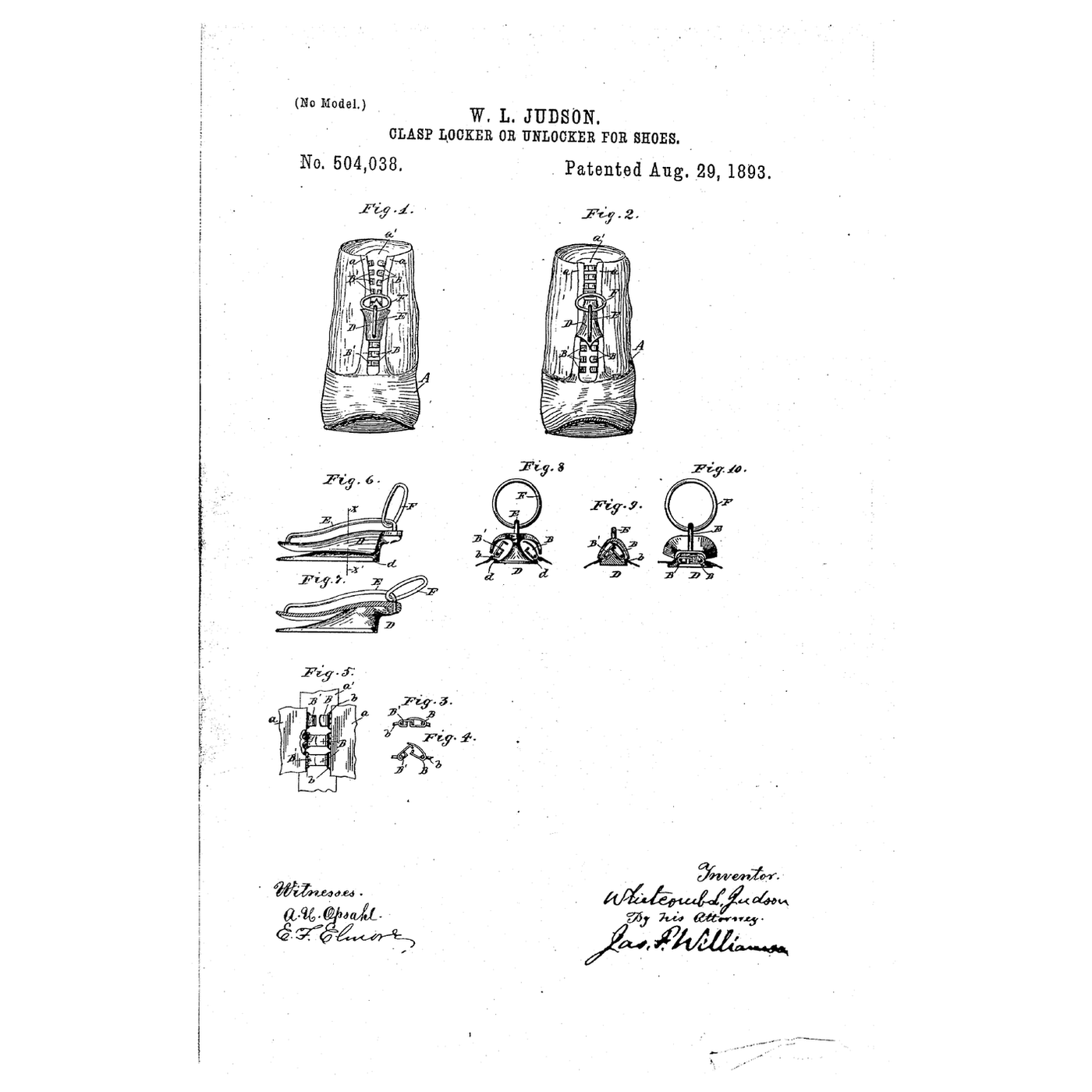


The Clasp Locker: Closing a Whole Row of Clasps in One Pull
A high boot of the 1890s might close with twenty or more hooks, laced or fastened one by one. Whitcomb L. Judson of Chicago proposed a hand device that fastened them all "by a single continuous movement".
His US 504,038 (filed 7 November 1891, renewed 18 February 1893, dated 29 August 1893) is a "clasp locker or unlocker". Each clasp has two parts whose hooks can engage or part only when tipped to about ninety degrees to each other. A small guide with two cam-ways at one end, meeting over a ridge into a single cam-way at the other, is pulled along the row: one way it tips each pair, hooks it and lays it flat; the other way it separates them.
This rung works out the cam-way's slope against the pull, and builds a short row of clasps with a printed guide. It is a different mechanism from the interlocking-tooth zip that came later.
中級者
About 3 hours
手順
1
1
Ramp angle, guide length and pull
Ramp angle, guide length and pull
Jupyter ノートブックを読み込み中…
2
2
The shoe the clasps were meant to close
The shoe the clasps were meant to close
Judson aimed the device at shoes. The embedded blueprint makes a simple shoe whose opening has to be closed somehow.
3
3
Read US 504,038
Read US 504,038
The clasps "are made with interlocking parts, which when in position, can only engage with each other when at an angle to the line of strain." Their lips "prevent the engagement or disengagement of the hook-portions of the clasps, except when thrown upward, so that the parts stand at an angle to each other of about ninety degrees." By hand, "this is a tedious operation".
The guide D has a flat base with upturned lips, a concave or bell-shaped top plate, and a centre piece of angular section that splits the front into two channels which "converge over an angular center ridge or instep" into one at the back. "By moving the guide, so that the separate parts of the clasp enter the respective channels or cam-ways at the front of the guide the entire series of clasps will be delivered from the other or rear end of the guide properly engaged together." Run the other way, it delivers them disengaged. A bail E carries a ring F as a finger pull that can be shifted to either end.
Judson notes the guide also "serves to draw the flaps together, and the parts of the shoe tightly about the foot", and that the invention applies wherever clasps of interlocking parts are used — "mail-bags, belts, and the closing of seams uniting flexible bodies".
4
4
The slider's work, clasp by clasp
The slider's work, clasp by clasp
Blocklyワークスペース
Loading Blockly workspace...
5
5
Make a short row and a guide
Make a short row and a guide
Cut sixteen small clasp halves from thin brass sheet: eight with a hook turned up at one end, eight with a matching slot and a lip that stops the hook engaging while the halves lie flat. File the edges smooth. Sew them at 6 mm spacing along two edges of denim, hooks on one side and slots on the other, so the halves meet across the gap.
Print a guide: two funnel-shaped channels at the front, a ridge between them that lifts the inner ends of both halves, and a single channel at the rear. Pull it along the row and watch each pair tip up, catch and lie down. Change the ridge height to see when it jams and when it fails to tip the clasps far enough.
このステップの材料:
 真鍮板1 個
 デニム生地1 個
 糸1 個
糸1 個必要な工具:
 FDM 3D プリンター
 PETGフィラメント
 平やっとこ
平やっとこ 手縫い針
手縫い針 裁ちばさみ
裁ちばさみ デジタルノギス 6インチ
 紙やすり詰め合わせ
6
6
A clasp row that will not close
A clasp row that will not close
Clasp locker troubleshooting.
Flow
Loading...
7
7
History and honest limits
History and honest limits
**Whitcomb L. Judson** of Chicago filed on 7 November 1891; the application was renewed on 18 February 1893 and US 504,038 is dated 29 August 1893. His claims cover the guide block with two ways converging into one, and its shifting finger pull.
**Honest limits.** The ramp model treats each clasp as needing a fixed sideways push and ignores the cloth's stiffness; the numbers are examples. Judson's clasps are not the interlocking teeth of the later zip.
関連ブループリント
これらのブループリントは知識を共有しています — 技術、材料、原理


CC0 パブリックドメイン
このブループリントはCC0で公開されています。許可を求めずに、自由にコピー、修正、配布、あらゆる目的で使用できます。
メイカーを応援するには、ブループリント経由で製品を購入してください。メイカーには メイカーコミッション がベンダーにより設定されています。または、このブループリントの新しいイテレーションを作成し、自分のブループリントにコネクションとして含めて収益を共有できます。