アート
美容とウェルネス
工芸
文化と歴史
エンターテインメント
環境
食品と飲料
リバースエンジニアリング
科学
スポーツ
テクノロジー
ウェアラブル
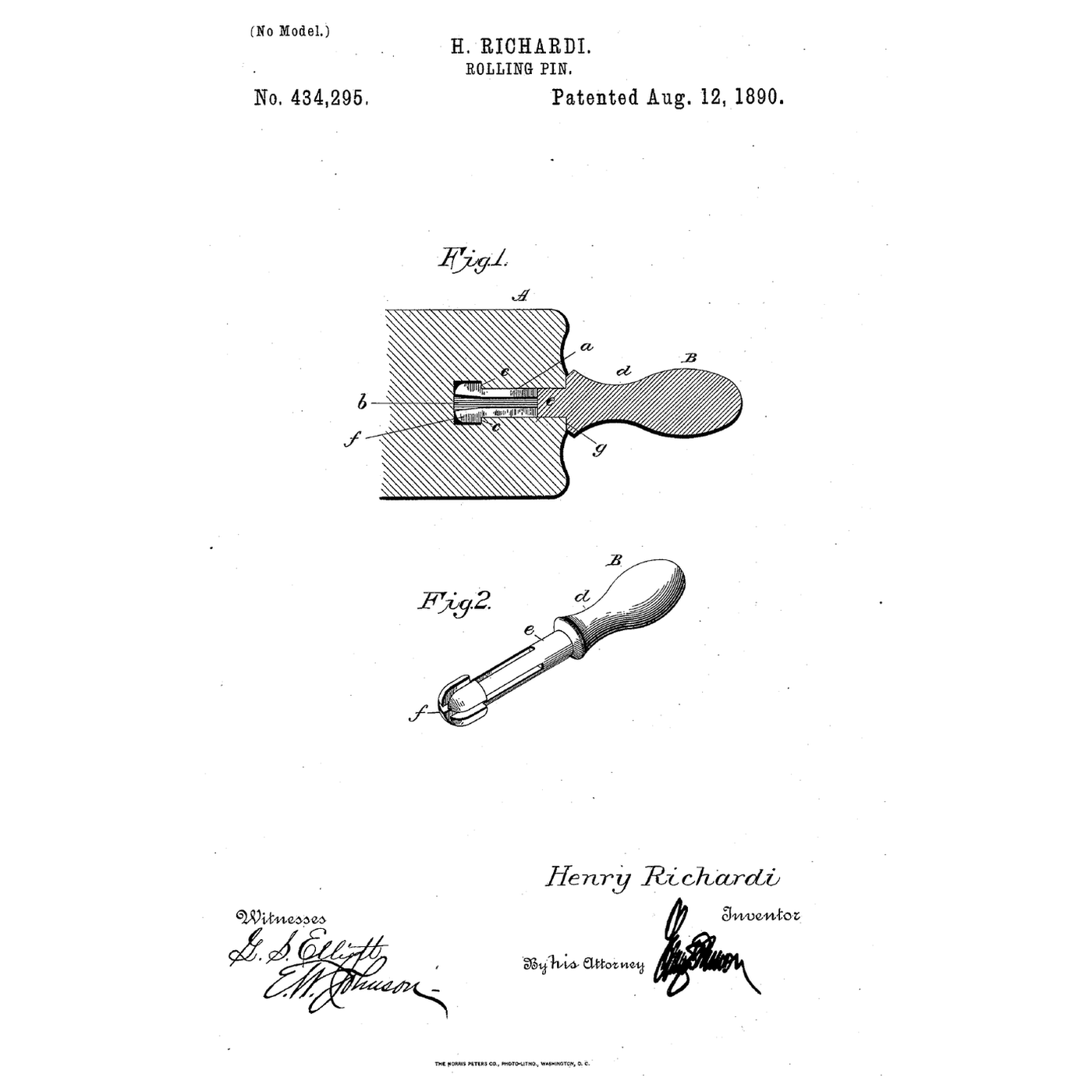


The Revolving Rolling Pin: Handles That Stay Still
A rolling pin spreads dough thinner a little at a time. If the handles turn with the roller, the hands must let them slide; if they stay still, the roller does the turning.
Henry Richardi of Bellaire, Michigan, received US 434,295, dated 12 August 1890 (filed 6 February 1890), for a rolling-pin "that permits the roller proper to revolve relative to the handles and yet consists of but three parts--to wit, the roller and the two handles", all of wood, each handle held in by a split head that springs open inside the roller.
This rung computes how many passes a dough needs and where the rubbing goes, then rolls a dough out and measures it pass by pass.
初心者
About 1 hour
手順
1
1
Passes and rubbing
Passes and rubbing
Jupyter ノートブックを読み込み中…
2
2
Rollers for dough, by machine
Rollers for dough, by machine
The embedded blueprint is an 1884 machine with corrugated then plain rolls; the rolling pin is the hand version.
3
3
Read US 434,295
Read US 434,295
"My invention has reference to rolling-pins for household use; and it consists in the construction hereinafter set forth and claimed, whereby a simple, efficient, and inexpensive rolling-pin is provided that permits the roller proper to revolve relative to the handles and yet consists of but three parts--to wit, the roller and the two handles."
Before, a metal bolt was driven into each end of the roller to carry the handle. Instead, "The head and a portion of the journal are split crosswise" so the head can be squeezed into the roller's recess, where it springs back behind a shoulder, "and thus prevent the accidental withdrawal of the handle."
A shoulder keeps the handle "a slight distance away from the end of the roller, and thereby protect the hand from frictional contact with the revolving roller."
4
4
Rolling out, as a program
Rolling out, as a program
Blocklyワークスペース
Loading Blockly workspace...
5
5
Measure a dough pass by pass
Measure a dough pass by pass
Mix 300 g of flour with about 150 g of water into a firm dough, knead it smooth and rest it for 20 minutes. Flatten it to about 2 cm.
Roll as in the program, measuring the thickness with the caliper after every pass, until it is 3 mm. Count the passes and work out what fraction each pass took off; compare with the notebook. Roll one half holding the handles and the other half with your palms on the roller, and note which is easier to keep even.
このステップの材料:
 小麦粉300 g
 水1 個
水1 個必要な工具:
 めん棒
めん棒 デジタルノギス 6インチ
 デジタルキッチンスケール
 定規
定規6
6
Dough that springs back, tears or rolls uneven
Dough that springs back, tears or rolls uneven
Rolling-pin troubleshooting.
Flow
Loading...
7
7
History and honest limits
History and honest limits
**Henry Richardi** of Bellaire, Antrim County, Michigan, filed US 434,295 on 6 February 1890; it is dated 12 August 1890. He says he does not claim a revolving handle as such, only his three-part all-wood construction.
**Honest limits.** The pass count assumes the same fraction off every pass; real dough changes as it is worked. The rubbing figures are simple sliding-friction estimates with example values. Your caliper readings are the measurement.
関連ブループリント
これらのブループリントは知識を共有しています — 技術、材料、原理


CC0 パブリックドメイン
このブループリントはCC0で公開されています。許可を求めずに、自由にコピー、修正、配布、あらゆる目的で使用できます。
メイカーを応援するには、ブループリント経由で製品を購入してください。メイカーには メイカーコミッション がベンダーにより設定されています。または、このブループリントの新しいイテレーションを作成し、自分のブループリントにコネクションとして含めて収益を共有できます。