アート
美容とウェルネス
工芸
文化と歴史
エンターテインメント
環境
食品と飲料
リバースエンジニアリング
科学
スポーツ
テクノロジー
ウェアラブル
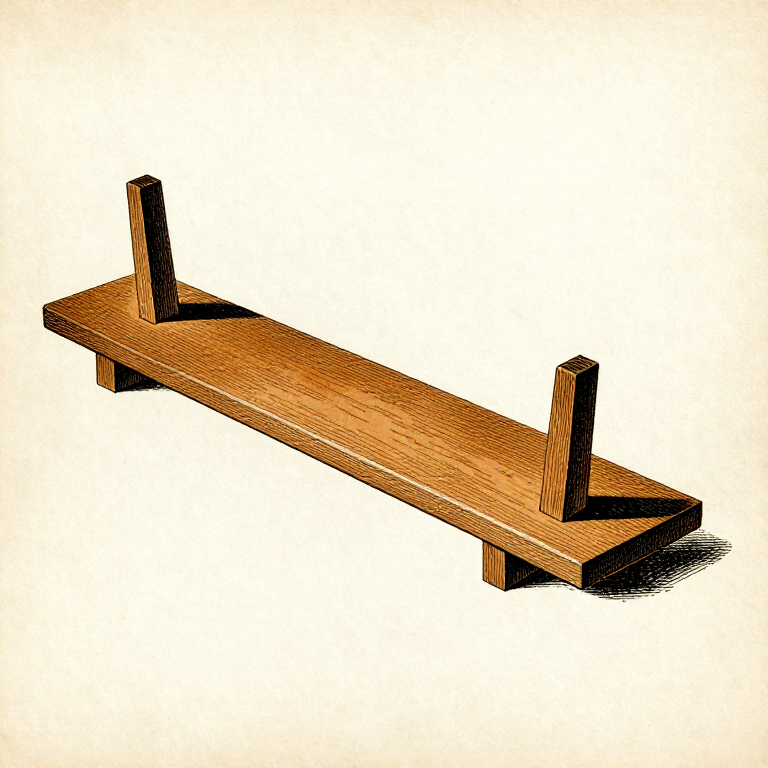


Twist, Cup and Bow: Winding Sticks Make the Invisible Obvious
A board can be out of true in three separate ways, and they need three different tests. BOW is a curve along its length, CUP is a curve across its width, and TWIST — wind — is the two ends being in different planes.
Twist is the one that matters most and the one you cannot see. A board can look perfectly flat, sit on the bench without rocking, and still be twisted enough to make a door that will not close.
Winding sticks solve it with no measurement at all: two straight battens and your eye, amplifying a fraction of a millimetre into something unmistakable.
中級者
3 hours
手順
1
1
Bow and cup: a straightedge finds both
Bow and cup: a straightedge finds both
Lay a straightedge along the length of the board and look for light under it: that is BOW. Lay it across the width and do the same: that is CUP.
Check in several places along and across, because a board is rarely uniform. Cup usually goes the same way on a flat-sawn board — away from the heart of the tree — which is why boards are often alternated in a glued panel.
Both are straightforward to see and straightforward to plane out, and both cost thickness. Take the measurement before deciding the finished thickness, or you will find the board is thinner than the design needs after truing it.
このステップの材料:
 堅木の板1 個
必要な工具:
 直定規
直定規 定規
定規 台鉋
台鉋2
2
Winding sticks: how the trick actually works
Winding sticks: how the trick actually works
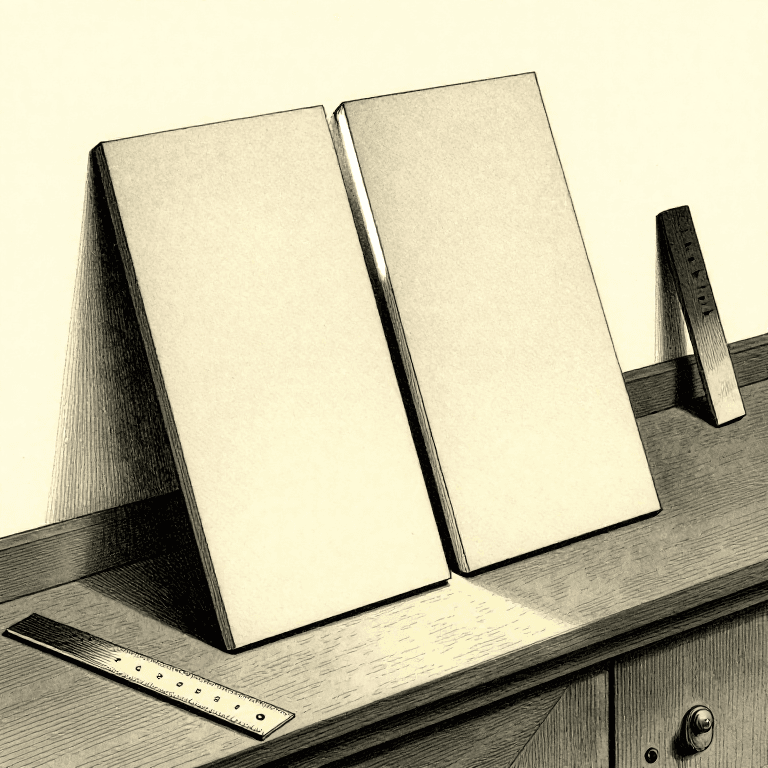
Stand one stick across the board at each end and sight across their top edges from a low angle. If the board is flat, the two top edges line up as a single line. If it is twisted, one stick appears tilted relative to the other.
The sticks amplify. They are much wider than the board is thick, so an end-to-end twist of a fraction of a millimetre becomes a visible several-millimetre offset between the two far corners — a difference you can see easily and could never feel.
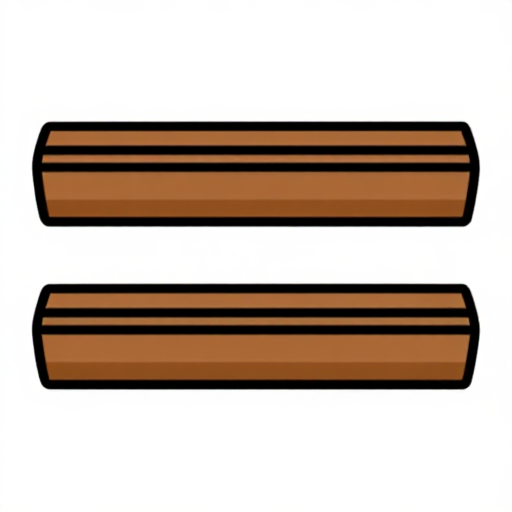
Make them from any straight stable stock, in a matched pair, dead parallel along their length. A dark inlay or a painted stripe along the top edge of one makes the sighting much easier, which is why traditional pairs have contrasting inlays.
このステップの材料:
堅木の板2 個必要な工具:
 捻れ確認用定規対直定規
3
3
How much a small twist actually costs
How much a small twist actually costs
Jupyter ノートブックを読み込み中…
必要な工具:
捻れ確認用定規対 計算機
計算機4
4
Take the high corners down, and re-check constantly
Take the high corners down, and re-check constantly
Twist is removed by planing the two diagonally opposite HIGH corners down until the sticks read parallel. Mark the high corners in pencil while the sticks are still in place so you know which they are once you pick up the plane.
Work diagonally across the board rather than along it — the high corners are on a diagonal, so that is the direction the shavings need to come from. Check again every few strokes. It is easy to overshoot and put a twist the other way in.
Then re-check with the straightedge for bow and cup, because removing twist changes them. True the face completely before touching the edge; a face that goes out of true afterwards takes the edge's squareness with it.
このステップの材料:
堅木の板1 個必要な工具:
捻れ確認用定規対台鉋直定規関連ブループリント
これらのブループリントは知識を共有しています — 技術、材料、原理
CC0 パブリックドメイン
このブループリントはCC0で公開されています。許可を求めずに、自由にコピー、修正、配布、あらゆる目的で使用できます。
メイカーを応援するには、ブループリント経由で製品を購入してください。メイカーには メイカーコミッション がベンダーにより設定されています。または、このブループリントの新しいイテレーションを作成し、自分のブループリントにコネクションとして含めて収益を共有できます。