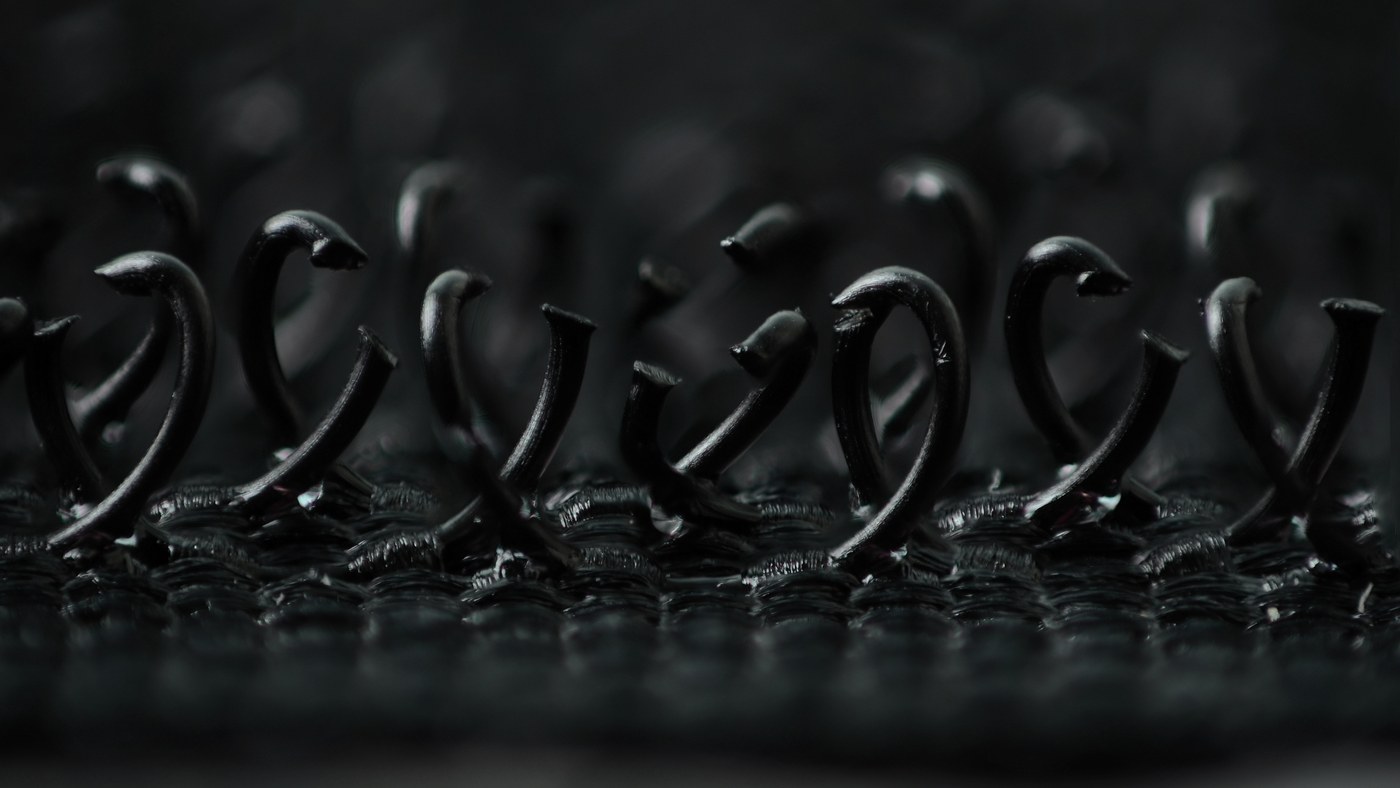


Velcro Hook-and-Loop
George de Mestral came back from a walk in the Alps in 1941 with burdock burrs stuck to his trousers and his dog. Instead of picking them off, he put one under a microscope — and found that each spine ends in a tiny hook, and that the hooks had caught in the loops of the woven cloth.
The fastener that follows is a distributed one. No single hook holds much; a few thousand per square centimetre hold a great deal. Because each engagement is independent, the closure has no discrete parts to align, no correct position, and no single point of failure — and it can be peeled open one row at a time with almost no force.
The patent is filed under a textile title, "Velvet type fabric and method of producing same" — US Patent 2,717,437, granted 13 September 1955. The name is velours plus crochet: velvet hook.
手順
Start where de Mestral started: look at a burr
Start where de Mestral started: look at a burr
Find a burdock or goosegrass burr and examine it under magnification. Every spine ends in a hook — the seed dispersal mechanism is the invention, already finished.
必要な工具:
 虫眼鏡
虫眼鏡Read US 2,717,437 and note its category
Read US 2,717,437 and note its category
It is filed as a VELVET FABRIC patent. De Mestral had to invent a weaving process, not just a fastener — the manufacturing is most of the document.
Examine the cloth the burr caught on
Examine the cloth the burr caught on
Look at a woollen or looped fabric under the same magnifier. It is a field of loops. The burr did not invent hooks alone — it exploited a surface that was already loops.
Weave a pile fabric with raised loops
Weave a pile fabric with raised loops
Weave a ground cloth with extra warp threads lifted over rods to leave standing loops. Pull the rods out and you have a loop pile — this is the LOOP half.
このステップの材料:
 木綿糸100 メートル
Keep the loop height uniform
Keep the loop height uniform
Use rods of one diameter throughout. Uneven loops mean only the tall ones ever engage, and you lose most of your fastening area.
必要な工具:
 定規
定規Weave a second panel from a stiff synthetic thread
Weave a second panel from a stiff synthetic thread
Make an identical loop pile in nylon rather than cotton. Cotton loops will not hold a hook shape — the material must have elastic memory.
このステップの材料:
 ナイロン糸100 メートル
Heat-set the nylon loops
Heat-set the nylon loops
Warm the nylon panel so the loops take a permanent set. De Mestral found that nylon woven under infrared held its shape — this step is why the hooks survive use.
Cut every loop on ONE side only
Cut every loop on ONE side only
Shear across the top of the nylon loops. Each cut loop springs into a hook. Cutting the loops is the whole manufacturing trick, and it took de Mestral years to mechanise.
必要な工具:
 クラフトナイフ
Check the cut height carefully
Check the cut height carefully
Cut too low and you get stubs that cannot hook; too high and you get long loops that pull straight out. There is a narrow correct height.
Press the two panels together and pull straight apart
Press the two panels together and pull straight apart
Engage them and pull perpendicular to the surface. It resists strongly — thousands of hooks share the load, and all of them must be straightened at once.
Now peel it from one corner instead
Now peel it from one corner instead
Lift a corner and peel. It opens easily. Peel loads one row at a time; shear loads every hook together — a factor of many between the two, from geometry alone.
Measure both strengths and record the ratio
Measure both strengths and record the ratio
Hang weights to find peel and shear strength for the same patch. That ratio is why hook-and-loop straps are designed to be loaded in shear and opened by peel.
Cycle it a hundred times and inspect
Cycle it a hundred times and inspect
Engage and peel repeatedly, then look under magnification. Hooks straighten out and loops break — the fastener degrades gradually rather than failing suddenly.
Contaminate it deliberately with lint and hair
Contaminate it deliberately with lint and hair
Rub debris into the loop side and re-test. Strength collapses. The loop field is an excellent filter, and that is the fastener's real-world failure mode.
Compendium — a fastener with no correct position
Compendium — a fastener with no correct position
The patent. US 2,717,437, "Velvet type fabric and method of producing same", granted 13 September 1955 to George de Mestral, a Swiss engineer. He had the idea in 1941 after a hunting trip in the Jura and spent roughly a decade getting from observation to manufacture. The name is a portmanteau of the French velours and crochet. Note the patent's framing: the problem he actually had to solve was how to WEAVE the thing at scale, which is why it is filed as a fabric patent rather than a fastener one.
Why nylon and not cotton. A hook must be stiff enough to hold shape under load and elastic enough to spring back after being straightened during peel. Natural fibres deform permanently. Nylon, heat-set, has the elastic memory to do this thousands of times, and de Mestral's discovery that nylon woven under infrared light held its hook form is the enabling material fact. It is a good example of an idea from nature that had to wait for a synthetic material before it could be built.
Peel versus shear is the design rule. Loaded in shear, every engaged hook resists simultaneously, and the total is large. Loaded in peel, the force concentrates on the leading row and each hook releases in turn, so the closure opens with modest effort. The ratio between the two is often an order of magnitude or more. This is why properly designed hook-and-loop straps are arranged to carry load in shear and to be opened by peeling a tab — and why a strap loaded in peel feels disappointingly weak.
The distributed-fastener advantage, and its cost. There is no alignment, no correct position, no discrete parts, and no single failure point — any overlap fastens, and losing individual hooks barely matters. It is fast, one-handed, and usable by people who cannot manage buttons or laces, which is why it appears on medical, children's and adaptive clothing. The costs are equally structural: it is noisy, it degrades with cycling as hooks straighten, and it collects lint, hair and grit that block the loops. NASA's extensive use aboard spacecraft is real, and the frequently repeated claim that NASA invented it is not — the patent predates the space programme.
この設計図で作るもの
関連ブループリント
これらのブループリントは知識を共有しています — 技術、材料、原理

CC0 パブリックドメイン
このブループリントはCC0で公開されています。許可を求めずに、自由にコピー、修正、配布、あらゆる目的で使用できます。
メイカーを応援するには、ブループリント経由で製品を購入してください。メイカーには メイカーコミッション がベンダーにより設定されています。または、このブループリントの新しいイテレーションを作成し、自分のブループリントにコネクションとして含めて収益を共有できます。