SANAA
UREMBO NA USTAWI
UJANJA
UTAMADUNI NA HISTORIA
BURUDANI
MAZINGIRA
CHAKULA NA VINYWAJI
UHANDISI WA KINYUME
SAYANSI
MICHEZO
TEKNOLOJIA
VAZI
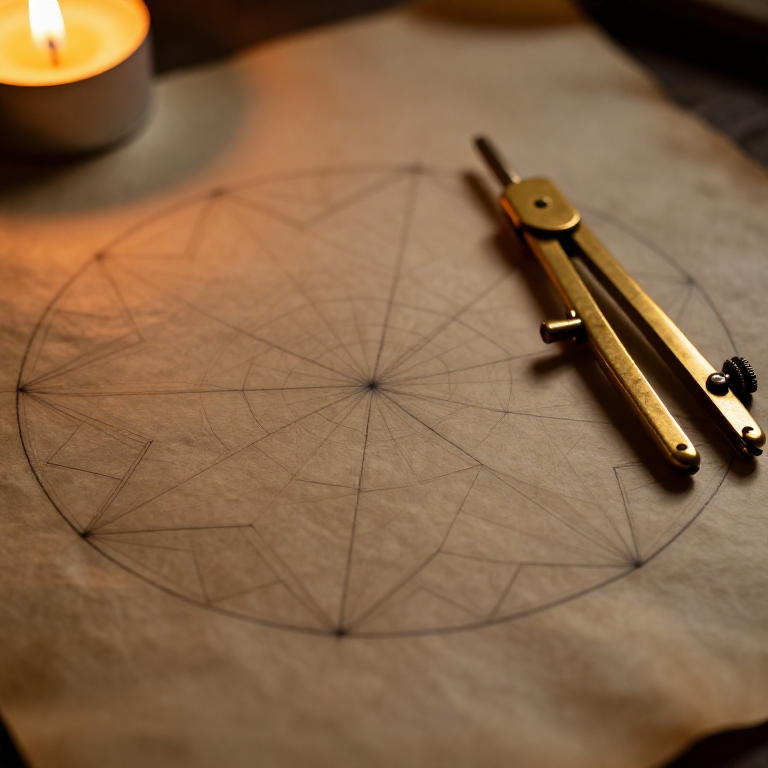


Measuring Pi — Archimedes' Method of Squeezing a Circle Between Polygons
Pi is the ratio of any circle's circumference to its diameter — the same number for every circle. You can measure it roughly with a string, but around 250 BC Archimedes found it exactly, with no measuring at all. He trapped a circle between a polygon drawn just inside it and one just outside, then doubled the sides again and again until the two polygons closed in on the circle from both directions. With 96-sided polygons he proved pi lies between 3+10/71 and 3+1/7. This blueprint walks through both the string measurement and Archimedes' rigorous squeeze.
Kati
30 minutes
Maagizo
1
1
Understand what pi is
Understand what pi is
Pi is the ratio of a circle's circumference (the distance around) to its diameter (the distance across). It is the same for every circle, large or small. Its value begins 3.14159… and never ends or repeats.
2
2
Measure pi with a string
Measure pi with a string
Wrap a cord snugly around a round object and mark its circumference, then measure straight across for the diameter. Divide circumference by diameter — you will get about 3.14. Try several sizes; the ratio stays the same every time.
Zana zinazohitajika:
 Uzi wa Pamba wa Jikoni
 Tepi ya kupimia
3
3
See the limit of measuring
See the limit of measuring
A cord and ruler give only two or three good digits — small measuring errors spoil the rest. To pin pi down exactly you need geometry, not string. This is the leap Archimedes made.
4
4
Trap the circle between two polygons
Trap the circle between two polygons
Draw a circle, then a regular polygon just inside touching it and another just outside enclosing it. The circle's circumference must lie between the two polygon perimeters — smaller than the outer, larger than the inner.
Zana zinazohitajika:
 Ubao wa Mti Mgumu
 Kamba ya kupiga mstari
5
5
Start with hexagons
Start with hexagons
Begin with six-sided polygons — the easiest to draw, since a hexagon's side equals the circle's radius. Their perimeters already bracket pi between 3 and about 3.46. Good, but still loose.
6
6
Keep doubling the sides
Keep doubling the sides
Double the sides: 6 to 12 to 24 to 48 to 96. Each doubling makes both polygons hug the circle more closely, so the inner and outer perimeters squeeze together and the gap that must contain pi shrinks.
7
7
Reach Archimedes' bounds
Reach Archimedes' bounds
At 96 sides Archimedes proved pi is greater than 3+10/71 (about 3.1408) and less than 3+1/7 (about 3.1429). The true value 3.14159… sits right in that gap — found by pure reasoning, with no ruler touching the circle.
8
8
Go as far as you like
Go as far as you like
The doubling never stops: more sides give more digits of pi, as many as your patience allows. Archimedes' squeeze was the best method known for almost two thousand years, until calculus offered faster ones.
Zana Zinazohitajika
4- Kishikilia Nafasi
- 1 vendor sell this, none ship to you yetKishikilia Nafasi
- Kishikilia Nafasi
- Kishikilia Nafasi
Blueprint zinazohusiana
Blueprint hizi zinashiriki maarifa — mbinu, vifaa au kanuni

CC0 Umma Wote
Mchoro huu umetolewa chini ya CC0. Uko huru kunakili, kubadilisha, kusambaza, na kutumia kazi hii kwa madhumuni yoyote, bila kuomba ruhusa.
Saidia Mtengenezaji kwa kununua bidhaa kupitia Mchoro wao ambapo wanapata Kamisheni ya Mtengenezaji iliyowekwa na Wachuuzi, au unda marudio mapya ya Mchoro huu na uiunganishe kama kiungo katika Mchoro wako kuchangia mapato.