

The Berserker's Fly Agaric — How Amanita muscaria May Have Fuelled Viking Battle Rage
The Viking berserkers (Old Norse 'berserkir' — bear-shirts) were elite warriors infamous for fighting in a trance-like fury, seemingly impervious to pain and fear. Snorri Sturluson's 13th-century Ynglinga Saga describes them: 'They went without armour, were as mad as dogs or wolves, bit their shields, were as strong as bears or bulls. They killed men, but neither fire nor iron could hurt them.' The sagas describe them foaming at the mouth, howling, and trembling before battle — then attacking with inhuman ferocity.
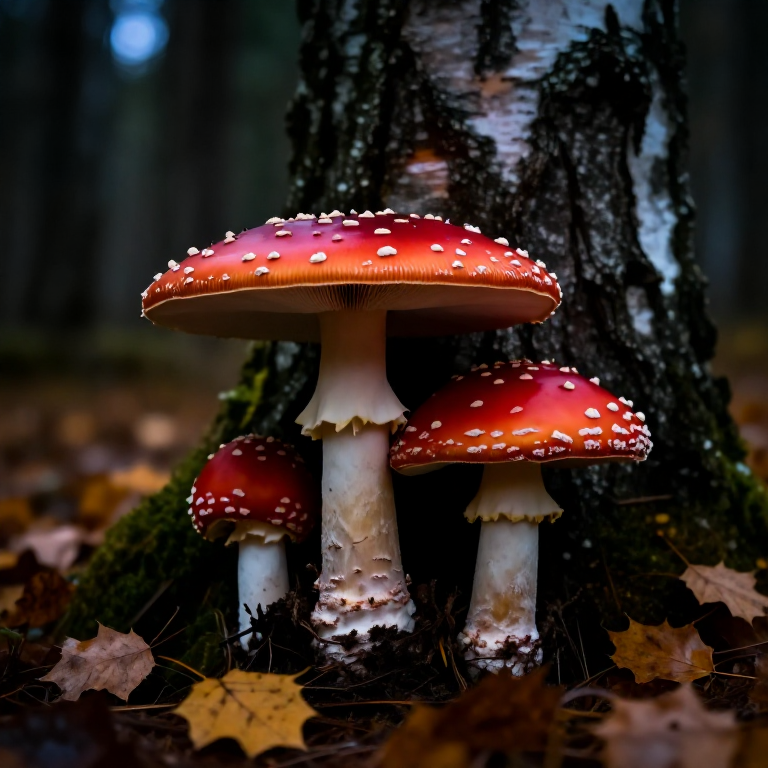
In 1784, Swedish ethnobotanist Samuel Ödmann proposed that berserkers achieved this state by consuming Amanita muscaria — the fly agaric mushroom (Norwegian: fluesopp). This iconic red-capped mushroom with white spots contains muscimol and ibotenic acid, psychoactive compounds that cause euphoria, distorted perception of size and strength, reduced pain sensitivity, involuntary muscle twitching, profuse sweating, and — critically — foaming at the mouth. The match between muscimol's pharmacological effects and the saga descriptions is striking.
But the berserker lifestyle carried a cost that swords and axes could not explain. Amanita muscaria is hepatotoxic — ibotenic acid damages liver cells with repeated exposure. A warrior who regularly consumed fly agaric before battle would develop progressive liver damage: jaundice, abdominal swelling, confusion, and eventually liver failure. The berserkers' legendary short lifespans may owe as much to mushroom-induced cirrhosis as to the hazards of charging into shield walls wearing nothing but animal skins.
Maagizo
Identifying Amanita muscaria in Scandinavian forests
Identifying Amanita muscaria in Scandinavian forests
Amanita muscaria (fly agaric) is unmistakable: a bright red to orange-red cap 8-20 cm across, covered with white to yellowish wart-like remnants of the universal veil. The gills are white and free (not attached to the stem). The stem is white, 10-20 cm tall, with a prominent ring (annulus) and a bulbous base surrounded by concentric rings of white volva remnants. It fruits in late summer and autumn under birch, pine, and spruce trees across all of Scandinavia.
The mushroom was common in the birch forests of Norway, Sweden, and Denmark during the Viking Age (793-1066 AD). Its psychoactive properties were well known to Sámi shamans (noaidi), who used it in ritual contexts. The Norse name 'berserkjasveppur' (berserker mushroom) persists in Icelandic, directly linking the fungus to the warrior tradition. WARNING: Amanita muscaria is toxic. This blueprint documents historical use for educational purposes only.
The chemistry of madness — muscimol and ibotenic acid
The chemistry of madness — muscimol and ibotenic acid
Amanita muscaria contains two primary psychoactive compounds: ibotenic acid and muscimol. Ibotenic acid is a potent glutamate receptor agonist — it overstimulates the same excitatory neurotransmitter system that MSG activates, but at vastly higher intensity. In the body, ibotenic acid is partially converted to muscimol through decarboxylation (loss of a CO₂ group).
Muscimol is a GABA-A receptor agonist — it mimics the brain's primary inhibitory neurotransmitter but in an abnormal pattern, producing a paradoxical combination of sedation and excitation: euphoria, visual distortions (objects appear larger or smaller than reality — macropsia/micropsia), reduced pain perception, involuntary muscle contractions, profuse sweating, and the characteristic foaming at the mouth caused by excessive salivation combined with muscular jaw clenching.
Historical preparation methods
Historical preparation methods
Norse and Sámi sources describe several preparation methods. The simplest was eating dried caps — drying converts ibotenic acid to the more potent muscimol, making dried mushrooms 5-10 times stronger per weight than fresh ones. Some accounts describe soaking dried caps in mead or water to create a psychoactive drink consumed before battle or ritual.
The most remarkable aspect of Amanita muscaria pharmacology is that muscimol passes through the kidneys largely unchanged — the urine of someone who has consumed the mushroom is itself psychoactive. Sámi and Siberian accounts describe recycling the active compounds by drinking the urine of an intoxicated person, sometimes through multiple 'passes.' This is not myth — muscimol is genuinely excreted in active form, and urine recycling is documented by multiple independent ethnographic sources across northern Eurasia.
The berserker state — matching symptoms to pharmacology
The berserker state — matching symptoms to pharmacology
The saga descriptions of berserker behaviour align remarkably well with muscimol intoxication. 'Foaming at the mouth' — muscimol causes hypersalivation combined with jaw muscle spasms, producing visible foam. 'Trembling and shaking before battle' — muscimol causes involuntary muscle fasciculations (twitching). 'Impervious to pain' — muscimol's GABA agonism suppresses pain signaling. 'Mad as dogs or wolves' — muscimol produces delirium and loss of normal social inhibition.
The 'berserkergang' (berserker fury) typically lasted 1-2 hours, after which the warrior would collapse into exhaustion and sleep for an extended period — consistent with muscimol's 2-3 hour peak duration followed by prolonged sedation. The post-battle collapse was so severe that berserkers were reportedly helpless and had to be protected by their companions — a dangerous vulnerability that made the berserker strategy high-risk regardless of its battlefield effectiveness.
The liver pays the price — chronic hepatotoxicity
The liver pays the price — chronic hepatotoxicity
Here is what the sagas do not celebrate: the cumulative organ damage from repeated Amanita muscaria consumption. Ibotenic acid is a confirmed hepatotoxin — it damages liver cells (hepatocytes) through excitotoxic mechanisms similar to its effect on neurons. A single large dose can cause acute hepatitis. Repeated exposure causes progressive fibrosis, as the liver attempts to repair damage with scar tissue rather than functional cells.
A berserker who consumed fly agaric before every significant battle — perhaps 5-15 times per year over a fighting career of 10-20 years — would accumulate substantial liver damage. Symptoms of advancing liver disease include jaundice (yellowing skin and eyes), ascites (abdominal fluid swelling), easy bruising and bleeding, confusion and personality changes (hepatic encephalopathy), and eventually liver failure. The berserker's legendary short lifespan may have owed as much to cirrhosis as to combat injuries.
Alternative theories and scholarly debate
Alternative theories and scholarly debate
The fly agaric theory, while compelling, is not universally accepted. Ethnobotanist Karsten Fatur (2019) proposed henbane (Hyoscyamus niger) as an alternative — henbane contains tropane alkaloids (scopolamine, hyoscyamine) that produce aggressive delirium, pain insensitivity, and amnesia, and it was widely available in Viking-age Scandinavia. Henbane seeds have been found in Viking archaeological contexts.
Other scholars argue that no drug is necessary: extreme psychological conditioning, sleep deprivation, alcohol, and the social expectation of berserker behaviour may have been sufficient to produce the described state. Modern combat psychology recognizes that extreme stress and group dynamics can produce dissociative states, pain suppression, and aggressive fury without any chemical input. The truth may involve all of these factors — mushrooms, henbane, alcohol, and psychology — in varying combinations depending on the individual and the occasion.
The end of the berserkers — outlawed by their own society
The end of the berserkers — outlawed by their own society
Berserkers were ultimately banned by Norse society itself. Iceland's Grágás laws (early 12th century) made 'going berserk' a criminal offense punishable by lesser outlawry (three years' exile). The Norwegian Gulathing Law similarly outlawed berserker behaviour. By the time Christianity became established in Scandinavia (11th-12th century), berserkers had transitioned in the sagas from celebrated heroes to dangerous, unpredictable villains — men who could not be trusted in civilized society.
The prohibition suggests that berserker fury was not just a battlefield tactic but a social problem — men who had trained (and perhaps chemically conditioned) themselves for uncontrollable violence could not simply switch it off in peacetime. The combination of psychoactive substance use, psychological conditioning for violence, and progressive brain damage from both the drugs and repeated head trauma made berserkers dangerous to their own communities. The warrior elite that had terrorized Europe became, in the end, too dangerous to tolerate even at home.
Blueprint zinazohusiana
Blueprint hizi zinashiriki maarifa — mbinu, vifaa au kanuni
CC0 Umma Wote
Mchoro huu umetolewa chini ya CC0. Uko huru kunakili, kubadilisha, kusambaza, na kutumia kazi hii kwa madhumuni yoyote, bila kuomba ruhusa.
Saidia Mtengenezaji kwa kununua bidhaa kupitia Mchoro wao ambapo wanapata Kamisheni ya Mtengenezaji iliyowekwa na Wachuuzi, au unda marudio mapya ya Mchoro huu na uiunganishe kama kiungo katika Mchoro wako kuchangia mapato.