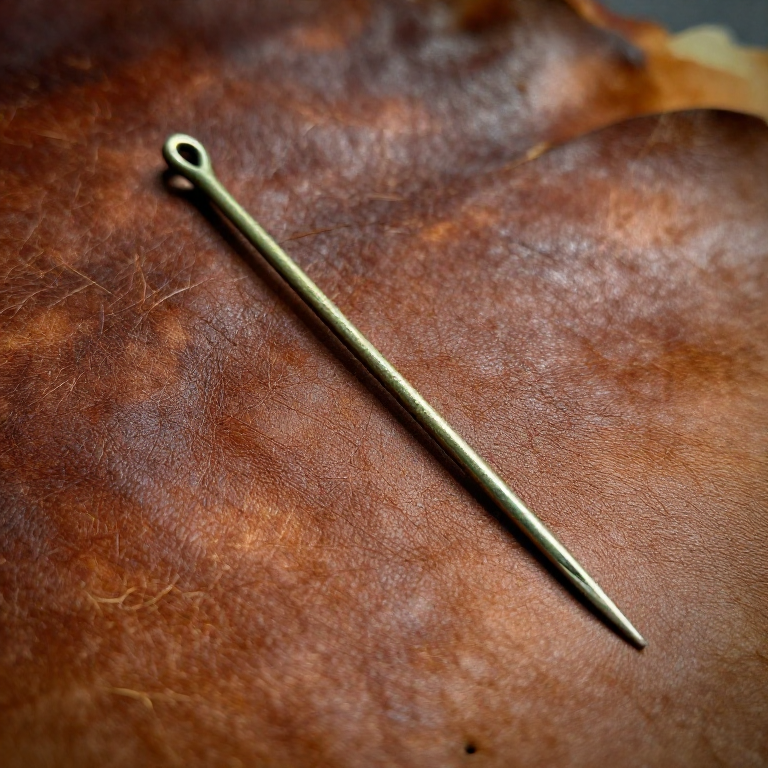


Making a Bronze Needle — Drawing and Hammering Fine Wire
The bronze needle was one of the smallest yet most transformative tools of the Bronze Age. It made possible fitted clothing, leather working, sail-making, and surgical suturing — tasks that bone needles could perform but bronze needles did faster, finer, and without breaking.
Unlike larger tools that are cast in moulds, a needle is too thin to cast directly. Instead, a short bronze rod is hammered and drawn into a taper, then the eye is punched through with a fine pointed tool. The entire process relies on repeated cycles of cold-hammering (to shape and harden) and annealing (heating to soften for further working).
A well-made bronze needle is 6-10 cm long, about 2 mm in diameter at the thickest point, tapers to a sharp point, and has an eye large enough to thread sinew or flax fibre.
Instructions
Cast a small bronze rod
Cast a small bronze rod
Materials for this step:
 Bamba la Shaba27 g
Hammer the rod to initial taper
Hammer the rod to initial taper
Tools needed:
 Jiwe la kugongea
 Bamba bapa la jiwe
Anneal to restore workability
Anneal to restore workability
Materials for this step:
 Mkaa500 g
Continue hammering to needle dimensions
Continue hammering to needle dimensions
Form the eye end
Form the eye end
Punch the eye
Punch the eye
Sharpen the point
Sharpen the point
Tools needed:
 Jiwe la kunoa
Polish and final work-hardening
Polish and final work-hardening
Tools Required
3- Placeholder
- Placeholder
- Placeholder
Connected Blueprint Materials
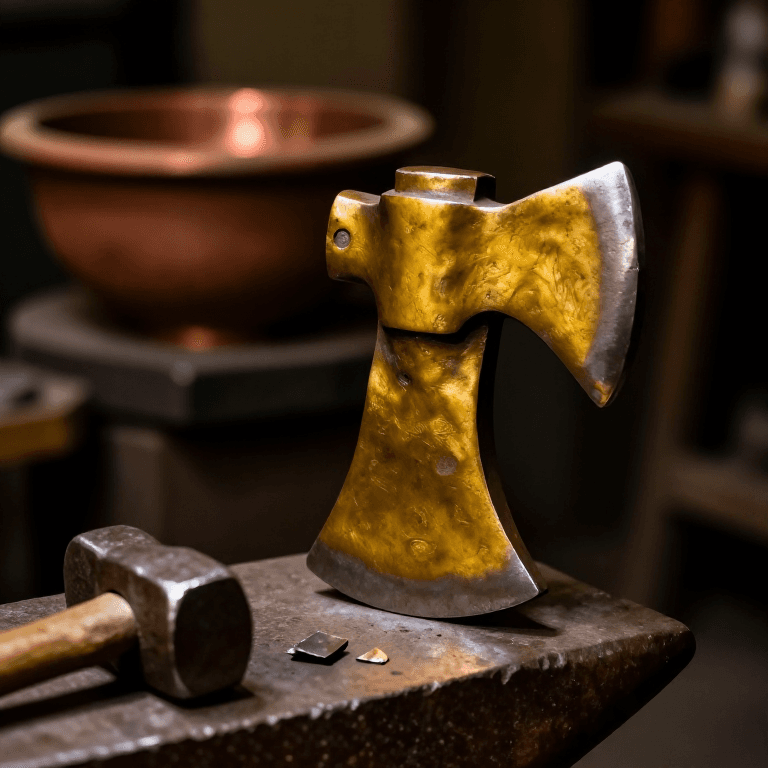
This blueprint makes
Related Blueprints
These blueprints share knowledge with this one — techniques, materials, or principles that connect them in the learning graph.
CC0 Public Domain
This blueprint is released under CC0. You are free to copy, modify, distribute, and use this work for any purpose, without asking permission.
Support the Maker by purchasing products through their Blueprint where they earn a Maker Commission set by Vendors, or create a new iteration of this Blueprint and include it as a connection in your own Blueprint to share revenue.