

Building a Persian Windmill — The First Machine Powered by Wind
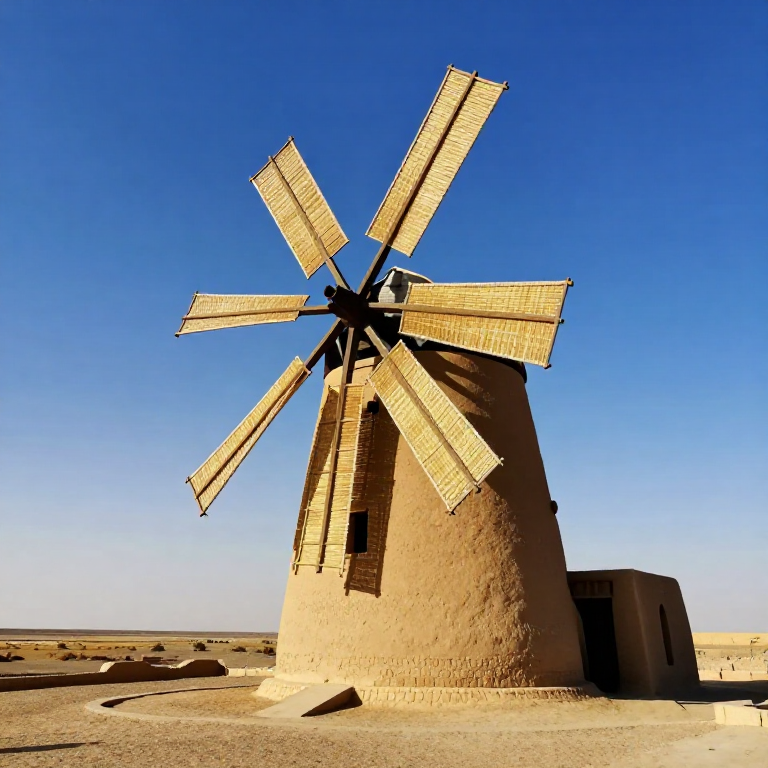
The Persian windmill (Arabic: طاحونة هوائية, Ṭāḥūnat hawāʾīya) is the earliest confirmed wind-powered machine in history, developed in the Sistan region of eastern Persia (modern Iran-Afghanistan border) around the 7th century CE, with the first clear written reference in a document from 644 CE describing the assassination of Caliph Umar — his assailant was reportedly a Persian slave who was an expert in windmill-making. The windmill was already mature technology by this date, suggesting its invention was several generations earlier.
The Persian design is a vertical-axis windmill (VAWM) — its rotating shaft is vertical, unlike the European horizontal-axis windmill that would not appear until the 12th century CE in northwestern Europe. The sails are mounted vertically on the vertical shaft inside a walled enclosure. One side of the enclosure has a large opening facing the prevailing wind direction (in Sistan, the 'Wind of 120 Days', a remarkably consistent northerly wind that blows from June through September). Wind enters the opening, strikes the exposed sails, and pushes them around the vertical axis. The wall of the enclosure blocks wind from pushing the returning sails in the opposite direction — without the windbreak wall, wind would push the sails equally from both sides and the rotor would not turn.
The vertical shaft drives a millstone directly below the rotor — no gearing is required, unlike the horizontal European windmill which needs a right-angle gear to transfer horizontal-shaft rotation to the vertical millstone drive. This simplicity is both the Persian windmill's strength (easy to build and maintain) and its limitation (the rotor speed cannot be optimised for the millstone speed independently). Sistan's grain was ground almost entirely by windmill power for over a thousand years — the 10th century Persian geographer al-Istakhri described the region as dependent on windmills in the same way Egypt was dependent on the Nile. The windmills of Nashtifan, Iran, are still operating today after perhaps 1,000 years of continuous service, making them the oldest functioning wind-powered machines in the world.
Maagizo
Survey the wind resource and site the windmill
Survey the wind resource and site the windmill
The Persian windmill only functions at a site with a consistent, strong, prevailing wind from one direction for a significant portion of the year. The Sistan design was optimised for the 'Wind of 120 Days' — the shamal, a persistent northerly that blows from June through September with average speeds of 8–12 m/s (Beaufort scale 5–6). Such winds are found in arid continental regions: steppes, high plateaux, desert margins, and exposed coastal headlands. A site with variable wind from multiple directions provides much less energy to a vertical-axis windmill with a fixed opening than a site with a dominant prevailing wind.
To assess wind suitability: observe a light flag or strip of cloth tied to a pole at the intended site location for four weeks, noting the dominant orientation on each day. If the flag points consistently in the same direction for 60% or more of the observation days, the site has sufficient prevailing wind for a Persian windmill. The opening of the windmill enclosure must face this prevailing wind direction. Avoid sites with significant turbulence — strong gusts from variable directions — which damage vertical-axis rotor sail frames.
Lay out and build the mud-brick enclosure foundation
Lay out and build the mud-brick enclosure foundation
The enclosure is a roughly square or rectangular walled structure with a large opening on the windward side. For a millstone approximately 80 cm in diameter, the enclosure interior should be approximately 3 m × 3 m to allow clearance for the sails to rotate. The walls should be at least 3 m tall (taller than the rotor) and approximately 50 cm thick — thick enough to withstand wind loading without cracking, and thick enough to provide good thermal mass that prevents the interior from overheating in the summer heat typical of Sistan.
Build the walls from sun-dried mud brick (adobe) — the traditional material of the Sistan plain. Mud brick is made by mixing clay-rich soil with straw (as fibre reinforcement), forming into rectangular blocks approximately 25 × 12 × 7 cm, and drying in the sun for 2–3 weeks. Lay the bricks in courses with mud mortar. The windward wall (the one with the opening) should be built first and must be the most strongly built — it receives the direct wind load and must resist being pushed inward. Leave the large rectangular opening in the windward wall as you build: approximately 2 m wide × 2.5 m tall, centred on the wall and directly facing the prevailing wind direction.
Zana zinazohitajika:
 Sepetu
Install the vertical shaft bearing in the floor and roof
Install the vertical shaft bearing in the floor and roof
The vertical shaft rotates on two bearings: a lower pivot bearing set into the enclosure floor and an upper bearing (or guide ring) set into the roof or an upper beam spanning the enclosure. The lower bearing carries the full weight of the shaft, rotor, and millstone — it is the critical bearing. In traditional Sistan windmills, the lower bearing is a hardwood block (or stone socket) with a hemispherical depression that accepts the rounded bottom of the shaft. The shaft's pointed or rounded lower end rotates in this depression — it is a simple thrust bearing, relying on the smoothness of the bearing surfaces and lubrication (tallow or olive oil) to reduce friction.
Set the lower bearing block in the centre of the enclosure floor, embedded in a stone or masonry plinth so it cannot be displaced by the torque reaction from the millstone grinding resistance. The upper shaft guide (a ring or split bearing through which the shaft passes) is mounted on a horizontal beam crossing the top of the enclosure walls — it keeps the shaft vertical and resists lateral forces from uneven wind loading on the sails. Align the upper and lower bearings on a true vertical axis using a plumb bob: a shaft that runs off vertical puts cyclic lateral loads on both bearings with every revolution, accelerating wear.
Vifaa kwa hatua hii:
 Kipande cha mbao ngumu2 vipande
Zana zinazohitajika:
 Kamba ya Katani
Shape the vertical drive shaft
Shape the vertical drive shaft
The vertical shaft is the structural spine of the windmill — it connects the rotor above to the millstone drive below. Select a straight-grained hardwood log (oak, walnut, or any dense local hardwood) approximately 12–15 cm in diameter and 4 m tall. The shaft must be perfectly straight — any bow causes vibration at speed and accelerates bearing wear. Check straightness by rolling the log on a flat surface: a straight log rolls smoothly; a bowed log bounces with each revolution.
Shape the shaft to a consistent round cross-section along its length with a drawknife. The bottom end is shaped to a smooth hemisphere (the pivot point) — this must be smooth and hard, so select a piece of especially dense, close-grained heartwood for the bottom 10 cm, or cap the bottom with a hardwood insert of greater density than the shaft timber. The top of the shaft extends above the upper bearing and is fitted with mortised holes to receive the sail frame members. The section between upper and lower bearings is the working shaft — drill no holes, make no notches, and select the most defect-free timber section for this portion.
Vifaa kwa hatua hii:
Kipande cha mbao ngumu3 vipandeZana zinazohitajika:
 Msumeno wa mkono
 Kisu
KisuBuild the sail frames from lightweight wood
Build the sail frames from lightweight wood
The sails (in Sistan called 'badgir' panels) are rectangular frames of lightweight wood covered with woven reed mats or heavy cloth. Each sail frame is approximately 1 m wide × 2 m tall — the full working height of the rotor. Make the frame from split bamboo (if available), straight willow poles, or lightweight pine — the key property is light weight and adequate stiffness. Heavy sail frames require more wind force to accelerate from rest and produce more centrifugal stress on the shaft attachment points.
Persian windmills typically had 6–8 sails arranged symmetrically around the shaft. Build a radial arm structure: cut 6–8 radial arms of equal length (1.2 m, slightly longer than the sail width to provide lashing clearance) and mortise them into horizontal holes in the shaft at two heights — 0.5 m above the enclosure floor and 2 m above the floor. The radial arms at each height form the horizontal spokes from which the vertical sail frames are suspended. Lash the sail frame sides to the radial arms at top and bottom with hemp cord — use double lashings and check that all six sail frames are at the same radial distance from the shaft.
Vifaa kwa hatua hii:
Kipande cha mbao ngumu2 vipandeKamba ya Katani30 mitaWeave and attach the reed mat sail covering
Weave and attach the reed mat sail covering
The traditional Sistan sail covering is woven from locally abundant Phragmites australis (common reed), woven into mats approximately 2 cm thick. The weave should be tight enough to be nearly impermeable to wind — sail efficiency depends on the wind pushing the sail surface, not flowing through it. A loose weave allows 30–40% of wind energy to pass through rather than imparting force, dramatically reducing rotor torque. In historical Sistan, weavers produced the sail mats as a specialised product for the windmill industry, with their quality (tightness and uniformity of weave) directly affecting the miller's output.
If reed mats are not available, heavy woven cloth (sailcloth or burlap) lashed to the sail frame works equally well. Lash the mat or cloth to the sail frame using hemp cord threaded through grommets (eyelets of twisted grass or leather) in the sail material at 15 cm spacing around all four edges. Pull the lashings firm but not tight enough to distort the frame — an over-tensioned sail covering bows the lightweight sail frame inward, reducing the projected wind-catching area and causing the sail to rotate forward under loading.
Vifaa kwa hatua hii:
Kamba ya Katani20 mitaConnect the vertical shaft to the millstone below
Connect the vertical shaft to the millstone below
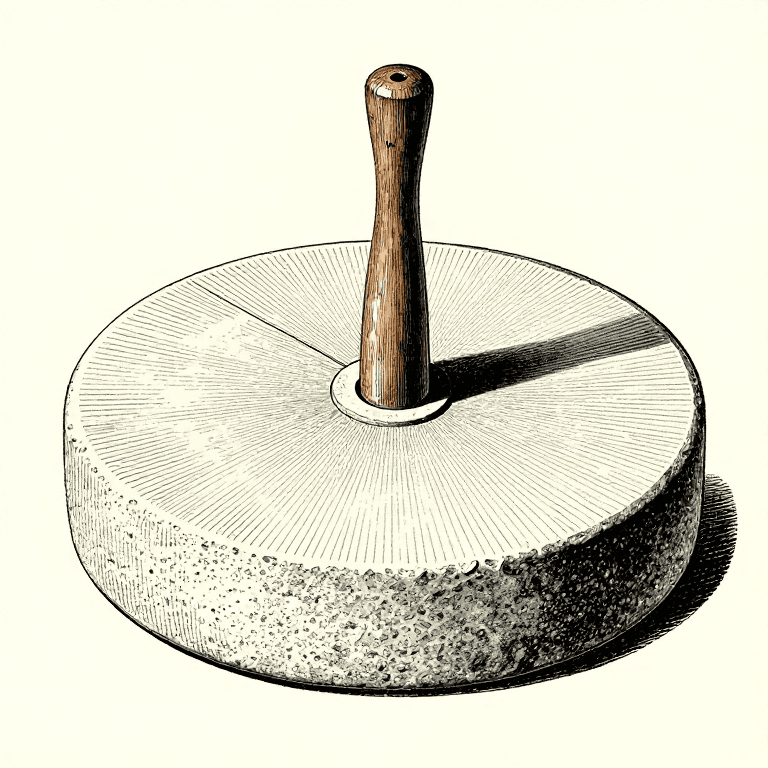
The vertical shaft passes through the lower bearing and continues below the enclosure floor into a lower milling chamber where the millstones are mounted. The shaft's lower end below the floor level is fitted with a horizontal cross-bar coupling (the rynd) that engages the upper runner millstone — the same coupling used in the horizontal water mill. The runner stone rotates with the shaft, grinding grain against the fixed bedstone below.
In the traditional Sistan design, the milling chamber is a separate room below and adjacent to the rotor enclosure — the miller works in the milling room while the rotor turns above, connected through the shaft passing through the dividing floor. The millstone pair (runner and bed) are typically 60–90 cm in diameter for a small windmill, dressed with the standard radial furrow pattern. The stone gap and feed hopper are adjusted identically to a water mill — the only difference is the wind drives the shaft from above rather than water driving it from below.
Vifaa kwa hatua hii:
 Jiwe la Kusagia2 vipande
 Misumari ya Chuma20 vipande
Test the rotor balance before first wind operation
Test the rotor balance before first wind operation
Before exposing the assembled rotor to wind, test its balance. Mount the shaft in its bearings without the millstone connected, position the rotor in the enclosure, and rotate it slowly by hand. A balanced rotor decelerates uniformly after a hand-push and comes to rest with any sail at the bottom. An unbalanced rotor always comes to rest with the heaviest sail downward — indicating one or more sails are heavier than their opposites. Remove the heavier sail frames, reduce their weight (trim the covering, shave the frame members) until the rotor balances within acceptable tolerance.
An unbalanced rotor creates cyclic loads on the lower pivot bearing at every revolution — at 30 RPM (a moderate operating speed), this means 30 unbalanced impacts per minute, 1,800 per hour, and 43,200 per 24-hour day. Over a season of continuous operation, this cyclic impact fatigue fails the lower bearing at the pivot hemisphere and can crack the shaft at the lower attachment point. The traditional Sistan mills' remarkable longevity (the Nashtifan mills have been operating for centuries) is partly due to careful attention to sail balance during construction and the tradition of checking and correcting balance at each annual maintenance.
First wind run — observe and correct
First wind run — observe and correct
Open the enclosure fully on the windward side on a day with steady wind of 5–8 m/s (a fresh breeze — leaves in constant motion, small trees swaying). The rotor should begin turning within a few seconds. If the rotor does not turn in 5 m/s wind, the sail area is insufficient relative to the rotor inertia — increase the sail area by widening or raising the sail frames. If the rotor turns erratically (lurching and stopping), the wind is turbulent or the sail alignment has errors — some sails are not presenting their face perpendicular to the wind at the moment they pass the enclosure opening.
Check rotation direction: the rotor should turn so that the sails inside the enclosure (sheltered by the windward wall) are moving against the wind while the sails in the opening are receiving the full wind push. If it turns the wrong way, two sails that are symmetric about the centreline have been swapped — dismount and re-position them. Observe the lower bearing temperature after 10 minutes of operation: warm to the touch (30–40°C) is normal; hot enough to cause discomfort indicates insufficient lubrication — stop, re-lubricate, and restart.
Vifaa kwa hatua hii:
 Mkaa1 kg
Measure rotor speed and calculate grinding capacity
Measure rotor speed and calculate grinding capacity
Measure the rotor speed by counting revolutions over one minute (count the number of times a marked sail passes a fixed reference point). At 8 m/s wind speed, a well-built 6-sail Persian windmill with 1.2 m sail radius typically rotates at 20–40 RPM. Calculate the shaft power: wind power available = ½ × ρ × A × v³, where ρ = air density (1.2 kg/m³ at sea level), A = swept area of the opening (2 m × 2.5 m = 5 m²), v = wind speed 8 m/s. Available wind power = ½ × 1.2 × 5 × 512 = 1,536 W. A vertical-axis windmill extracts approximately 10–15% of this (compared to 35–45% for a modern horizontal-axis turbine) = 150–230 W of mechanical shaft power.
Grinding capacity at 150–230 W and 30 RPM: a pair of 80 cm millstones at 30 RPM grinds approximately 5–8 kg of grain per hour. This is less than the Roman undershot water wheel (150–200 kg/hour) but equivalent to the output of 3–5 people grinding by hand with quern stones, and the windmill runs continuously without human labour. The Sistan windmills supplied grain for communities of 100–200 people during the 120-day wind season, grinding the annual grain supply in four months of automated wind-powered operation.
Storm protection — reducing sail area in high winds
Storm protection — reducing sail area in high winds
The Persian windmill's greatest vulnerability is over-speed in storm winds. Above approximately 15 m/s (strong gale), the rotor accelerates beyond the millstone grinding capacity to control it, and centrifugal forces can tear the sails from their lashings, crack the sail frames, or — in extreme cases — split the vertical shaft from the torque. Traditional Sistan practice handles this by partially closing the windward opening with a wooden shutter or screen that can be lowered to reduce the wind inlet area and control rotor speed.
Install a hinged wooden shutter inside the windward opening that can be partially closed (lowered) to reduce effective wind area by 30–50% during strong gusts. Operate the shutter from a rope running to the milling chamber below so the miller can adjust without entering the rotor chamber. An alternative approach used by some Nashtifan-style mills is removable outer sail coverings — the reeds from some or all sail frames are pulled off and stored during storms, leaving bare frames that offer 80% less wind resistance than covered sails. Keep spare sail mats on hand for re-covering after storms pass.
Annual maintenance schedule for the Nashtifan tradition
Annual maintenance schedule for the Nashtifan tradition
The Nashtifan windmills have operated continuously for centuries because of a rigorous maintenance tradition passed from miller to miller. At the end of each 120-day wind season (September), the mill is shut down for inspection. The sail frames are removed from the shaft and each reed mat covering is inspected — mats with holes larger than a coin are re-woven or replaced. The salt-laden desert wind gradually deteriorates the reed fibres; plan to replace at least one-third of the sail coverings each year.
Inspect the lower pivot bearing for wear — measure the depth of the hemispherical depression annually and compare to the original dimension. If the depression has deepened by more than 5 mm, replace the bearing block with a new hardwood piece (or carve the worn block to a fresh surface if material remains). Re-dress the millstones at the start of each grinding season — the radial furrows wear smooth after 500–800 hours of grinding and must be re-cut with a mill bill. Re-lubricate all rotating surfaces (lower bearing, upper guide bearing, millstone rynd) with fresh tallow before restarting. A Persian windmill maintained to this schedule will provide reliable service for 50 years or more before the shaft or enclosure walls require major replacement.
Vifaa
5- 7 vipandeKishikilia Nafasi
- 50 mitaKishikilia Nafasi
- 2 vipandeKishikilia Nafasi
- 20 vipandeKishikilia Nafasi
- 1 kgKishikilia Nafasi
Zana Zinazohitajika
5- Kishikilia Nafasi
- Kishikilia Nafasi
- Kishikilia Nafasi
- Kishikilia Nafasi
- Kishikilia Nafasi
Vifaa vya Michoro Iliyounganishwa


Mchoro huu unatengeneza

Blueprint zinazohusiana
Blueprint hizi zinashiriki maarifa — mbinu, vifaa au kanuni

CC0 Umma Wote
Mchoro huu umetolewa chini ya CC0. Uko huru kunakili, kubadilisha, kusambaza, na kutumia kazi hii kwa madhumuni yoyote, bila kuomba ruhusa.
Saidia Mtengenezaji kwa kununua bidhaa kupitia Mchoro wao ambapo wanapata Kamisheni ya Mtengenezaji iliyowekwa na Wachuuzi, au unda marudio mapya ya Mchoro huu na uiunganishe kama kiungo katika Mchoro wako kuchangia mapato.