SANAA
UREMBO NA USTAWI
UJANJA
UTAMADUNI NA HISTORIA
BURUDANI
MAZINGIRA
CHAKULA NA VINYWAJI
UHANDISI WA KINYUME
SAYANSI
MICHEZO
TEKNOLOJIA
VAZI
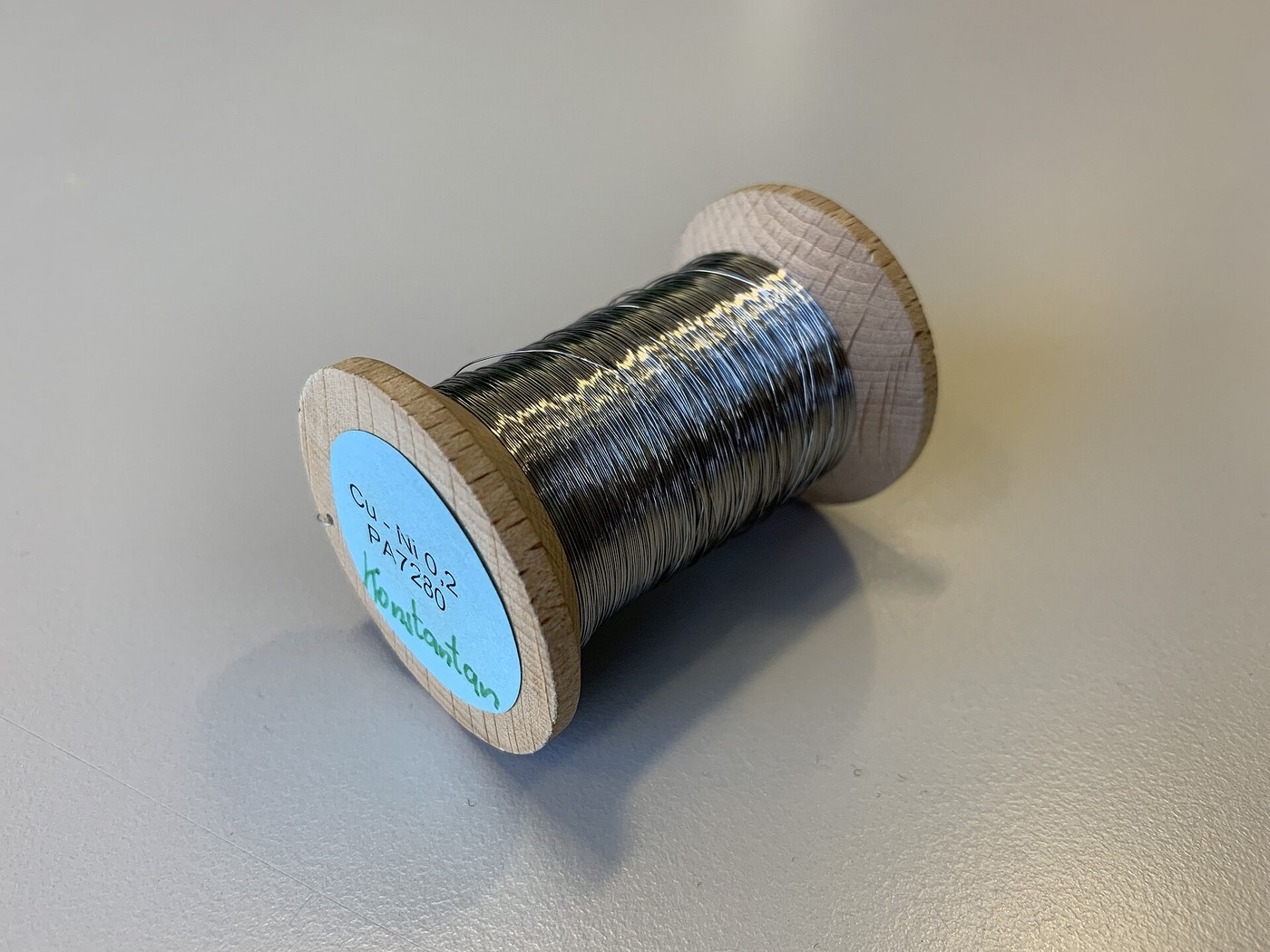


Constantan Resistance Wire from Copper and Nickel
Constantan is a copper-nickel alloy, usually 55 % copper and 45 % nickel, whose electrical resistance stays nearly the same as it warms; that is why strain gauges, thermocouples and resistance coils are wound with it. Copper and nickel melt together in any proportion, so the alloy is made by fusing the two, casting small sticks and drawing them into wire.
The melt follows C. Morfit's copper-nickel alloy as Brannt gives it in *The Metallic Alloys* (1889): nickel and an equal weight of copper fused with borax in a graphite crucible, the rest of the copper stirred in. Hiorns (1912) adds that the nickel must be as pure as possible, which is what the Mond process gives.
Juu
Foundry day, then drawing
Maagizo
1
1
Weigh the charge
Weigh the charge
For 1 kg of 55/45 constantan weigh 450 g nickel and 550 g copper, and set aside 100 g of the copper for the second addition. Use nickel as pure as you can get: Hiorns warns that silicon, carbon, iron and sulphur in it greatly reduce how well the alloy works.
Vifaa kwa hatua hii:
 Mche wa Shaba550 g
 Nikeli ya mchakato wa kabonili450 g
Zana zinazohitajika:
 Mizani ya mizani-mbili
2
2
Fuse nickel with an equal weight of copper
Fuse nickel with an equal weight of copper
Put the nickel and an equal weight of copper (450 g of each) into a graphite crucible with some borax, and fuse them in the furnace. This is Morfit's first stage: nickel melts far hotter than copper, and melting it among copper brings it down sooner. Constantan itself melts at about 1,220–1,300 °C.
Vifaa kwa hatua hii:
 Poda ya boraksi1 as required
Zana zinazohitajika:
 Kalibu ya grafiti na udongo
 Tanuru la mkaa
 Koleo la kaure ya kuyeyushia
 Glavu Zinazostahimili Joto
 Aproni ya Ngozi
3
3
Stir in the rest of the copper
Stir in the rest of the copper
Add the remaining 100 g of copper to the melted mass, stirring constantly with an iron rod until it has gone in and the metal is one even liquid.
Zana zinazohitajika:
 Kikorogeo cha chumaTanuru la mkaaKoleo la kaure ya kuyeyushiaGlavu Zinazostahimili Joto
4
4
Cast small sticks
Cast small sticks
Pour the alloy into a warmed ingot mould as small sticks, as Morfit did. Pour in one run; the alloy chills quickly.
Zana zinazohitajika:
 Kalibu ya kutupa madiniKoleo la kaure ya kuyeyushiaGlavu Zinazostahimili JotoAproni ya Ngozi
5
5
Anneal the sticks
Anneal the sticks
Anneal the cast sticks before working them: cast copper-nickel is crystalline, and Hiorns gives careful annealing at a moderate temperature as the cure.
Zana zinazohitajika:
 Tanuru la kulainisha metaliKoleo la kaure ya kuyeyushiaGlavu Zinazostahimili Joto
6
6
Draw it like copper wire
Draw it like copper wire
Forge a stick into a round rod, file a taper and draw it through the drawplate hole by hole, as copper wire is drawn. Never take the size down too fast: Hiorns warns that metal drawn without annealing breaks unless it rests five to ten minutes between passes. Anneal it as the copper wire is annealed. Simmons's strain gauges used No. 40 gauge, about 0.08 mm.
7
7
Measure the resistance
Measure the resistance
Measure the diameter in several places, cut a measured length and find its resistance on a Wheatstone bridge. Compare the result with the ohms per metre in the next step. A wire that reads much higher than expected has a thin place or a crack in it.
Zana zinazohitajika:
 Maikromita
 Daraja la Wheatstone
8
8
Charge and resistance figures
Charge and resistance figures
Inapakia daftari la Jupyter…
9
9
Troubleshooting
Troubleshooting
Constantan wire troubleshooting.
Flow
Loading...
10
10
History and honest limits
History and honest limits
In 1887 Edward Weston found an alloy whose resistance falls as it warms, a property, he wrote, of no other metallic conductor he knew. Wikipedia says his "Alloy No. 2" was produced in Germany and renamed Konstantan. By 1912 Hiorns listed Constantan, Eureka and Heckenham metal among the copper-nickel alloys used for resistances.
Morfit's alloy was 33 nickel to 67 copper; we keep his two-stage method and scale it to 55/45, the usual constantan and Simmons's wire. That scaling is ours. The 55/45 figure and the resistivity are from Wikipedia's Constantan article. Very fine wire like No. 40 gauge needs drawplate holes that fine.
Vifaa
3- 550 gKishikilia Nafasi
- Kishikilia Nafasi
- 1 as requiredKishikilia Nafasi
Zana Zinazohitajika
11- Kishikilia Nafasi
- Kishikilia Nafasi
- Kishikilia Nafasi
- Kishikilia Nafasi
- Kishikilia Nafasi
- Kishikilia Nafasi
- Kishikilia Nafasi
- Kishikilia Nafasi
- Kishikilia Nafasi
- Kishikilia Nafasi
- Kishikilia Nafasi
Mchoro huu unatengeneza

Blueprint zinazohusiana
Blueprint hizi zinashiriki maarifa — mbinu, vifaa au kanuni

CC0 Umma Wote
Mchoro huu umetolewa chini ya CC0. Uko huru kunakili, kubadilisha, kusambaza, na kutumia kazi hii kwa madhumuni yoyote, bila kuomba ruhusa.
Saidia Mtengenezaji kwa kununua bidhaa kupitia Mchoro wao ambapo wanapata Kamisheni ya Mtengenezaji iliyowekwa na Wachuuzi, au unda marudio mapya ya Mchoro huu na uiunganishe kama kiungo katika Mchoro wako kuchangia mapato.