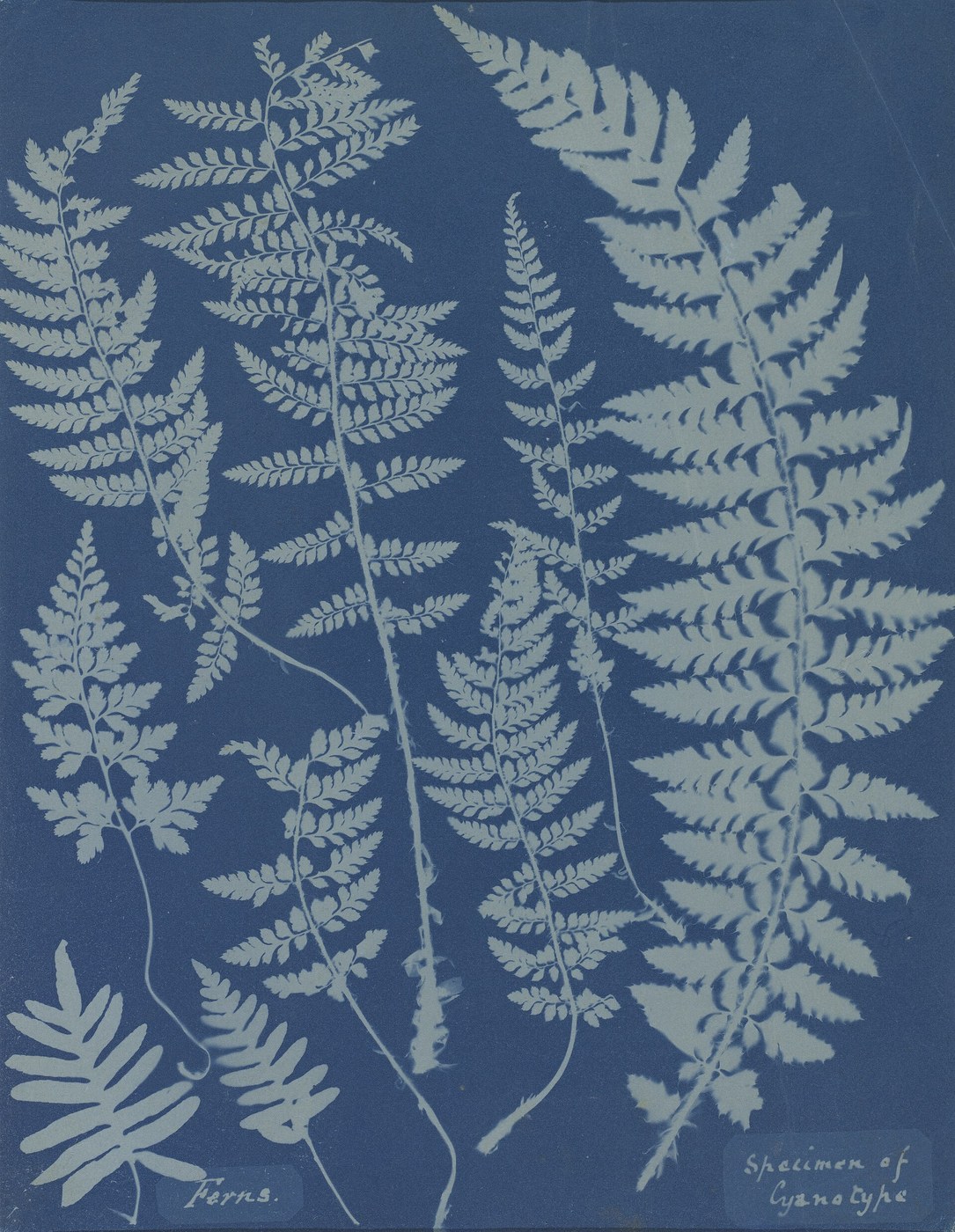


Cyanotype Print
The cyanotype is where the word blueprint comes from. Sir John Herschel invented it in 1842, and he was not trying to make art — he wanted a cheap way to copy mathematical tables. It was quickly adopted for reproducing technical drawings, and for the better part of a century an engineering drawing was literally a white line on a blue ground.
The chemistry is two iron salts: ferric ammonium citrate and potassium ferricyanide. Brushed onto paper and dried in the dark, the coating is sensitive to ultraviolet. Where UV strikes it, the iron is reduced and reacts to form Prussian blue, which lodges permanently between the paper fibres. Where something blocked the light, it washes away white.
No darkroom, no enlarger, no developer. Sunlight and water. It remains one of the oldest photographic processes still in everyday use.
Maagizo
Put on gloves and eye protection
Put on gloves and eye protection
Wear gloves and safety glasses. Both salts stain skin and clothing persistently, and potassium ferricyanide should not be handled casually or allowed near acid.
Zana zinazohitajika:
 Miwani ya usalama iliyo wazi
 Glavu za Naitrili
Mix solution A
Mix solution A
Dissolve 25 g ferric ammonium citrate in 100 ml water. This is the light-sensitive half — it is what reacts when UV hits it.
Vifaa kwa hatua hii:
 Sitrati ya feri na amonia25 g
Mix solution B
Mix solution B
Dissolve 10 g potassium ferricyanide in 100 ml water in a separate container. Keep the two solutions apart until the moment of coating.
Vifaa kwa hatua hii:
 Ferisianidi ya potasiamu10 g
Store both in the dark
Store both in the dark
Keep both solutions in brown bottles away from light. Stored separately they keep for months; mixed, they begin to go off within a day.
Combine equal parts, only what you need
Combine equal parts, only what you need
Under dim light with little UV, mix equal volumes of A and B. Mix only enough for the session — the combined sensitiser does not keep.
Coat the paper
Coat the paper
Brush an even coat onto watercolour paper. Work in dim light. A heavy ragged coat prints as blotches; aim for a thin uniform film.
Vifaa kwa hatua hii:
 Karatasi ya rangi za maji1 karatasi
Zana zinazohitajika:
 Brashi bapa ya kuandikia herufi
Dry completely in the dark
Dry completely in the dark
Dry flat in a dark room, an hour or more. Damp paper is the main cause of failure — the image goes muddy and the highlights never clear.
Lay out the objects or negative
Lay out the objects or negative
Arrange leaves, feathers, lace or a printed transparency on the dry sheet and press it flat under glass. Anything opaque prints white; anything translucent prints a mid tone.
Expose to sunlight
Expose to sunlight
Put it in direct sun for 10 to 20 minutes. Watch the coating: it shifts from yellow-green through grey to a bronze that looks distinctly wrong. Bronze is correct — that is the cue.
Wash in plain water
Wash in plain water
Rinse in cold running water for 5 minutes. The unexposed salts wash straight out and the blue deepens as you watch. There is no developer and no fixer — water does both jobs.
Let it dry and darken
Let it dry and darken
Dry flat. The blue continues to deepen over the next 24 hours as the Prussian blue fully oxidises. Judge the exposure tomorrow, not today.
Make an exposure test strip
Make an exposure test strip
Coat one sheet, cover it progressively, and expose in bands of 5, 10, 15, 20 and 30 minutes. Your sun, your paper and your coating are all variables — the strip is the only way to know your numbers.
History & Context
History & Context
The origin of the word. Sir John Herschel (1792–1871) invented the cyanotype in 1842. He intended it for reproducing mathematical tables — a copying process, not a picture-making one. Its use for technical drawings is where "blueprint" comes from, and the term outlived the process by decades. Every time this platform says "blueprint", it is borrowing Herschel's chemistry.
What the blue actually is. Exposure to UV reduces the ferric iron, which then reacts with the ferricyanide to form ferric ferrocyanide — Prussian blue — trapped between the paper fibres. It is a pigment generated in place, not a dye absorbed by the paper, which is why cyanotypes are unusually stable and why the image cannot be bleached out with ordinary washing.
Anna Atkins. Within a year of the invention, Anna Atkins used the process to record British algae, producing what is widely regarded as the first book illustrated with photographic images. She laid specimens directly on sensitised paper — exactly the technique in step 8. A copying process for engineers became, almost immediately, a scientific illustration medium.
Why no darkroom. The sensitiser responds to ultraviolet, not to the visible spectrum, so it can be handled under ordinary dim indoor light. That single property is why cyanotype is the standard entry point into historical photographic processes: no safelight, no enlarger, no chemistry beyond two salts, and water for both development and fixing.
On safety, stated plainly. Potassium ferricyanide sounds alarming and is not. The cyanide is bound tightly in a coordination complex and is not bioavailable in normal handling. It must never be mixed with strong acid or strongly heated, because that can liberate hydrogen cyanide — so keep it away from acids and out of a fire. Handled sensibly with gloves it is a standard school and hobby chemical, which is why this blueprint is not gated.
Vifaa
3- Kishikilia Nafasi
- Kishikilia Nafasi
- 1 karatasiKishikilia Nafasi
Zana Zinazohitajika
3- Kishikilia Nafasi
- Kishikilia Nafasi
- Kishikilia Nafasi
Mchoro huu unatengeneza

CC0 Umma Wote
Mchoro huu umetolewa chini ya CC0. Uko huru kunakili, kubadilisha, kusambaza, na kutumia kazi hii kwa madhumuni yoyote, bila kuomba ruhusa.
Saidia Mtengenezaji kwa kununua bidhaa kupitia Mchoro wao ambapo wanapata Kamisheni ya Mtengenezaji iliyowekwa na Wachuuzi, au unda marudio mapya ya Mchoro huu na uiunganishe kama kiungo katika Mchoro wako kuchangia mapato.