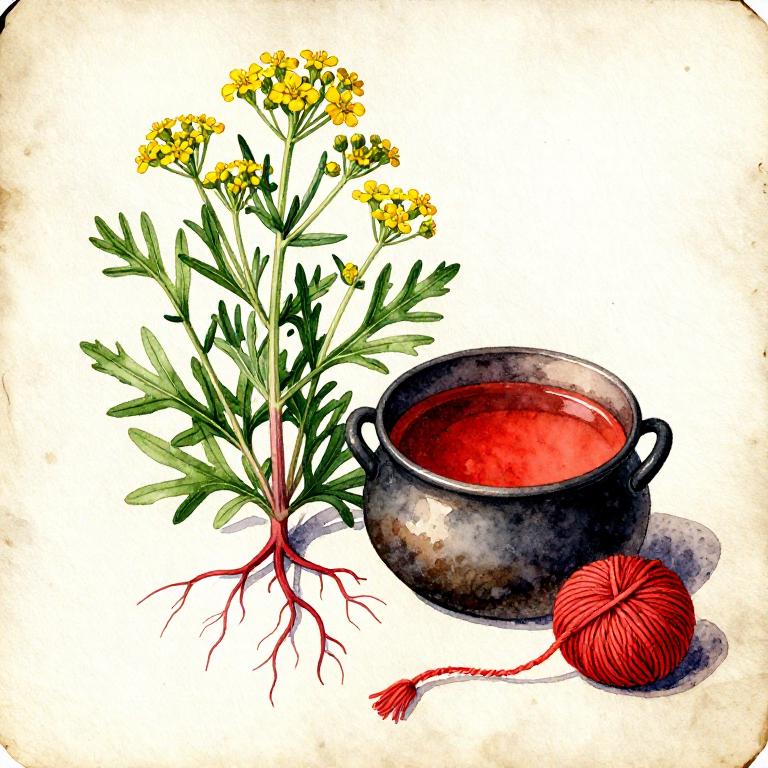


Dyeing Red with Lady's Bedstraw — The Wild Madder of Northern Europe
Lady's bedstraw (Galium verum) is a delicate, sprawling wildflower native to grasslands and meadows across Europe and temperate Asia. Its roots contain the same anthraquinone pigments found in its famous relative madder (Rubia tinctorum) — both belong to the Rubiaceae family. On alum-mordanted wool, the dried roots of lady's bedstraw produce a warm coral-red to orange-red, lighter and more orange than madder but with the same excellent lightfastness that characterises anthraquinone dyes.
In northern Europe, where true madder did not grow well, lady's bedstraw was the primary source of red dye from the Neolithic period through the Viking Age and medieval period. Norse and Anglo-Saxon dyers used the roots extensively. The plant appears in archaeological textile finds from Scandinavia, the British Isles, and northern Germany dating back to the Bronze Age. In Old Norse, the plant was called 'gulmaðra' — golden madder — reflecting both its yellow flowers and its red-dyeing roots.
Lady's bedstraw roots are much thinner and more fibrous than madder roots, requiring a larger quantity for equivalent colour depth. The typical recommendation is 200-300% WOF, compared to 100% for madder. The colour is worth the extra material — a unique coral-red that sits between madder's deep red and sappanwood's rose-red, with a warm orange undertone distinctive to Galium species.
Maagizo
Weigh the dried lady's bedstraw roots
Weigh the dried lady's bedstraw roots
Use 200-300% WOF of dried lady's bedstraw roots. For 100 g of wool, weigh out 200-300 g of dried roots. The roots are thin, wiry, and reddish-brown — much finer than madder roots. They are available dried from specialty dye suppliers, or can be harvested from wild plants in autumn when anthraquinone content peaks. Chop into 2-3 cm lengths to increase surface area for extraction.
Vifaa kwa hatua hii:
 Mzizi wa galiamu (mkavu)250 g
Zana zinazohitajika:
 Mizani ya dijitali ya jikoni
Soak the roots overnight in warm water
Soak the roots overnight in warm water
Place the chopped roots in a dye pot with 4 litres of warm water and soak overnight (8-12 hours). The water will turn a deep reddish-orange as the anthraquinones dissolve. Lady's bedstraw roots are fibrous and release dye more slowly than madder — the long soak is essential. By morning, the liquid should be a rich orange-red.
Zana zinazohitajika:
 Sufuria kubwa ya mchuzi
Simmer at 70°C for 60 minutes
Simmer at 70°C for 60 minutes
Raise the temperature slowly to 70°C and hold for 60 minutes. Like madder, lady's bedstraw anthraquinones are heat-sensitive — temperatures above 80°C shift the colour from coral-red toward dull brown. The same temperature discipline applies: slow heating, careful monitoring, never boil. Stir occasionally. The liquid will deepen to a vivid red-orange.
Zana zinazohitajika:
 Kipimajoto cha kupikia
 Kijiko cha mbao cha kukorogea
Strain out the roots
Strain out the roots
Strain the dye liquor through a fine mesh strainer into a clean pot. Press the roots to extract all remaining liquid. The thin, fibrous roots can tangle with wool — strain thoroughly. The strained liquor should be a clear, warm red-orange.
Zana zinazohitajika:
 Chujio la matundu madogo
Dye alum-mordanted wool at 70°C for 60 minutes
Dye alum-mordanted wool at 70°C for 60 minutes
Pre-wet the alum-mordanted wool in lukewarm water for 15 minutes, squeeze gently, and lower it into the dye bath at room temperature. Slowly raise to 70°C over 20 minutes, then hold for 60 minutes. Turn gently every 10 minutes. The wool will develop a warm coral-red to orange-red — lighter and more orange than madder, but with the same excellent permanence. The anthraquinone-alum complex is nearly identical to the madder-alum bond, giving lady's bedstraw comparable lightfastness.
Vifaa kwa hatua hii:
 Fungu la uzi wa sufu100 g
 Alumu (alumu ya potasiamu)10 g
Cool overnight, rinse, and dry
Cool overnight, rinse, and dry
Turn off the heat and let the wool cool in the dye bath overnight. Remove, squeeze gently, and rinse in lukewarm water until the runoff is mostly clear. The final colour is a warm coral-red to salmon-orange — a shade unique to Galium species that cannot be easily replicated from other dye plants. Lightfastness is excellent, approaching madder. This was the red that coloured Viking-age textiles across Scandinavia, centuries before Mediterranean madder became available through trade. Dry in shade.
Vifaa
3- Kishikilia Nafasi
- 100 gKishikilia Nafasi
- Kishikilia Nafasi
Zana Zinazohitajika
5- Kishikilia Nafasi
- Kishikilia Nafasi
- Kishikilia Nafasi
- Kishikilia Nafasi
- Kishikilia Nafasi
Vifaa vya Michoro Iliyounganishwa
Blueprint zinazohusiana
Blueprint hizi zinashiriki maarifa — mbinu, vifaa au kanuni
CC0 Umma Wote
Mchoro huu umetolewa chini ya CC0. Uko huru kunakili, kubadilisha, kusambaza, na kutumia kazi hii kwa madhumuni yoyote, bila kuomba ruhusa.
Saidia Mtengenezaji kwa kununua bidhaa kupitia Mchoro wao ambapo wanapata Kamisheni ya Mtengenezaji iliyowekwa na Wachuuzi, au unda marudio mapya ya Mchoro huu na uiunganishe kama kiungo katika Mchoro wako kuchangia mapato.