Ushirikiano
SANAA
UREMBO NA USTAWI
UJANJA
UTAMADUNI NA HISTORIA
BURUDANI
MAZINGIRA
CHAKULA NA VINYWAJI
UHANDISI WA KINYUME
SAYANSI
MICHEZO
TEKNOLOJIA
VAZI
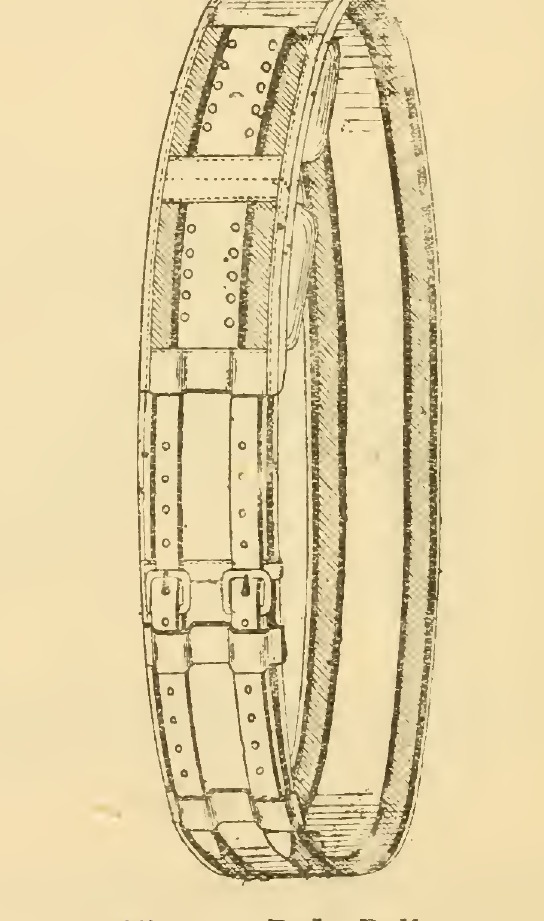


Body Roller: Web Band With a Quilted, Flock-Stuffed Pad and Two Buckled Straps (Hasluck, Saddlery, 1904)
A body roller is buckled round a horse behind the withers to keep its rug or sheet in place. This is the two-strap roller from Paul N. Hasluck's Saddlery (1904): a 6 ft 2 in web band with a stuffed pad of two compartments, faced with hogskin, lined with serge, quilted with twenty small leather rounds, and fastened with two buckled straps. Every size is his.
Rollers may be of worsted, linen, union, webbing or leather.
Juu
About 2 days
Maagizo
1
1
The marks on the roller
The marks on the roller
Inapakia daftari la Jupyter…
2
2
Read Saddlery, ch. IX
Read Saddlery, ch. IX
"Body rollers are made of worsted, linen, union, webbing, or leather, with one, two, or three straps, a full-sized roller being 6 ft. 2 in. long."
3
3
Bind the ends and mark the pad
Bind the ends and mark the pad
Cut the roller 6 ft 2 in long; the pad sits about 10 in from one point. Bind the short end near the pad with leather 1 in wide on each side, stitched with single thread. Bind the other end the same way, 1 in wide on the front, but line the girth for about 6 in below and stitch along the edge of the roller; raise a stitch over the edge of the leather without running through. With a lead pencil, mark a line across 10 in from the end without lining, a second line 1 ft away, and two more 5-1/4 in from each line, leaving a 1-1/2 in space between them.
Vifaa kwa hatua hii:
 Utepe wa mkanda wa tumbo1 kipande
 Ngozi ya nguruwe iliyotengenezwa1 kipande
 Uzi wa kitani1 kipande
 Nta ya Nyuki1 kipande
 Penseli1 kipande
Zana zinazohitajika:
 Kisu cha ngozi
 Uma wa kutoboa (ushindilio)
 Sindano mbili za kushonea ngozi
 Kibano cha mbao cha kushona ngozi
 Tepi ya kupimia
4
4
Cut the card, lining and facings
Cut the card, lining and facings
Cut stiff cardboard the width of the roller, reaching 1 in below each end line, and thin its edges. Cut white serge (basil or hogskin for a leather girth) to reach 2 in below the two end lines and 1/2 in wider on each side. Cut two hogskin facings 1 ft 4 in by 1-1/4 in, narrowed at the centre to a little less than half opposite the space between the inner lines; round the corners and cut slanting towards the ends until each is about 1/2 in wide at the point. Turn the serge down 1/4 in along its long edges and whip it to the facings along the shaped edge, centre to centre, with the full and narrow parts matching on each side.
Vifaa kwa hatua hii:
 Kadibodi ya kubandika1 kipande
 Serge ya sufu1 kipandeNgozi ya nguruwe iliyotengenezwa1 kipandeUzi wa kitani1 kipandeNta ya Nyuki1 kipande
Zana zinazohitajika:
Kisu cha ngozi MkasiSindano mbili za kushonea ngoziTepi ya kupimia
5
5
Make and set the straps
Make and set the straps
Cut two pieces of leather 2-1/4 in deep and the width of the roller and crease them along the long sides with a hot iron; cut two similar pieces of basil. Cut two strong 1-1/4 in brown leather straps 1 ft 6 in long, point one end, shave the other, crease them double and make eight holes in each. Put one basil piece underneath, level with the roller edges, reaching a little above the line nearer the short end. Place the straps within 1/4 in of that line, pointing towards the short end, and stitch them down firmly through roller and basil.
Vifaa kwa hatua hii:
Ngozi ya nguruwe iliyotengenezwa1 kipande Ngozi ya kondoo (basil)1 kipande
 Ngozi ya vifaa vya farasi1 kipandeUzi wa kitani1 kipandeNta ya Nyuki1 kipande
Zana zinazohitajika:
Kisu cha ngozi Kifaa cha kukunja
 Kitoboa ngoziUma wa kutoboa (ushindilio)Sindano mbili za kushonea ngozi
6
6
Build the pad
Build the pad
Place the hogskin end pieces on the ends of the pad, their upper edges about 1/8 in above the end lines, and the other basil piece under the end without straps; tack the basil down. Tack a creased piece 1-3/4 in wide across the centre to cover the two central lines, then tack the cardboard underneath, centred. The end piece at the strap end covers the stitched ends of the straps. Stitch the end pieces through roller and card along their upper cross lines and the ends of the centre piece at the edges, leaving the two central lines unstitched.
Vifaa kwa hatua hii:
Ngozi ya nguruwe iliyotengenezwa1 kipande Vipini vya kushikilia kwenye kalibu1 kipandeUzi wa kitani1 kipandeNta ya Nyuki1 kipande
Zana zinazohitajika:
 NyundoKifaa cha kukunjaUma wa kutoboa (ushindilio)Sindano mbili za kushonea ngozi
7
7
Line, bind and stuff
Line, bind and stuff
Put the serge lining and facing centre to centre on each side and whip the facing to the roller along both edges through web and card, the ends reaching just below the stitched end lines. Bind both edges with a thin hogskin strip about 1/2 in wide from end piece to end piece. Stitch the two centre lines through from side to side, making two compartments. Make two rows of stitches down through the leather between and close to the straps, and two at the other end. Stuff both sides firm and level with flock through the bottom opening, turn in the serge edge, and raise a stitch to hold the leather lining opposite the serge.
Vifaa kwa hatua hii:
Ngozi ya nguruwe iliyotengenezwa1 kipande Sufu ya kujaza1 kipandeUzi wa kitani1 kipandeNta ya Nyuki1 kipande
Zana zinazohitajika:
Kisu cha ngoziUma wa kutoboa (ushindilio)Sindano mbili za kushonea ngozi8
8
Quilt the pad
Quilt the pad
Cut twenty small round or scalloped pieces of coloured roan or hogskin, a little smaller than a threepenny bit. Quilt five on each side of each part, twenty in all, in a perfectly straight line 1 in from the edge: drive the needle up from below, through the leather round, down again through it and the roller, and knot it below over a small tuft of coloured wool.
Vifaa kwa hatua hii:
 Ngozi ya kondoo iliyotiwa rangi (roan)1 kipande
 Uzi wa Sufu Uliotiwa Rangi1 kipandeUzi wa kitani1 kipandeNta ya Nyuki1 kipande
Zana zinazohitajika:
Kisu cha ngoziSindano mbili za kushonea ngozi9
9
Fit the buckles and loops
Fit the buckles and loops
Cut two chapes for two 1-1/4 in buckles and two loops, and stitch the chapes with the outside of the buckles flush with the end of the roller, straight to the straps. Make a loop long enough to reach across the girth, stitched across at both ends and with two cross rows in the centre, leaving room for the two straps, about 6 in below the chapes. Block, crease and finish the loops; he puts a fancy stamp in the centre of each.
Vifaa kwa hatua hii:
Ngozi ya vifaa vya farasi1 kipande Bakoli ya chuma yenye ulimi2 vipandeUzi wa kitani1 kipandeNta ya Nyuki1 kipande
Zana zinazohitajika:
Kisu cha ngoziKifaa cha kukunja Kijiti cha kuundia vitanziUma wa kutoboa (ushindilio)Sindano mbili za kushonea ngozi
10
10
Troubleshooting
Troubleshooting
Body roller troubleshooting.
Flow
Loading...
11
11
History and honest limits
History and honest limits
From **Saddlery**, edited by Paul N. Hasluck, David McKay, 1904 (archive.org saddlery00hasl), chapter IX, "Horse Clothing", body rollers, pp. 75-80, Figs. 31-32; every fraction was read on the scan. His wording on the end pieces is brief; check them against Figs. 31 and 32. The stallion roller, surcingle, sheets and hood are not made here. The thread, tools and metric figures are ours.
Vifaa
14- 1 kipandeKishikilia Nafasi
- 5 vipandeKishikilia Nafasi
- 7 vipandeKishikilia Nafasi
- 7 vipandeKishikilia Nafasi
- Kishikilia Nafasi
- 1 kipandeKishikilia Nafasi
- 1 kipandeKishikilia Nafasi
- 1 kipandeKishikilia Nafasi
- 2 vipandeKishikilia Nafasi
- 1 kipandeKishikilia Nafasi
- 1 kipandeKishikilia Nafasi
- Kishikilia Nafasi
- 1 kipandeKishikilia Nafasi
- 2 vipandeKishikilia Nafasi
Zana Zinazohitajika
10- Kishikilia Nafasi
- Kishikilia Nafasi
- Kishikilia Nafasi
- Kishikilia Nafasi
- 1 vendor sell this, none ship to you yetKishikilia Nafasi
- Kishikilia Nafasi
- Kishikilia Nafasi
- Kishikilia Nafasi
- Kishikilia Nafasi
- Kishikilia Nafasi
Mchoro huu unatengeneza
Blueprint zinazohusiana
Blueprint hizi zinashiriki maarifa — mbinu, vifaa au kanuni
CC0 Umma Wote
Mchoro huu umetolewa chini ya CC0. Uko huru kunakili, kubadilisha, kusambaza, na kutumia kazi hii kwa madhumuni yoyote, bila kuomba ruhusa.
Saidia Mtengenezaji kwa kununua bidhaa kupitia Mchoro wao ambapo wanapata Kamisheni ya Mtengenezaji iliyowekwa na Wachuuzi, au unda marudio mapya ya Mchoro huu na uiunganishe kama kiungo katika Mchoro wako kuchangia mapato.