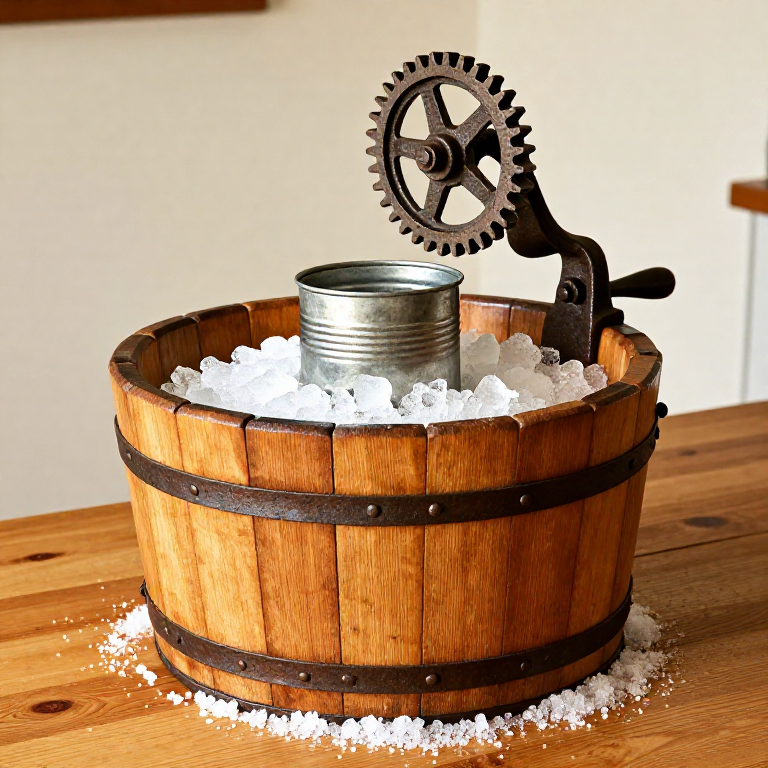


Ice Cream Freezer
Freeze cream in a bowl and you get a solid block with gritty crystals through it. Ice cream is not frozen cream — it is cream frozen while being stirred, and the stirring is what makes it a different substance.
Nancy Johnson's patent is a crank, a paddle and a can. The inner can holds the mixture, an ice-and-salt bath surrounds it, and a scraper turns continuously against the wall. Every crystal that forms on the cold metal is scraped off before it can grow, so the ice stays microscopic and the texture stays smooth. Air is beaten in at the same time, which is why ice cream is soft enough to scoop at a temperature where cream would be a brick.
US Patent 3,254, "Artificial Freezer", granted 9 September 1843 to Nancy M. Johnson of Philadelphia — one of the earliest US patents granted to a woman, and the design every hand-cranked machine still copies.
Maagizo
Freeze cream in a bowl first and taste the failure
Freeze cream in a bowl first and taste the failure
Put sweetened cream in the freezer, unstirred. It sets hard and coarse. That gritty block is what the machine exists to prevent, and you need it as a reference.
Read US 3,254 and find the scraper
Read US 3,254 and find the scraper
Johnson's claim is a hand-cranked dasher that scrapes the freezing surface. The can and the ice bath were known; the moving scraper is the invention.
Make an inner can of thin metal
Make an inner can of thin metal
Use a tall narrow can with thin walls. Thin because it must conduct heat out fast — a thick insulating wall defeats the whole machine.
Vifaa kwa hatua hii:
 Bati la chuma cha pua1 karatasi
Build an outer bucket with room for ice all round
Build an outer bucket with room for ice all round
Make a wooden bucket that leaves 40-50 mm of space around the can. Wood insulates the bath from the room, which is exactly what you want.
Vifaa kwa hatua hii:
 Ubao wa Mti Mgumu1 kipande
Zana zinazohitajika:
 Msumeno wa mkono
Cut a dasher that reaches the wall
Cut a dasher that reaches the wall
Make wooden paddles that sweep within a millimetre of the can's inner surface. A dasher that misses the wall lets crystals grow exactly where they form fastest.
Angle the blades to fold as well as scrape
Angle the blades to fold as well as scrape
Set the paddles at an angle so they lift the mixture from the wall to the centre. Scraping alone leaves the middle unfrozen; folding mixes it.
Fit a crank and a lid that locates the dasher
Fit a crank and a lid that locates the dasher
Mount the shaft through a lid so the dasher stays centred. A wandering dasher scrapes one side and rides free on the other.
Vifaa kwa hatua hii:
 Ufito wa chuma laini1 kipande
Pack crushed ice and coarse salt in layers
Pack crushed ice and coarse salt in layers
Roughly three parts ice to one part salt, layered. Crushed, not cubes — contact area is what moves heat.
Vifaa kwa hatua hii:
 Chumvi ya Bahari Mbichi500 g
Measure the brine temperature and be surprised
Measure the brine temperature and be surprised
Put a thermometer in the bath. It reads well BELOW zero — around −10 to −20 °C. Salt does not make it colder by magic; it lowers the freezing point so the ice must melt and melting absorbs heat.
Zana zinazohitajika:
 Kipimajoto cha Chumbani
Chill the mixture thoroughly before it goes in
Chill the mixture thoroughly before it goes in
Refrigerate the cream base first. Starting warm means a long slow freeze, and slow freezing grows big crystals however hard you crank.
Fill the can only two-thirds
Fill the can only two-thirds
Leave headroom. The mixture expands as air is beaten into it, and a full can simply forces the lid off.
Crank steadily and without stopping
Crank steadily and without stopping
Turn continuously for twenty to thirty minutes. Every pause lets crystals grow undisturbed on the wall, and you can taste each break as grit.
Feel the resistance rise and then stop
Feel the resistance rise and then stop
The crank stiffens as the mixture sets. When it becomes hard to turn, it is done — pushing further just churns it towards butter.
Harden it in a freezer before serving
Harden it in a freezer before serving
Straight from the churn it is soft-serve. An hour undisturbed in a freezer firms it without growing crystals, because the structure is already set.
Compendium — texture is a rate, not a temperature
Compendium — texture is a rate, not a temperature
The patent. US 3,254, "Artificial Freezer", granted 9 September 1843 to Nancy M. Johnson of Philadelphia. She is among the earliest women to hold a United States patent, and she sold the rights for 200 dollars to a Mr Young, who marketed it as the "Johnson Patent Ice-Cream Freezer" and kept her name on it. Ice cream itself is far older — it was a luxury made by hand-beating a mixture in a pot set in ice, a job that took an hour and a servant. Johnson's machine put it within reach of a domestic kitchen.
Why stirring changes the substance. Ice crystals nucleate on the coldest surface, which is the can wall, and then grow. Crystals above roughly 50 micrometres are detectable on the tongue as grit. A scraper removes each crystal from the wall the moment it forms and disperses it into the warmer bulk, so a very large number of very small crystals form instead of a few large ones. Simultaneously the dasher whips air in — the overrun — which physically separates ice from ice and stops the mass setting solid. Ice cream is therefore a foam containing ice crystals, fat globules and a concentrated sugar solution, and its softness at −18 °C comes from the unfrozen sugary phase between the crystals.
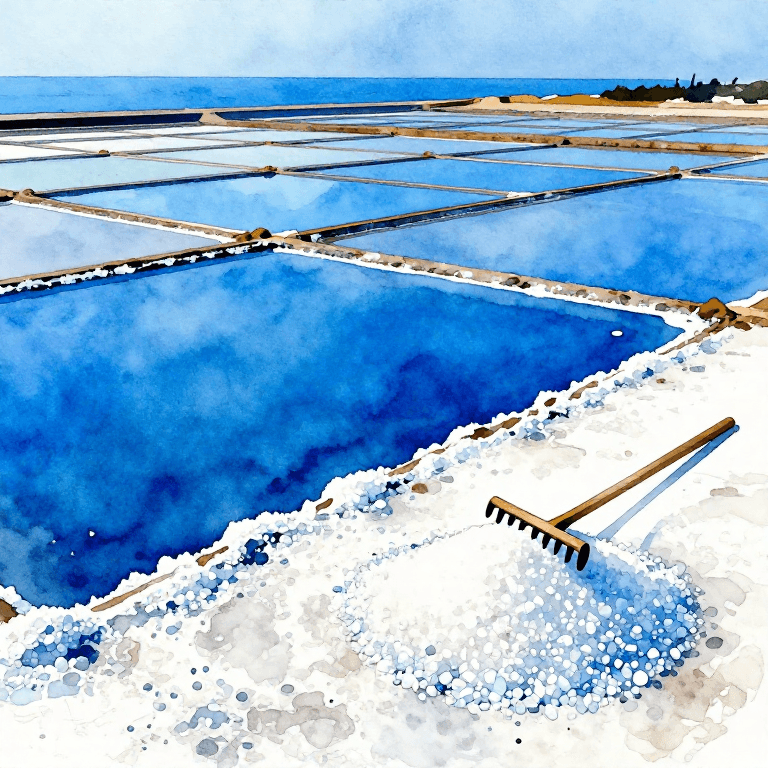
The salt is doing thermodynamics, not chemistry. Adding salt to ice depresses the freezing point of the water, so ice at 0 °C is now above its melting point and must melt. Melting absorbs its latent heat from the surroundings, and the bath drives itself down towards −20 °C. Nothing is being cooled by the salt; the mixture is paying for the ice's phase change. This is the same principle as gritting a road, run in the useful direction.
Why the machine survives. Modern domestic machines replace the ice bath with a pre-frozen bowl or a compressor, and the crank with a motor. Neither touches Johnson's actual claim — there is still a dasher scraping the wall, because there is no other way to keep crystals small. Commercial continuous freezers push the mixture through a chilled barrel against rotating scraper blades at high speed, which is the same geometry at industrial scale. A patent from 1843 still describes the working part of every ice cream machine made.
Vifaa
4- 1 karatasiKishikilia Nafasi
- 1 kipandeKishikilia Nafasi
- 1 kipandeKishikilia Nafasi
- Kishikilia Nafasi
Zana Zinazohitajika
2- Kishikilia Nafasi
- Kishikilia Nafasi
Mchoro huu unatengeneza
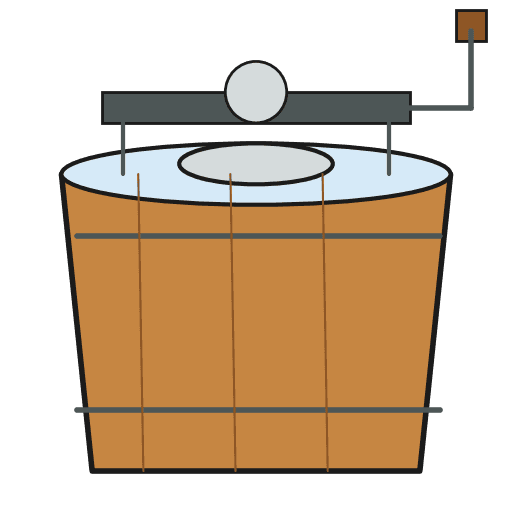

Blueprint zinazohusiana
Blueprint hizi zinashiriki maarifa — mbinu, vifaa au kanuni


CC0 Umma Wote
Mchoro huu umetolewa chini ya CC0. Uko huru kunakili, kubadilisha, kusambaza, na kutumia kazi hii kwa madhumuni yoyote, bila kuomba ruhusa.
Saidia Mtengenezaji kwa kununua bidhaa kupitia Mchoro wao ambapo wanapata Kamisheni ya Mtengenezaji iliyowekwa na Wachuuzi, au unda marudio mapya ya Mchoro huu na uiunganishe kama kiungo katika Mchoro wako kuchangia mapato.