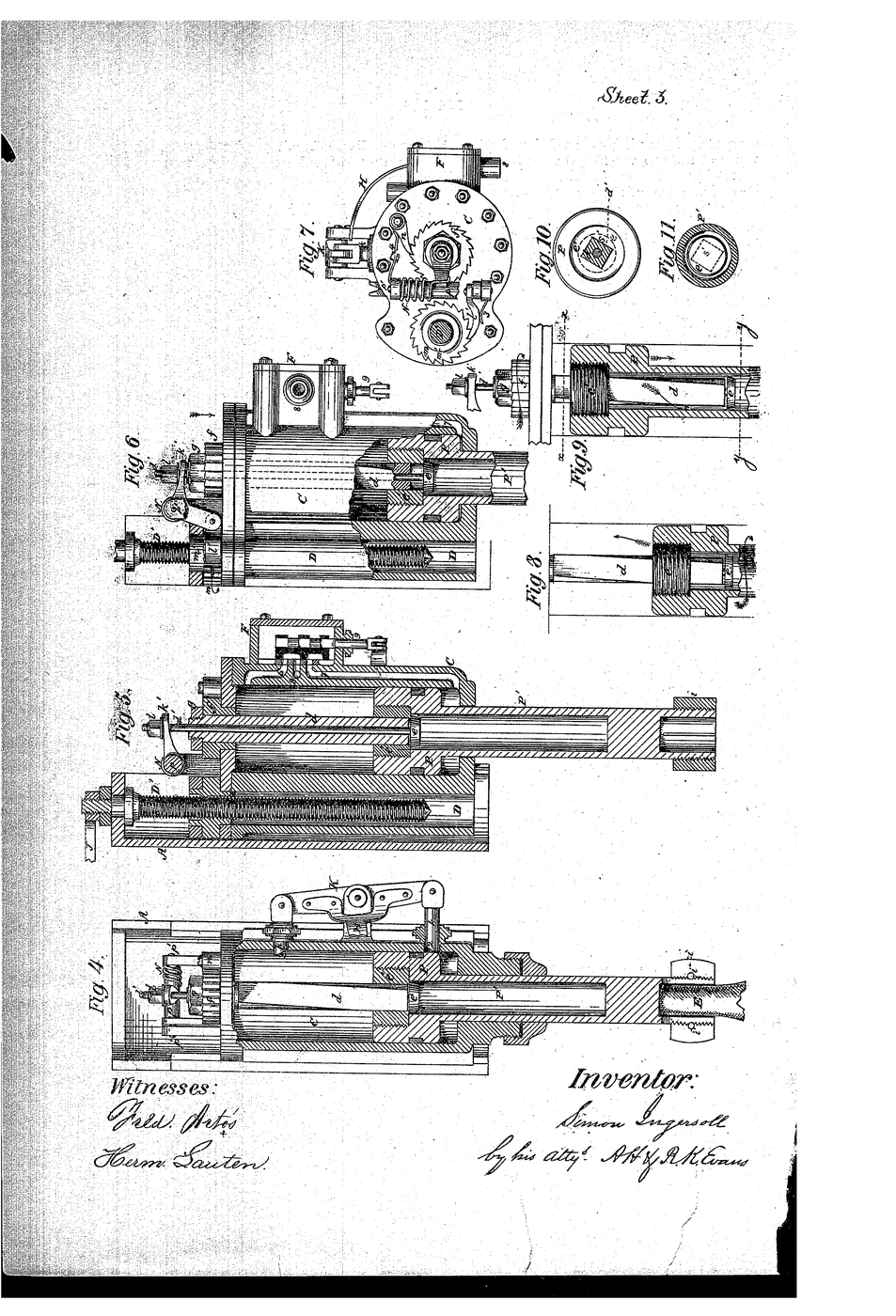


Ingersoll Rock Drill
Drilling a shot-hole in rock by hand is two people and a hammer. One holds a steel chisel against the face and rotates it a few degrees between blows; the other swings. The rotation is the whole trick — without it the chisel jams in its own cuttings and stops cutting. A metre of hole is most of a day.
A percussion drill mechanises exactly those two motions, and nothing else. It strikes, it indexes the bit a fraction of a turn, it strikes again. The rotation is not driven separately: a twisted square bar runs through a fixed nut, so the reciprocation of the plunger produces the turn for free.
US Patent 112,254, "Improvement in rock-drills", granted 28 February 1871 to Simon Ingersoll. Rock drills already existed and were mounted on carriages for tunnel work; Ingersoll's is built around a feed-rod and plunger that advance the bit automatically, and an adjustable tripod that lets one machine be set up anywhere on a face instead of running on rails.
Maagizo
Wear eye protection and control the dust
Wear eye protection and control the dust
Struck stone throws sharp chips. Wear goggles, and wet the hole — dry silica dust from sandstone is the real long-term hazard, not the chips.
Read US 112,254 and find the twisted bar
Read US 112,254 and find the twisted bar
Ingersoll claims a feed-rod and plunger for automatic advance, and a twisted square bar that turns the bit between strokes. Note that rotation is a by-product of the stroke, not a second drive.
Drill a baseline hole by hand
Drill a baseline hole by hand
Hold a cold chisel against a sandstone block and strike it 100 times, rotating it about 15° by hand between blows. This is single-jack drilling.
Vifaa kwa hatua hii:
 Tofali la jiwe la mchanga1 kipande
Zana zinazohitajika:
 Patasi ya chuma baridi
Measure the baseline depth
Measure the baseline depth
Record depth in mm per 100 blows. This single number is what every later change gets compared against.
Repeat 100 blows without rotating
Repeat 100 blows without rotating
Strike a second hole with no indexing at all. It stalls within about 30 blows. This is the failure the machine exists to prevent — the chisel re-crushes its own cuttings instead of biting new rock.
Grind a four-edged bit on the steel rod
Grind a four-edged bit on the steel rod
Grind a cross ('X') bit onto one end of a 6 mm mild steel rod, 4 cutting edges at 90°, included angle about 90°. Quench often — do not let the tip turn blue.
Vifaa kwa hatua hii:
 Ufito wa chuma laini1 kipande
Cut the guide block
Cut the guide block
Cut a 150 × 60 mm plywood block and bore it to pass the rod as a sliding fit. This holds the bit square to the face — the job Ingersoll's tripod does.
Vifaa kwa hatua hii:
 Bati la mbao za kubandika1 kipande
Twist a square bar through 180°
Twist a square bar through 180°
Clamp a length of square steel bar, heat it to bright red, and twist one full half-turn along about 120 mm. Let it air-cool. This is the rifle bar.
File a matching square nut
File a matching square nut
File a square hole in a steel plate so the twisted bar passes through it snugly. Fix the plate to the guide block so it cannot rotate.
Zana zinazohitajika:
 Koleo la Mdomo Bapa
Slide the bar and watch it index
Slide the bar and watch it index
Push the twisted bar through the fixed nut by hand. It rotates as it travels. Confirm one full stroke gives a partial turn, not a full one — a full turn would put the edges back where they started.
Couple the bar to the bit
Couple the bar to the bit
Join the twisted bar to the drill rod so they turn together. Keep the joint short; every millimetre of slop is lost stroke.
Fit the return spring
Fit the return spring
Set a compression spring between the guide block and a collar on the rod, so the bit lifts clear of the hole after each blow. Cuttings only escape when the bit lifts.
Vifaa kwa hatua hii:
 Seti ya springi za kubana1 seti
Add a feed screw behind the assembly
Add a feed screw behind the assembly
Run a threaded rod through a nut in the frame to push the whole guide forward as the hole deepens. This is Ingersoll's automatic feed, cranked by hand.
Vifaa kwa hatua hii:
 Skrubu ya mti #8 x inchi 14 vipande
Drill 100 blows with the mechanism
Drill 100 blows with the mechanism
Strike the head of the rod 100 times, advancing the feed screw a quarter-turn every 10 blows. Do not rotate anything by hand — the bar does it.
Flush the hole and compare depths
Flush the hole and compare depths
Wash out the cuttings and measure. Compare against step 4 and step 5. The indexed hole should beat the hand-rotated one and hugely beat the unrotated one.
History & Context — the tripod was the invention
History & Context — the tripod was the invention
The patent. US 112,254, "Improvement in rock-drills", granted 28 February 1871 to Simon Ingersoll (1818-1894), a Connecticut-born farmer and prolific inventor whom the document names as "of the city of Brooklyn and State of New York". The patent shows application and publication on the same date, so only the grant date should be cited for it.
He did not invent the rock drill, and the record is clear about that. Powered rock drills were already at work before 1871 — Germain Sommeiller's compressed-air drills, building on Giovanni Battista Piatti's design, had been driving the Mont Cenis tunnel since the early 1860s. Those machines were mounted on carriages that ran on rails, which suits a tunnel face and suits nothing else. Ingersoll's contribution was to put the drill on an adjustable tripod with leg weights, so a single machine could be planted anywhere — on a quarry bench, a hillside, a foundation trench. That is a mobility change, not a mechanism change, and it is why the design spread beyond tunnelling.
Why rotation matters more than force. A percussion bit does not cut by turning; it cuts by fracturing rock under impact. But an X-shaped bit striking the same four lines repeatedly just powders the material already broken. Indexing the bit even a few degrees between blows puts fresh edges onto un-fractured rock, and it also lets the cuttings escape past the flutes. The twisted-bar-and-fixed-nut arrangement gets this for nothing: the reciprocation that delivers the blow also delivers the turn. Step 5 is worth doing honestly, because the stall is dramatic and it explains the entire machine in about thirty blows.
Ingersoll sold the rights and missed the fortune. He disposed of his patent rights for enough capital to buy a stall in Fulton Market in New York, where he sold garden produce. The company built on his name — via the Ingersoll Rock Drill Company, and after the 1905 merger with Rand, Ingersoll-Rand — became one of the largest machinery firms in the world. Ingersoll himself did not share in it. He is a useful corrective to the idea that patenting an invention and profiting from it are the same act; they are separate businesses, and he was only ever good at the first.
What this bench model does and does not show. It reproduces the kinematics — impact, indexed rotation, spring return, screw feed — at a scale a maker can actually build. It does not reproduce the energy. A real drill of this period ran on steam or compressed air at several hundred blows per minute, and the difference between that and a hand-swung hammer is the whole difference between a demonstration and a shot-hole. The silica-dust warning in step 1 is not decorative: dry-drilling rock is the classic cause of silicosis, and it killed drill operators for a century before wet drilling became standard.
Vifaa
5- 1 kipandeKishikilia Nafasi
- 1 kipandeKishikilia Nafasi
- 1 kipandeKishikilia Nafasi
- Kishikilia Nafasi
- 4 vipandeKishikilia Nafasi
Zana Zinazohitajika
2- Kishikilia Nafasi
- Kishikilia Nafasi
Blueprint zinazohusiana
Blueprint hizi zinashiriki maarifa — mbinu, vifaa au kanuni

CC0 Umma Wote
Mchoro huu umetolewa chini ya CC0. Uko huru kunakili, kubadilisha, kusambaza, na kutumia kazi hii kwa madhumuni yoyote, bila kuomba ruhusa.
Saidia Mtengenezaji kwa kununua bidhaa kupitia Mchoro wao ambapo wanapata Kamisheni ya Mtengenezaji iliyowekwa na Wachuuzi, au unda marudio mapya ya Mchoro huu na uiunganishe kama kiungo katika Mchoro wako kuchangia mapato.