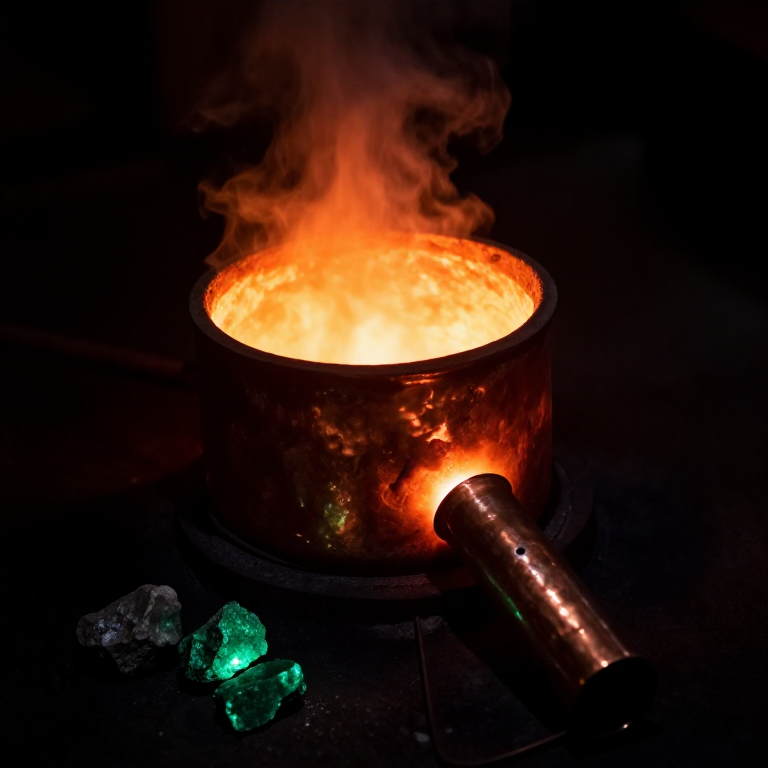
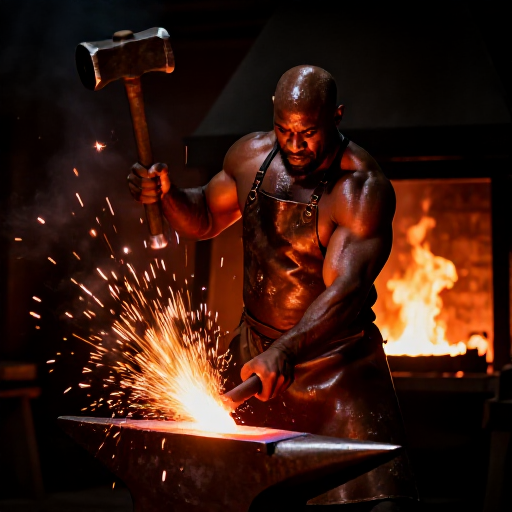

Smelting Copper from Malachite — The Birth of Metallurgy
Maagizo
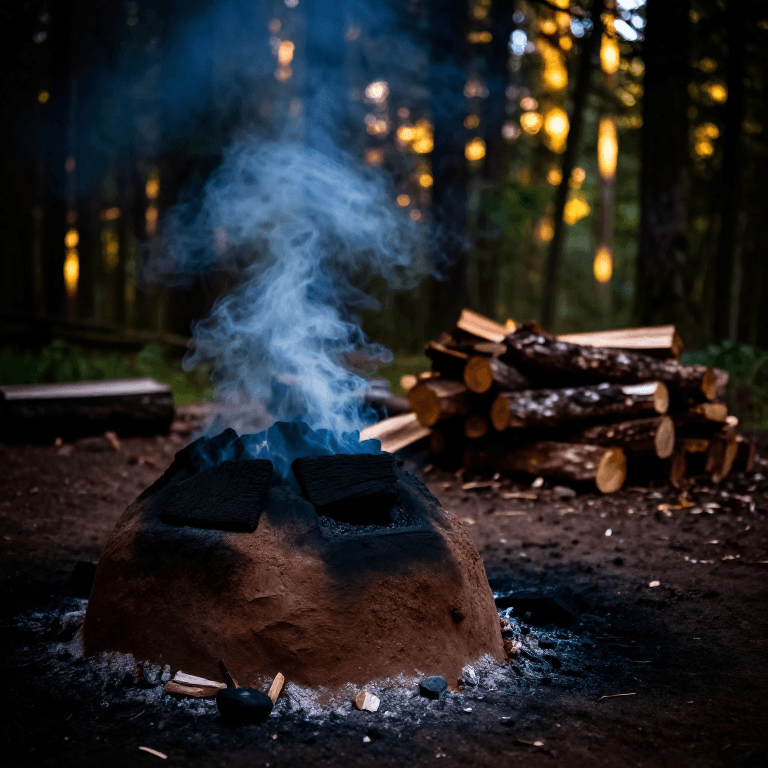
Prerequisite: Making Charcoal
Prerequisite: Making Charcoal
You need 15kg of quality charcoal. Attempting copper smelting with wood fire will fail — copper melts at 1085°C, beyond what wood alone achieves.
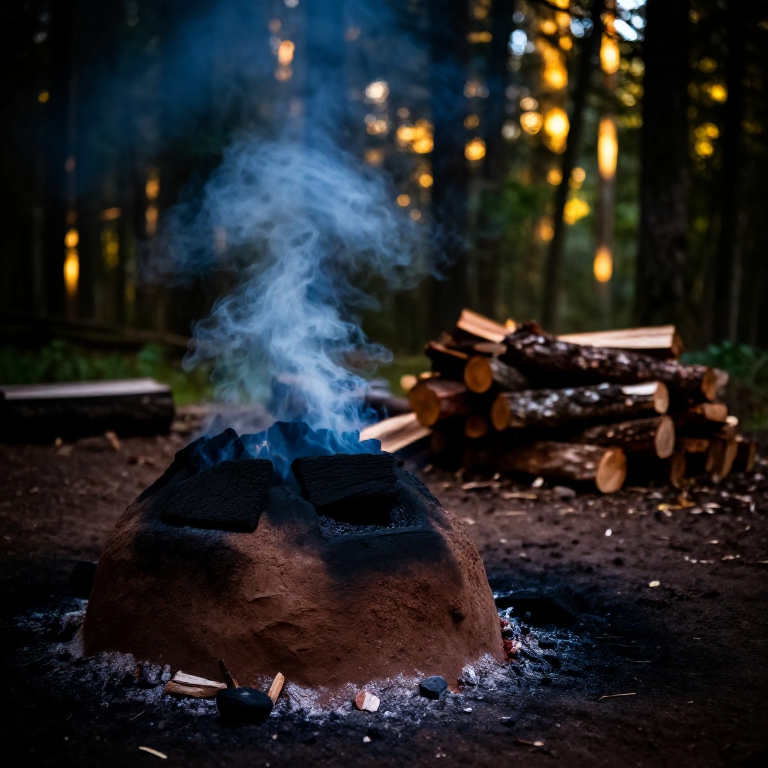
Mchoro wa Sharti la Awali
Making Charcoal — The First Chemical Process
Vifaa kwa hatua hii:
 Unga wa mkaa ulioamilishwa15 kg
 Shaba-njekundu1 rejea
Zana zinazohitajika:
 Tanuru
 Mivuo
Mivuo Koleo la kaure ya kuyeyushia
 Jiwe la kumwagia (bapa, laini)
 Nyundo ya jiwe (kuponda madini)
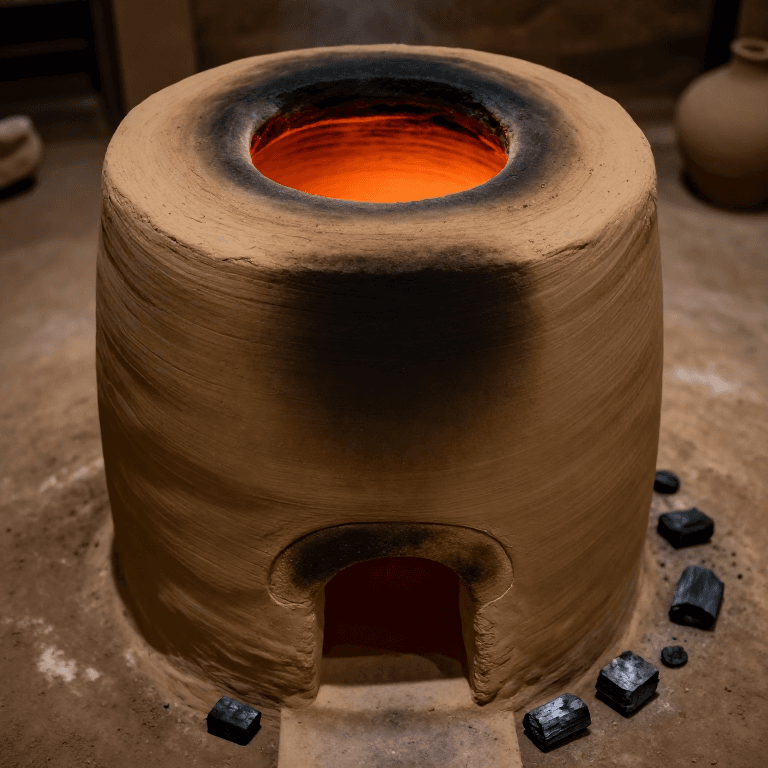
Prerequisite: Building a Clay Kiln
Prerequisite: Building a Clay Kiln
You need a kiln capable of reaching 1100°C for copper smelting.
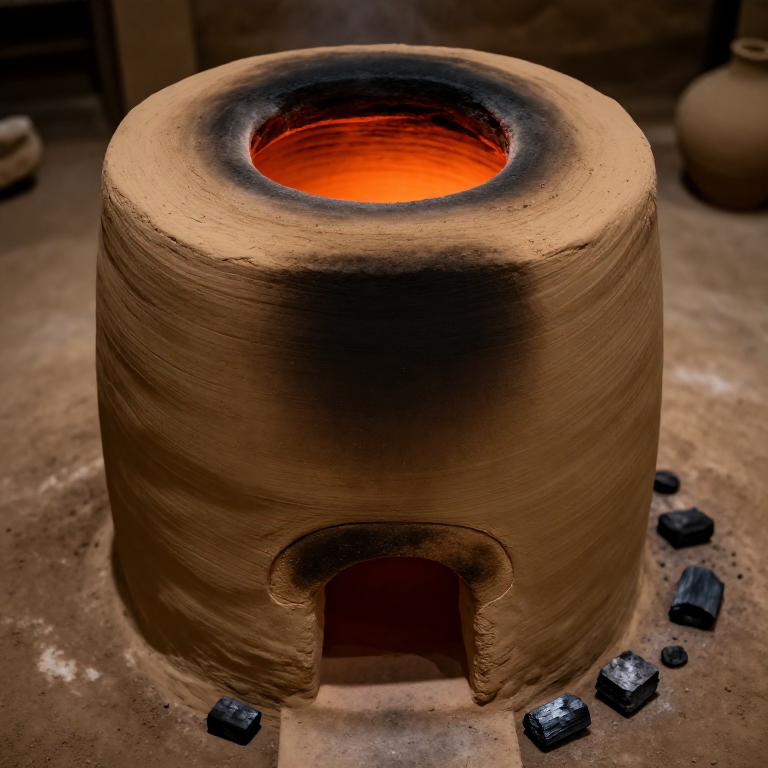
Mchoro wa Sharti la Awali
Building a Clay Kiln — The First Furnace
Vifaa kwa hatua hii:
Shaba-njekundu1 rejea Chombo cha Kuyeyushia1 pc
The Chemistry of Copper Smelting
The Chemistry of Copper Smelting
The Reduction Reaction
Smelting is a chemical reduction. Carbon (from charcoal) strips oxygen from the copper ore:
Cu₂CO₃(OH)₂  →  2CuO + CO₂ + H₂O    (at ~300°C, decomposition)
2CuO + C     →  2Cu + CO₂             (at ~800°C, reduction)
In plain English: heat breaks malachite into copper oxide + gas. Then carbon steals the oxygen from the copper oxide, leaving pure copper metal + carbon dioxide gas.
Why Charcoal, Not Wood?
Two reasons:
- Temperature: The reduction reaction requires ~800°C sustained. Wood fires don't reliably reach this.
- Carbon monoxide: Charcoal produces CO gas, which is a more efficient reducing agent than solid carbon. CO penetrates the ore and reduces it from the inside out.
Ore Preparation
- Crush the malachite to pea-sized pieces (5-10mm). Smaller = faster reduction, but powder clogs airflow.
- Sort — remove any non-green rock (gangue). Pure green malachite smelts best.
- Roast (optional): Heat crushed ore in an open fire for 1 hour. This drives off moisture and CO₂, converting malachite to black CuO (tenorite). Pre-roasted ore reduces faster.
Vifaa kwa hatua hii:
Unga wa mkaa ulioamilishwa15 kg Madini ya malakiti (Cu2CO3(OH)2)2 kgShaba-njekundu1 rejea
The Smelt
The Smelt
Loading the Kiln
- Fill the kiln ⅓ full with charcoal. Light it and bring to full temperature (orange-hot interior, ~1000°C) using bellows.
- Place the crucible in the center of the charcoal bed. Pre-heat it for 10 minutes before loading ore.
- Add crushed malachite to the crucible — don't fill more than ⅔ (it will bubble as CO₂ escapes).
- If using flux (borax or wood ash), add a thin layer on top of the ore.
- Cover the ore with a layer of charcoal pieces inside the crucible.
- Pack more charcoal around and above the crucible inside the kiln.
Maintaining Temperature
- Continuous bellows: Pump steadily — one full pump every 2-3 seconds. Temperature drops fast without forced air.
- Add charcoal from the top every 15-20 minutes as it burns down. The crucible must stay buried in hot charcoal.
- Duration: 2-4 hours for a full smelt. Don't rush.
Signs of Success
- Green flames: Copper compounds produce distinctive green-tinted flames. Good sign.
- Bubbling in crucible: CO₂ escaping from the reduction reaction.
- Slag forming on top: A glassy, dark layer of impurities floating above the copper. This is normal and desirable — it protects the copper from re-oxidation.
Vifaa kwa hatua hii:
Unga wa mkaa ulioamilishwa15 kgChombo cha Kuyeyushia1 pcMadini ya malakiti (Cu2CO3(OH)2)2 kg Boraksi ya utengenezaji wa wanyama0.5 kgShaba-njekundu1 rejea
Pouring and Recovery
Pouring and Recovery
The Pour
- When the slag looks glassy and the crucible contents are liquid, it's time to pour.
- Pre-heat your casting stone by placing it near the kiln opening. Cold stone + molten copper = dangerous spatter.
- Using crucible tongs, carefully lift the crucible from the charcoal bed.
- Pour in a steady stream into the depression in the casting stone. Pour the slag separately.
- Allow to cool naturally. DO NOT quench with water (causes brittleness and can cause steam explosion).
What You Should See
A copper button — a rough, reddish-orange disc of metal. It may have slag inclusions and a rough surface. This is normal for primitive smelting.
Yield
Expect 50-70% copper recovery from good malachite. Some copper remains trapped in slag. Ancient smiths re-smelted slag to recover more.
The Innovation Moment
You've just performed the most transformative chemical process in human history. From green rock, you extracted a metal that can be hammered into tools, ornaments, and weapons. But pure copper is soft. To make it truly useful, you need to alloy it — see Blueprint 07: Alloying Bronze.
First, though, you should learn to shape this copper — see Blueprint 05: Casting Copper Tools.
Vifaa kwa hatua hii:
Unga wa mkaa ulioamilishwa15 kgChombo cha Kuyeyushia1 pcShaba-njekundu1 rejeaVifaa
6- Kishikilia Nafasi
- Kishikilia Nafasi
- 1 kipandeKishikilia Nafasi
- 1 rejeaKishikilia Nafasi
- Kishikilia Nafasi
- 15 kgKishikilia Nafasi
Zana Zinazohitajika
5- Kishikilia Nafasi
- Kishikilia Nafasi
- Kishikilia Nafasi
- Kishikilia Nafasi
- Kishikilia Nafasi
Vifaa vya Michoro Iliyounganishwa

CC0 Umma Wote
Mchoro huu umetolewa chini ya CC0. Uko huru kunakili, kubadilisha, kusambaza, na kutumia kazi hii kwa madhumuni yoyote, bila kuomba ruhusa.
Saidia Mtengenezaji kwa kununua bidhaa kupitia Mchoro wao ambapo wanapata Kamisheni ya Mtengenezaji iliyowekwa na Wachuuzi, au unda marudio mapya ya Mchoro huu na uiunganishe kama kiungo katika Mchoro wako kuchangia mapato.