


Forging an Iron Fish Hook — Drawing, Bending, and Barbing Wire Stock
Bone and bronze fish hooks served for thousands of years, but iron hooks changed the economics of fishing. Iron is cheaper than bronze, harder than bone, and can be drawn to finer gauges — meaning smaller hooks for smaller fish, and stronger hooks for larger ones. Iron hooks could be mass-produced by a village smith in batches of dozens, making them nearly disposable.
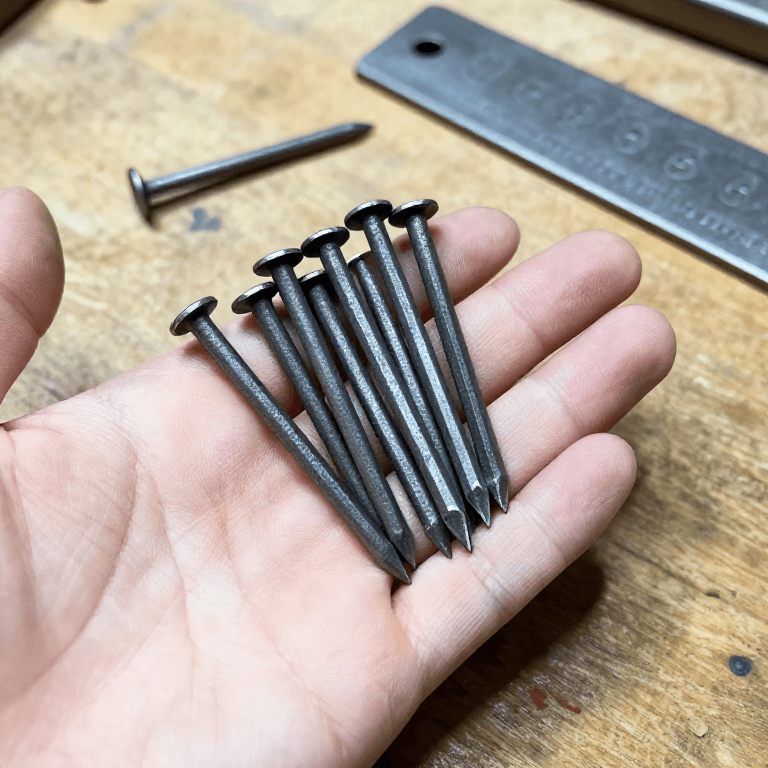
An iron fish hook is forged from a short length of iron wire or drawn rod. The wire is tapered to a sharp point, a barb is cut with a chisel, the shaft is bent into a J or U shape around a mandrel, and the eye is formed by bending a small loop at the top. The entire hook is then case-carburised to harden the point and barb so they hold their edge in use.
This is one of the simplest forge projects — it uses almost no material and teaches fine control of thin stock at low heat. It also demonstrates that not all forge work involves heavy hammering; the smith must work delicately to avoid burning the thin wire.
Maagizo
Draw iron wire from rod stock
Draw iron wire from rod stock
Vifaa kwa hatua hii:
 Mkaa1 kg
Zana zinazohitajika:
 Nyundo ya Kufua
 Koleo la forji
 Meko (Moto wa Kufua)
Taper the point
Taper the point
Cut the barb
Cut the barb
Bend the hook shape
Bend the hook shape
Form the eye
Form the eye
Harden the point and barb
Harden the point and barb
Test and finish the batch
Test and finish the batch
Zana Zinazohitajika
3- Kishikilia Nafasi
- Kishikilia Nafasi
- Kishikilia Nafasi
Vifaa vya Michoro Iliyounganishwa
Mchoro huu unatengeneza

Blueprint zinazohusiana
Blueprint hizi zinashiriki maarifa — mbinu, vifaa au kanuni
CC0 Umma Wote
Mchoro huu umetolewa chini ya CC0. Uko huru kunakili, kubadilisha, kusambaza, na kutumia kazi hii kwa madhumuni yoyote, bila kuomba ruhusa.
Saidia Mtengenezaji kwa kununua bidhaa kupitia Mchoro wao ambapo wanapata Kamisheni ya Mtengenezaji iliyowekwa na Wachuuzi, au unda marudio mapya ya Mchoro huu na uiunganishe kama kiungo katika Mchoro wako kuchangia mapato.