SANAA
UREMBO NA USTAWI
UJANJA
UTAMADUNI NA HISTORIA
BURUDANI
MAZINGIRA
CHAKULA NA VINYWAJI
UHANDISI WA KINYUME
SAYANSI
MICHEZO
TEKNOLOJIA
VAZI
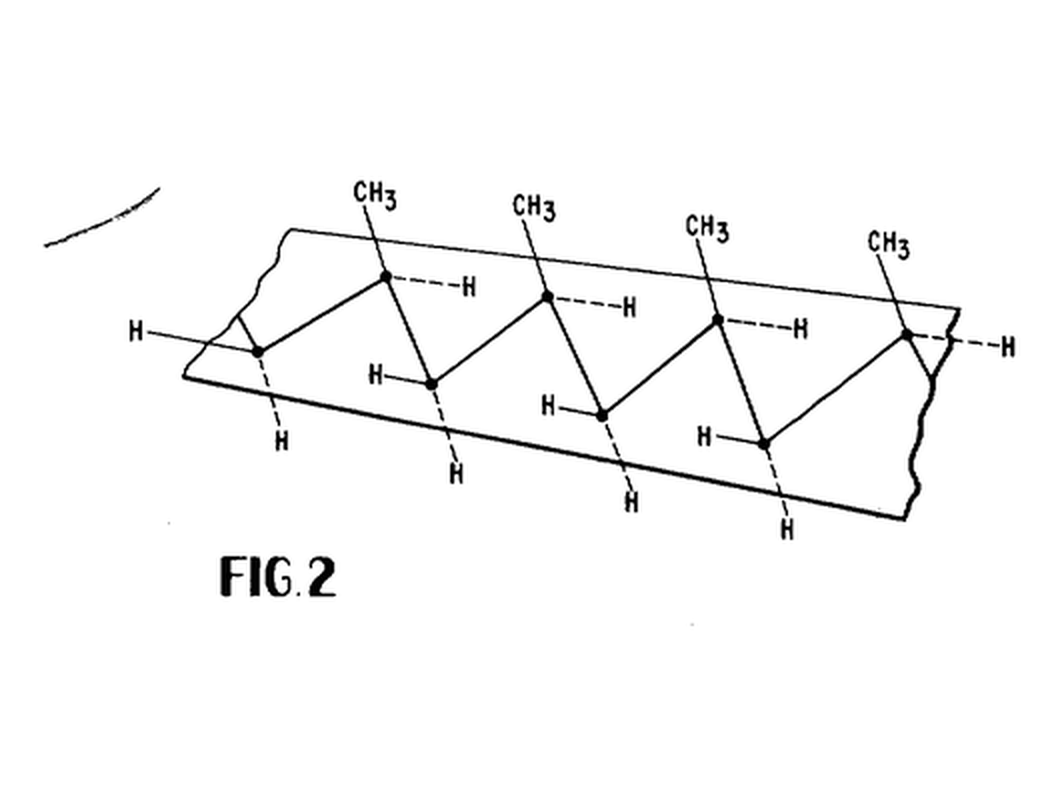


Isotactic Polypropylene
Propylene had always polymerised into a useless sticky mass. In March 1954 Giulio Natta's group at the Milan Polytechnic, using catalysts of the kind Karl Ziegler had just found for ethylene, made polypropylene in which every methyl group sits on the same side of the chain. They called it isotactic. The ordered chains crystallise, and a sticky nothing became a stiff, light, tough plastic. Natta and Ziegler shared the 1963 Nobel Prize in Chemistry.
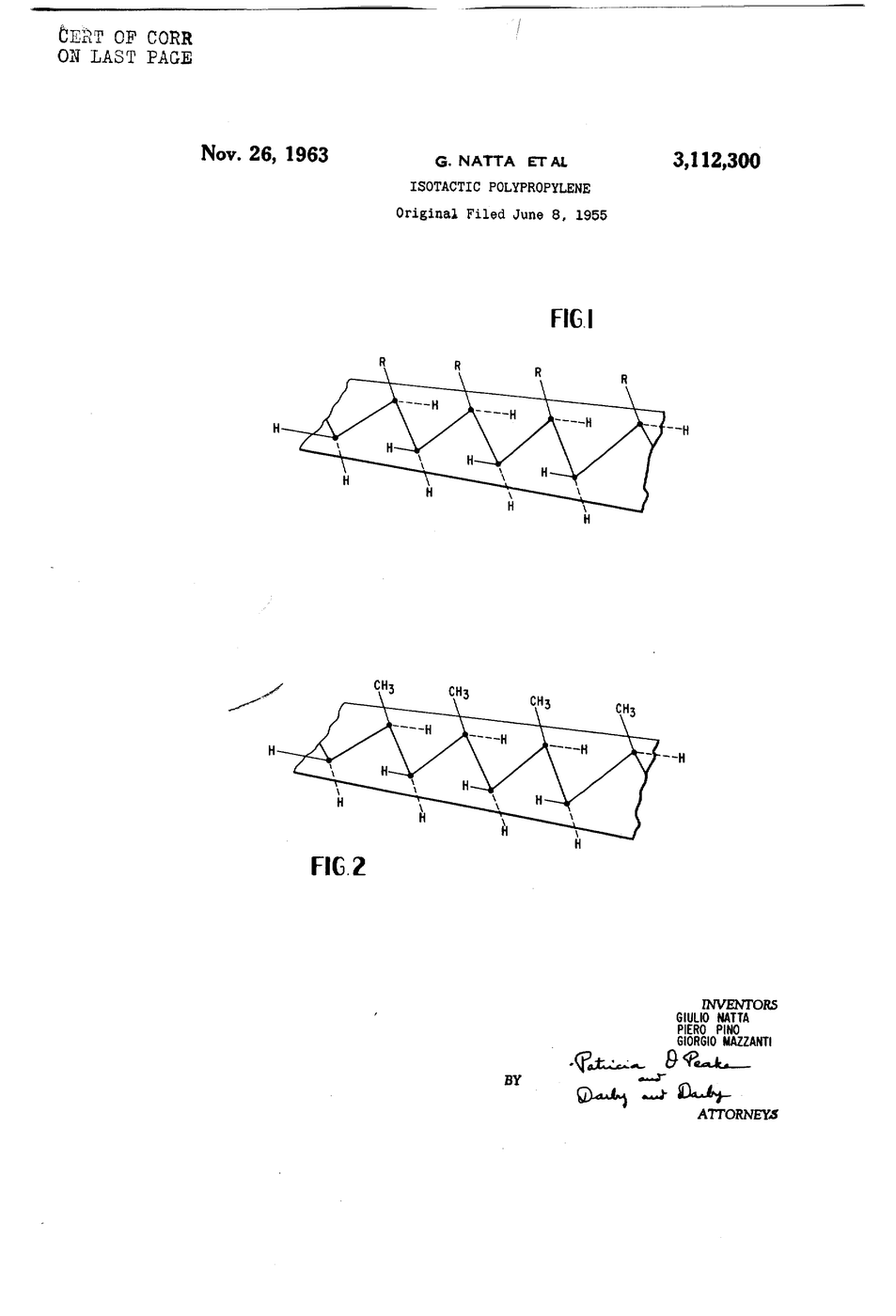
**US 3,112,300**, "Isotactic polypropylene", Natta, Pino and Mazzanti, assigned to Montecatini, filed 9. December 1957 (continuing an application of 8. June 1955), granted 26. November 1963. Its single claim is the arrangement itself: macromolecules "insoluble in boiling n-heptane" with the structure "shown in FIGURE 2 of the accompanying drawing".
**You build the property that made it famous**: an Arduino servo rig that folds a polypropylene living hinge thousands of times, beside PET film.
Kati
3 hours plus flex runs
Maagizo
1
1
Cut the hinges
Cut the hinges
Cut 80 x 20 mm strips from 0.5 mm polypropylene and from PET film. Measure both thicknesses. Fold each sharply across the middle once and flatten the crease with a fingernail - flexing it right away is how moulded hinges are made too.
Zana zinazohitajika:
 Kisu cha kazi
 Rula
Rula Kipima-unene cha dijitali cha inchi 6
 Bamba la polipropilini (A4)
 Karatasi ya kiolezo cha mylar
2
2
Build the fixture
Build the fixture
Screw two 100 x 50 mm pine blocks side by side. Hot-glue the servo to one so its shaft sits exactly on the crease line. Clamp one leaf of the hinge to the other block with a binder clip; hot-glue the free leaf to the servo horn.
Vifaa kwa hatua hii:
 Ubao wa msonobari1 kipande
 Parafujo za mbao2 vipande
 Motori Ndogo ya Servo ya SG90 (5)1 paketi
Zana zinazohitajika:
 Bastola ya gundi ya moto
 Klipu kubwa za kubana karatasi
 Seti ya bisibisi
3
3
Wire and flash the counter
Wire and flash the counter
Servo signal to D9, power to 5V and GND; microswitch between D2 and GND. One SG90 can run from the Uno's 5 V pin - if the board resets under load, power the servo separately with a shared GND. Open the serial monitor at 115200.
living_hinge_flex_counter.inocpp
Vifaa kwa hatua hii:
 Kibonyezo kidogo (kinachoendeshwa kwa mkono wa kibao)1 kipande
 Seti ya nyaya za Dupont (dume-jike)1 seti
Zana zinazohitajika:
 Arduino Uno R3
 Bao la Majaribio
 Kebo ya USB-B
4
4
Run and inspect
Run and inspect
Press the switch to start. Every 1000 cycles it stops: look at the crease under the loupe. Whitening is normal; a crack you can see through is failure. Record the last intact count, then run the other material.
Zana zinazohitajika:
 Lupu ya Kukuza
5
5
Strain, counts, siblings
Strain, counts, siblings
Inapakia daftari la Jupyter…
6
6
History & Context
History & Context
**What the patent specifies:** high-molecular polypropylene made of isotactic macromolecules, insoluble in boiling n-heptane, with the structure of its FIGURE 2 (shown here). **Modern build (derived):** commercial PP sheet, creased by hand into a hinge.
Montecatini began production in 1957. Moulded PP hinges now close most flip-top caps, and PP makes crates, car bumpers, rope and food tubs. Its limits: it turns brittle in deep cold, degrades in sunlight without stabilisers, and is hard to glue or paint.
Vifaa
5- 1 kipandeKishikilia Nafasi
- 2 vipandeKishikilia Nafasi
- Kishikilia Nafasi
- Kishikilia Nafasi
- Kishikilia Nafasi
Zana Zinazohitajika
12- Kishikilia Nafasi
- Kishikilia Nafasi
- Kishikilia Nafasi
- Kishikilia Nafasi
- Kishikilia Nafasi
- Kishikilia Nafasi
- Kishikilia Nafasi
- Kishikilia Nafasi
- 1 vendor sell this, none ship to you yetKishikilia Nafasi
- 1 vendor sell this, none ship to you yetKishikilia Nafasi
- 1 vendor sell this, none ship to you yetKishikilia Nafasi
- Kishikilia Nafasi
Blueprint zinazohusiana
Blueprint hizi zinashiriki maarifa — mbinu, vifaa au kanuni



CC0 Umma Wote
Mchoro huu umetolewa chini ya CC0. Uko huru kunakili, kubadilisha, kusambaza, na kutumia kazi hii kwa madhumuni yoyote, bila kuomba ruhusa.
Saidia Mtengenezaji kwa kununua bidhaa kupitia Mchoro wao ambapo wanapata Kamisheni ya Mtengenezaji iliyowekwa na Wachuuzi, au unda marudio mapya ya Mchoro huu na uiunganishe kama kiungo katika Mchoro wako kuchangia mapato.