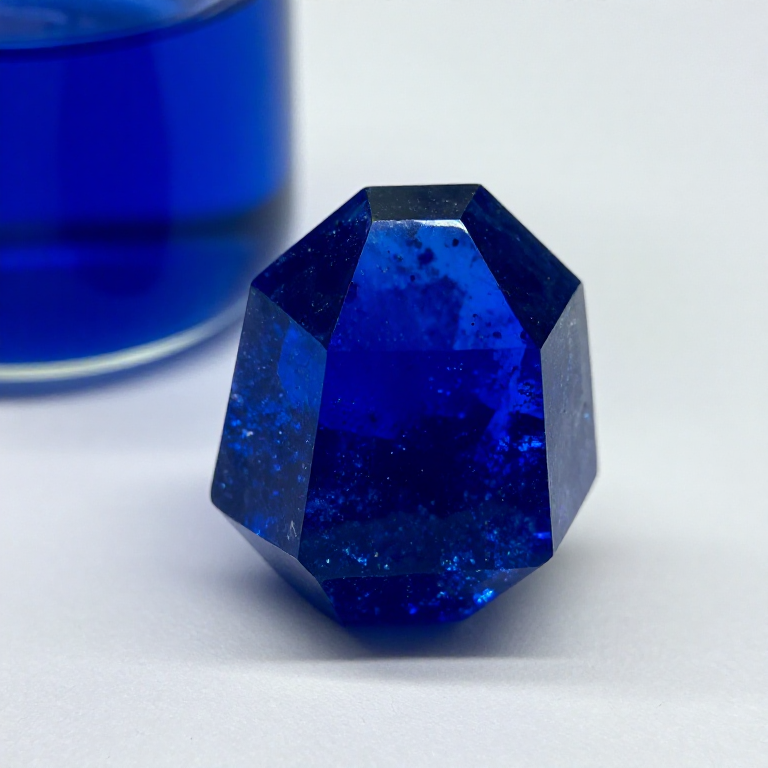


Growing Copper Sulfate Crystals
Maagizo
Making a Saturated Solution
Making a Saturated Solution
Solubility of Copper Sulfate
Copper sulfate's solubility in water increases with temperature:
| Temperature | Solubility (g CuSO₄ per 100ml water) |
|---|---|
| 20°C (68°F) | ~20g |
| 40°C (104°F) | ~29g |
| 60°C (140°F) | ~40g |
| 80°C (176°F) | ~56g |
| 100°C (212°F) | ~75g |
Preparing the Solution
- Heat 250ml distilled water to 70-80°C (hot but not boiling — boiling causes excessive evaporation and can decompose the pentahydrate).
- Slowly add copper sulfate while stirring, about 20g at a time. Continue adding until no more dissolves — you'll see undissolved crystals sitting at the bottom despite vigorous stirring.
- At 70°C, this should be approximately 120-140g of copper sulfate in 250ml water.
- The solution will be a deep, intense blue.
Filtering
While still warm, filter the solution through a coffee filter into a clean jar. This removes any undissolved particles and impurities that would cause many small crystals instead of one large one.
Vifaa kwa hatua hii:
 Maji yaliyosafishwa kwa mvuke500 ml
 Salfati ya shaba (daraja la maabara)200 g
Zana zinazohitajika:
 Bikari ya kioo
 Fimbo ya Kioo ya Kukoroga
 Sahani ya Kupasha Joto
 Vichujio vya kahawa / karatasi ya kuchuja
 Uzi wa monofilamenti ya nailoni
 Penseli
 Miwani ya usalama iliyofungwa
Growing a Seed Crystal
Growing a Seed Crystal
Creating the Seed
- Pour a small amount (50ml) of the filtered, warm solution into a shallow dish (petri dish, saucer, or jar lid).
- Cover loosely with a paper towel (allows slow evaporation, keeps dust out).
- Leave undisturbed for 1-3 days at room temperature.
- As the water evaporates and the solution cools, it becomes supersaturated — more copper sulfate is dissolved than the water can hold at the lower temperature. The excess begins crystallizing out.
Selecting the Best Seed
After 1-3 days, you should see blue crystals forming on the bottom of the dish. Look for:
- Transparent, well-formed shape: Copper sulfate forms a triclinic crystal system — flattened diamond/rhomboid shapes with slightly asymmetric faces.
- Single crystal (not a cluster): A single crystal grows more evenly than a polycrystalline cluster.
- Size: 5-10mm is a good starting seed. Larger seeds grow faster.
Pick the best crystal with tweezers. Dry it gently on a paper towel. This is your seed crystal.
Vifaa kwa hatua hii:
Maji yaliyosafishwa kwa mvuke500 mlSalfati ya shaba (daraja la maabara)200 gGrowing the Large Crystal
Growing the Large Crystal
Suspending the Seed
- Tie the seed crystal to a nylon monofilament (fishing line). Tie carefully — copper sulfate crystals are fragile. A small loop of line around the crystal works better than trying to poke a hole through it.
- Tie the other end of the line to a pencil or stick laid across the top of the growth jar.
- Adjust the length so the seed hangs in the center of the solution — not touching the bottom, sides, or other crystals.
Preparing Fresh Growth Solution
- Prepare a new saturated solution at room temperature: add copper sulfate to 250ml distilled water at 20-25°C until no more dissolves (~50-55g). Stir for several minutes.
- Filter the solution into the growth jar.
- Lower the seed crystal into the solution.
- Cover the jar with a paper towel or loose lid (allows slow evaporation).
Growth Conditions
- Temperature: Stable room temperature (20-25°C). Temperature fluctuations cause the solution to alternate between supersaturated and undersaturated, dissolving and re-growing the crystal unevenly.
- Vibration: Minimize vibration — it causes premature nucleation (many small crystals instead of growing the seed).
- Dust: Keep covered — dust particles serve as nucleation sites.
- Light: Indirect light is fine. Direct sunlight heats the solution unevenly.
Vifaa kwa hatua hii:
Maji yaliyosafishwa kwa mvuke500 mlSalfati ya shaba (daraja la maabara)200 gMaintenance and Harvesting
Maintenance and Harvesting
Daily Maintenance
- Check for parasitic crystals: Small crystals growing on the jar walls, thread, or bottom compete with your seed crystal for dissolved solute. Remove them daily — lift out the seed crystal, pour the solution through a filter into a clean jar, and re-suspend the seed.
- Top up the solution: As water evaporates, the level drops. Add small amounts of fresh saturated solution (prepared at room temperature) to maintain the level.
- Rotate occasionally: The crystal may grow faster on the top face (where fresh, more concentrated solution contacts it due to convection). Rotating 180° every few days promotes more symmetrical growth.
Growth Rate
Expect approximately 1-3mm growth per week under good conditions. Factors that speed growth:
- Higher degree of supersaturation (more dissolved CuSO₄)
- Larger surface area of the seed crystal
- Better control of temperature stability
- Slower evaporation (more uniform growth)
Harvesting
- When the crystal reaches your desired size (2-5cm is typical for a first attempt), remove it from the solution.
- Gently pat dry with a paper towel. Do not rub — the faces can scratch.
- To preserve the crystal, coat it with a thin layer of clear nail polish or clear acrylic spray. Without this coating, copper sulfate crystals slowly lose their water of crystallization in dry air, turning from vivid blue to pale white (dehydrating to anhydrous CuSO₄).
The Science
Your finished crystal is a single crystal lattice — every copper ion, sulfate ion, and water molecule is arranged in a perfectly repeating 3D pattern. The blue color comes from d-d electronic transitions in the Cu²⁺ ion: the five water molecules create a crystal field that splits the d-orbitals, absorbing red/orange light and transmitting blue. Remove the water (heat to 110°C) and the crystal turns white — the crystal field collapses.
Vifaa kwa hatua hii:
Maji yaliyosafishwa kwa mvuke500 mlSalfati ya shaba (daraja la maabara)200 gVifaa
2- Kishikilia Nafasi
- Kishikilia Nafasi
Zana Zinazohitajika
7- Kishikilia Nafasi
- Kishikilia Nafasi
- Kishikilia Nafasi
- Kishikilia Nafasi
- Kishikilia Nafasi
- 1 vendor sell this, none ship to you yetKishikilia Nafasi
- Kishikilia Nafasi
CC0 Umma Wote
Mchoro huu umetolewa chini ya CC0. Uko huru kunakili, kubadilisha, kusambaza, na kutumia kazi hii kwa madhumuni yoyote, bila kuomba ruhusa.
Saidia Mtengenezaji kwa kununua bidhaa kupitia Mchoro wao ambapo wanapata Kamisheni ya Mtengenezaji iliyowekwa na Wachuuzi, au unda marudio mapya ya Mchoro huu na uiunganishe kama kiungo katika Mchoro wako kuchangia mapato.