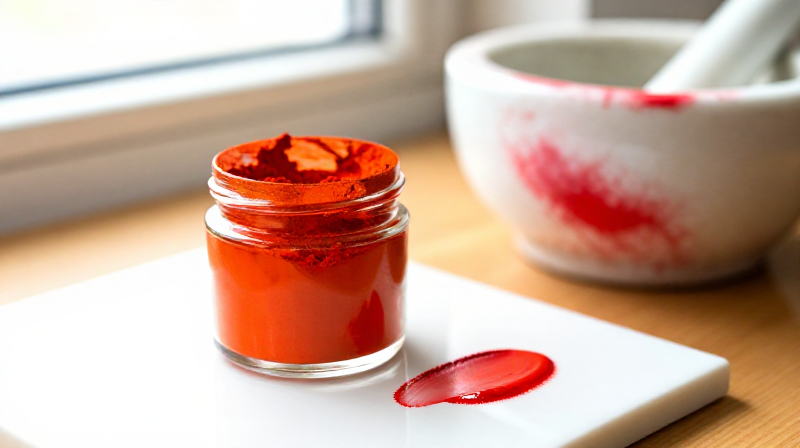

Making DPP Red (Pyrrole Red) — The Accidental Ferrari Pigment That Ended the Synthetic Colour Revolution
DPP Red (Pigment Red 254, CI 56110) — also known as Pyrrole Red or Diketo-Pyrrolo-Pyrrole Red — is the youngest major pigment in the painter's palette and one of the most remarkable accidental discoveries in colour chemistry. In 1974, chemist Abul Iqbal at Ciba-Geigy in Basel was attempting to synthesise a lactam intermediate for pharmaceutical research. Instead, the reaction produced a brilliant, insoluble red solid that proved to be an entirely new class of chromophore: the diketopyrrolopyrrole (DPP) system.
The molecule — 3,6-diphenyl-2,5-dihydropyrrolo[3,4-c]pyrrole-1,4-dione (C₁₈H₁₂N₂O₂) — consists of a central bicyclic diketopyrrole core flanked by two phenyl rings. The extensive conjugation across this planar system absorbs green light strongly, producing an intense, brilliant red with a slight orange undertone. The pigment was not commercialised until 1986, after over a decade of development to optimise its crystal form and processing.
The synthesis is deceptively simple — a one-pot condensation of diethyl succinate with benzonitrile using a strong alkoxide base. Two molecules of benzonitrile and one of diethyl succinate combine to form the DPP core in a single step. The elegance of this reaction — three cheap, simple starting materials producing a world-class pigment — makes it one of the most remarkable transformations in synthetic chemistry.
PR254 is the pigment of choice for Ferrari red automotive paint, and it dominates the modern artist's palette as the most permanent, brilliant warm red available. It has essentially perfect lightfastness (ASTM I), extraordinary heat stability (above 350 °C), and complete resistance to acids, alkalis, and solvents.
SAFETY WARNING: Sodium metal reacts violently with water and is flammable. Benzonitrile is toxic by inhalation and skin absorption. tert-Amyl alcohol vapours are narcotic. Work under ventilation with full PPE. Have dry sand (not water) available for sodium fires.
Maudhui hatari
Blueprint hii ina taratibu za hatari. Ingia na uwashe maudhui ya hatari katika mipangilio ya akaunti yako ili kuona maagizo ya hatua kwa hatua.
IngiaMchoro huu unatengeneza
Blueprint zinazohusiana
Blueprint hizi zinashiriki maarifa — mbinu, vifaa au kanuni
Making Cadmium Red — The Brilliant Cadmium Selenide Pigment of the 20th Century
na Charlie
SANAA
Making Synthetic Alizarin Crimson — The Coal Tar Pigment That Destroyed the Madder Industry
na Charlie
SANAA
Making Hansa Yellow — The Monoazo Pigment in Every Paint Box Since 1910
na Charlie
SANAA
Making Isoindoline Yellow — The High-Performance Pigment That Outlasts Cadmium
na Charlie
SANAA
Making Dioxazine Violet — The Staggeringly Powerful Purple That Replaced Cobalt Violet
na Charlie
SANAA
Making Phthalocyanine Blue — The Copper Complex That Became the World's Most Used Blue Pigment
na Charlie
SANAA
CC0 Umma Wote
Mchoro huu umetolewa chini ya CC0. Uko huru kunakili, kubadilisha, kusambaza, na kutumia kazi hii kwa madhumuni yoyote, bila kuomba ruhusa.
Saidia Mtengenezaji kwa kununua bidhaa kupitia Mchoro wao ambapo wanapata Kamisheni ya Mtengenezaji iliyowekwa na Wachuuzi, au unda marudio mapya ya Mchoro huu na uiunganishe kama kiungo katika Mchoro wako kuchangia mapato.