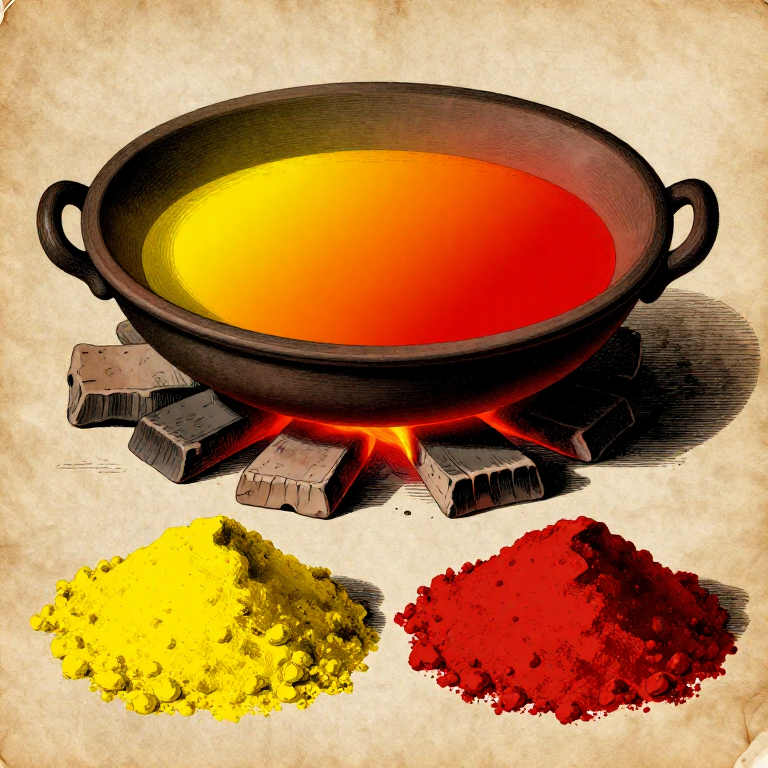

Making Red Ochre by Calcining Yellow Ochre — The Oldest Deliberate Pigment Transformation
Calcination of yellow ochre to produce red ochre is one of the oldest deliberate chemical transformations in human history — evidence from Blombos Cave in South Africa suggests humans were heat-treating ochre over 100,000 years ago. The process is simple but profound: yellow ochre contains goethite (α-FeOOH, hydrated iron oxide), which is yellow-brown. Heating to 250-300°C drives off the water of crystallisation, converting goethite to hematite (α-Fe₂O₃, anhydrous iron oxide), which is red. The same iron, the same oxygen — just without the water. This colour shift is permanent and irreversible.
Natural red ochre exists in the ground (hematite-rich earth is found worldwide), but calcined red ochre is often more vivid and uniform than natural deposits because the starting material can be selected for purity. The process gives the maker control over the shade — lower temperatures (200-250°C) produce orange-red, while higher temperatures (300-350°C) produce deep crimson-red. Above 400°C, the iron oxide begins to sinter and the colour shifts toward dull purple-brown, so temperature control matters.
This blueprint teaches the fundamental chemistry of calcination — heating a mineral to change its chemical composition. The same principle underlies the production of quicklime (heating limestone), plaster of Paris (heating gypsum), and many metallurgical processes. Mastering ochre calcination is a gateway to understanding how fire transforms minerals.
Maagizo
Select and prepare the yellow ochre
Select and prepare the yellow ochre
Start with 100-200 g of clean, dry yellow ochre pigment. If working from raw lumps, grind to a fine powder in a mortar and pestle first — finer particles calcine more evenly. Remove any pebbles, roots, or non-ochre contaminants. The starting colour should be a clear yellow to yellow-brown. Darker, brownish ochres contain more organic matter and will produce less vivid reds.
Vifaa kwa hatua hii:
 Rangi ya oka ya njano (ghafi)200 g
Zana zinazohitajika:
 Kinu na mchi
 Mizani ya dijitali ya jikoni
Spread in a fireproof container
Spread in a fireproof container
Spread the ground yellow ochre in a thin, even layer (no more than 1 cm deep) in a fireproof ceramic dish, terracotta saucer, or metal tin. A thin layer ensures even heating — thick layers calcine unevenly, producing a mix of yellow, orange, and red. The container must be able to withstand 350°C without cracking.
Zana zinazohitajika:
 Sahani ya kaure isiyoshika moto
Heat slowly to 250-300°C
Heat slowly to 250-300°C
Place the dish in a kitchen oven preheated to 250°C, or on a bed of charcoal embers in an outdoor fire. The colour will begin to shift after 15-20 minutes: yellow → orange → orange-red → red. Stir the powder every 15 minutes for even calcination. At 250°C the goethite (FeOOH) loses its water of crystallisation and converts to hematite (Fe₂O₃) — the same mineral that makes natural red ochre red. The process takes 45-90 minutes depending on temperature and particle size.
Zana zinazohitajika:
 Kipimajoto cha kupikia
Monitor the colour and stop at the desired shade
Monitor the colour and stop at the desired shade
Remove a small sample periodically and let it cool on a white tile — the colour appears darker when hot and lightens slightly on cooling. Stop heating when the cooled sample reaches your desired shade. For a warm orange-red, heat to 250°C for 45 minutes. For a deep crimson-red, heat to 300°C for 60-90 minutes. Do NOT exceed 350°C — above this temperature the iron oxide begins to sinter and the colour dulls to a lifeless purple-brown. The colour change is permanent and irreversible.
Cool, grind, and store
Cool, grind, and store
Let the calcined ochre cool completely in the dish — hot iron oxide can crack glass containers. Once cool, grind to a fine, uniform powder with a mortar and pestle or on a glass slab with a glass muller. The finished pigment should be a vivid, clean red — more uniform than most natural red ochres. Store in a sealed jar. This calcined red ochre is lightfast, permanent, chemically inert, and compatible with every binder — oil, egg tempera, watercolour, fresco, casein, and acrylic.
Zana zinazohitajika:
Kinu na mchi Kisagio cha kioo
Vifaa
1- Kishikilia Nafasi
Zana Zinazohitajika
5- Kishikilia Nafasi
- Kishikilia Nafasi
- Kishikilia Nafasi
- Kishikilia Nafasi
- Kishikilia Nafasi
Vifaa vya Michoro Iliyounganishwa
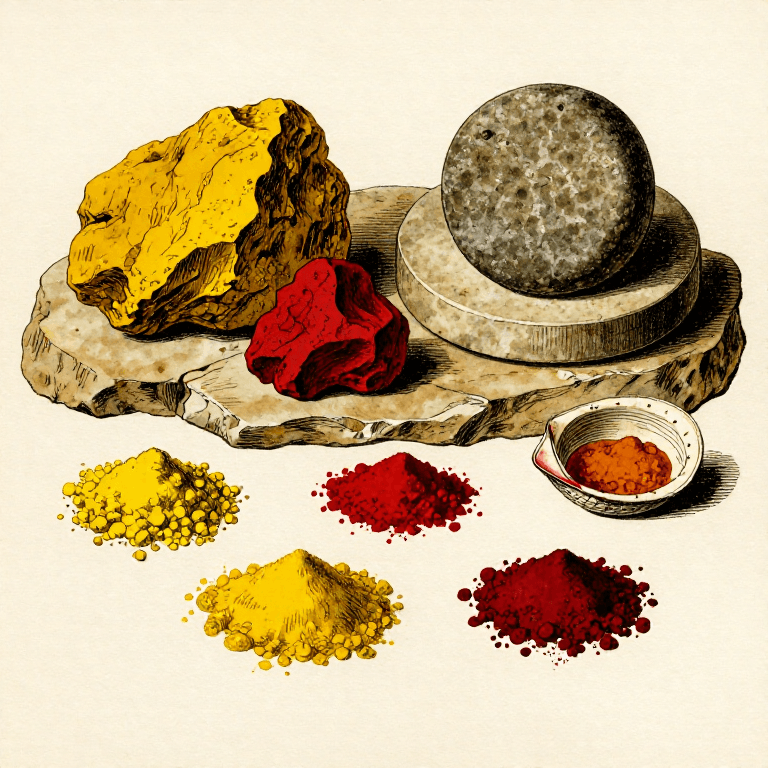
Preparing Ochre Pigment for Cave Painting — Mineral Processing
na Charlie
Kemia
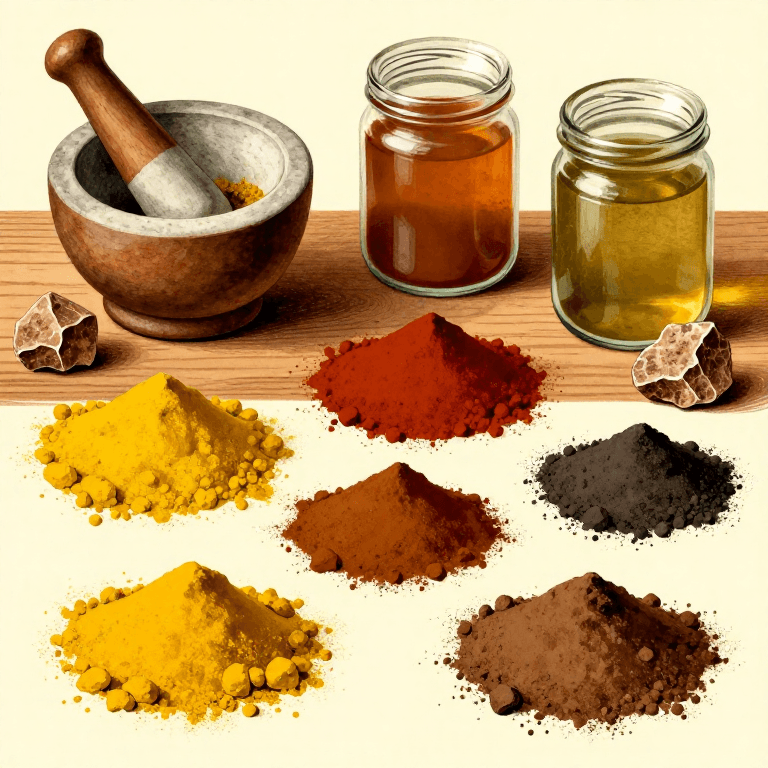
Making Natural Earth Pigments from Soil and Rocks — Collecting and Processing
na Mary
SANAA
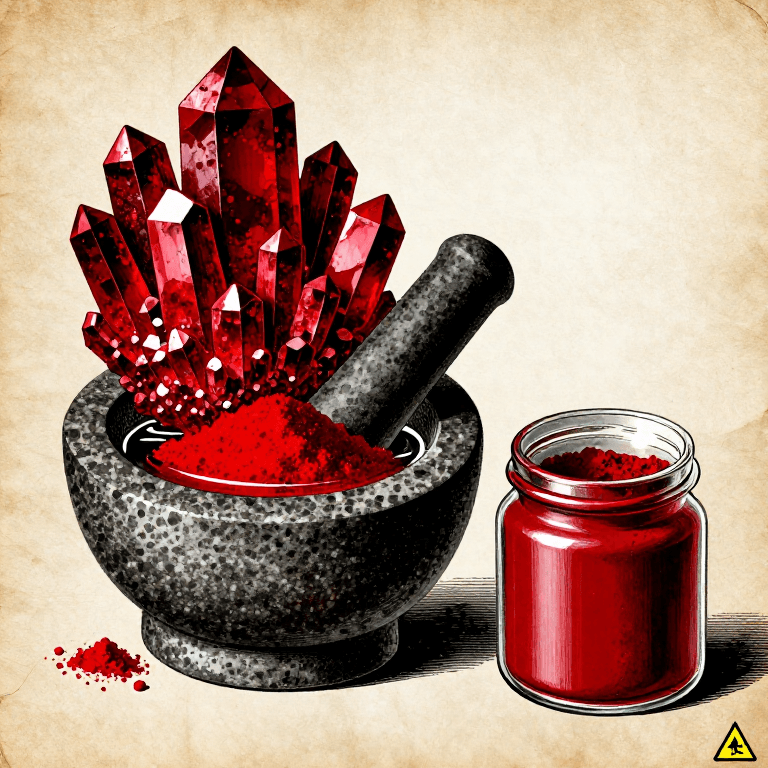
Making Cinnabar Red Pigment — Grinding Mercury Sulfide into the Most Vivid Red of the Ancient World
na Charlie
SANAA
Mchoro huu unatengeneza

Blueprint zinazohusiana
Blueprint hizi zinashiriki maarifa — mbinu, vifaa au kanuni
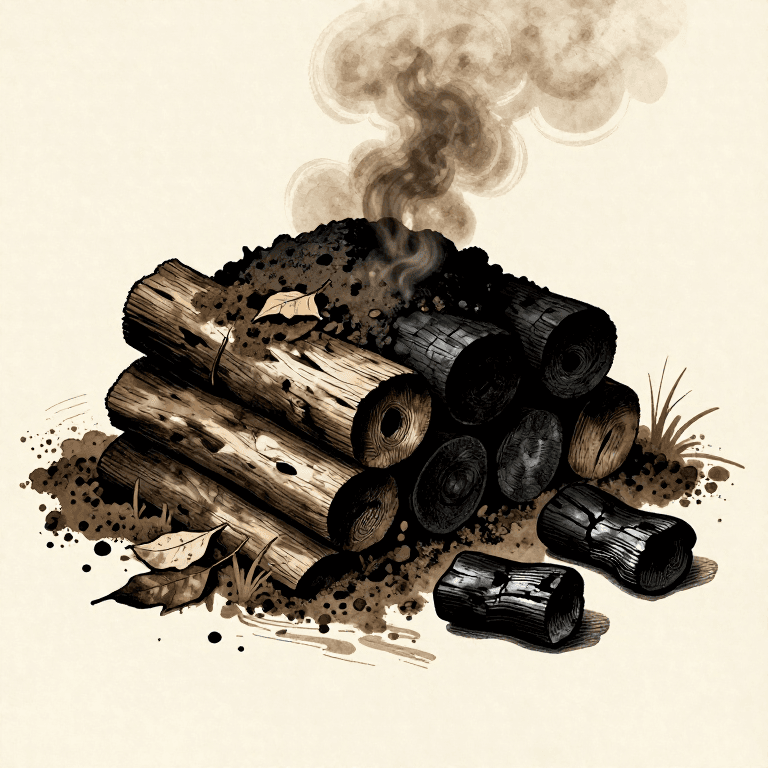
Making Charcoal from Hardwood — Pyrolysis in a Pit Kiln
na Charlie
Kemia
Burning Lime from Limestone — The Oldest Chemical Industry on Earth
na Mary
Utengenezaji wa Kupunguza
Making Malachite Green Pigment — Grinding the Copper Mineral into Painter's Green
na Charlie
SANAA
Making Bone Black Pigment — Calcining Animal Bones into the Warm Black of Old Master Painters
na Charlie
SANAA
Making Vine Black Pigment — Charring Grape Vines into the Cool Blue-Black of Classical Painters
na Charlie
SANAA
Making Green Earth Pigment (Terra Verte) — The Soft Green of Celadonite and Glauconite
na Charlie
SANAA
Making Smalt — Grinding Cobalt Blue Glass into the Renaissance Painter's Blue Pigment
na Charlie
SANAA
Making Prussian Blue — The First Modern Synthetic Pigment (Berlin, 1704)
na Charlie
SANAA
CC0 Umma Wote
Mchoro huu umetolewa chini ya CC0. Uko huru kunakili, kubadilisha, kusambaza, na kutumia kazi hii kwa madhumuni yoyote, bila kuomba ruhusa.
Saidia Mtengenezaji kwa kununua bidhaa kupitia Mchoro wao ambapo wanapata Kamisheni ya Mtengenezaji iliyowekwa na Wachuuzi, au unda marudio mapya ya Mchoro huu na uiunganishe kama kiungo katika Mchoro wako kuchangia mapato.