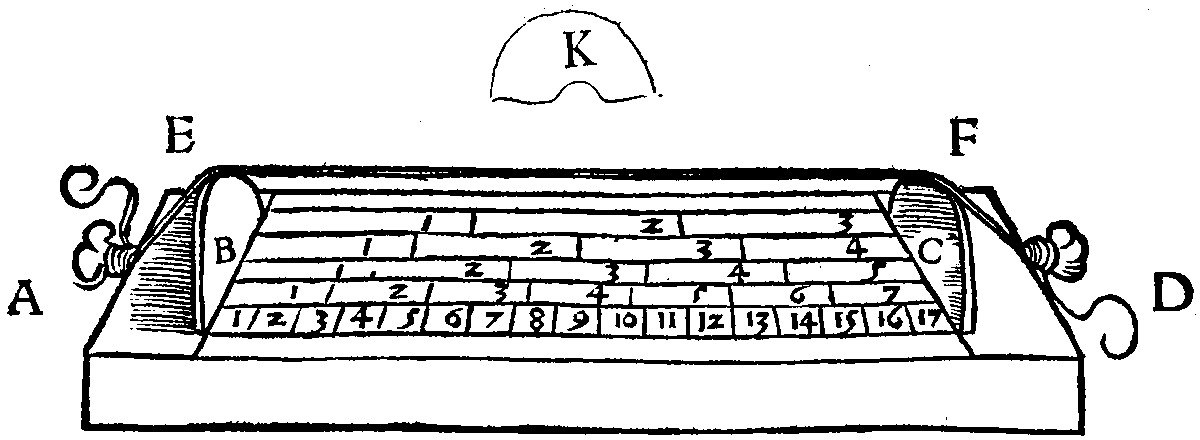


Monochord
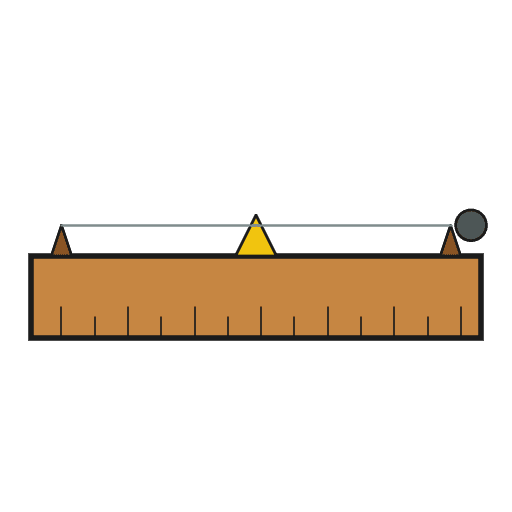
One string over a box, and a bridge you can slide along it. That is the whole instrument, and it is the oldest apparatus in physics that is still worth building.
Move the bridge to the exact middle so you play half the string, and the note you get is an octave above the open string. Set the bridge so you play two thirds of it, and you get a perfect fifth. Those are not approximations — they are 2:1 and 3:2, whole numbers, and they sound consonant precisely because the ratios are simple.
Tradition credits Pythagoras with the discovery, and the monochord is the instrument the story attaches to. What you can verify yourself, in about forty minutes with a ruler, is the underlying claim: musical intervals correspond to simple ratios of string length. That is a measurement, not a belief, and it is the beginning of mathematical physics.
Maagizo
Take a hollow box
Take a hollow box
Use a wooden box at least 600 mm long — a long soundbox gives a longer string and finer bridge placement. It must be hollow; a solid plank will barely sound.
Vifaa kwa hatua hii:
 Kipande cha mbao ngumu1 kipande
Fix a nut at each end
Fix a nut at each end
Glue a hardwood strip 10 mm tall across the box near each end. These two fixed bridges define the string's full sounding length — measure between them and write it down.
Anchor the string at one end
Anchor the string at one end
Fix a steel string to a screw or pin beyond one nut. A plain steel guitar string works well and holds tension without stretching much once settled.
Vifaa kwa hatua hii:
 Waya wa Chuma wa Muziki 0.032"1 mita
Fit a tuning peg at the other end
Fit a tuning peg at the other end
Fit a guitar machine head or an eye bolt past the far nut and tension the string until it rings a clear steady note. It does not matter which note — every result here is a ratio.
Vifaa kwa hatua hii:
 Vigingi vya Kupanga Sauti1 kipande
Fix a ruler alongside the string
Fix a ruler alongside the string
Glue or tape a millimetre ruler along the box, zeroed at the inside edge of one nut. Every measurement from here is read directly off it.
Zana zinazohitajika:
 Rula
RulaMake the movable bridge
Make the movable bridge
Cut a small wedge slightly taller than the nuts, so sliding it under the string lifts it clear. It must move freely but stay where you put it.
Sound the open string and listen
Sound the open string and listen
Pluck the full length and hold the note in your head. This is the reference every interval is measured against.
Halve the string — find the octave
Halve the string — find the octave
Slide the bridge to exactly half the sounding length and pluck one side. The note is an octave higher — the same note, higher. Ratio 2:1.
Take two thirds — find the fifth
Take two thirds — find the fifth
Set the bridge so the plucked portion is two thirds of the full length. That is a perfect fifth above the open string. Ratio 3:2 — the most consonant interval after the octave.
Take three quarters — find the fourth
Take three quarters — find the fourth
Set the plucked portion to three quarters of the full length: a perfect fourth, ratio 4:3. You now have the three intervals every tuning system in history is built from.
Try a deliberately awkward ratio
Try a deliberately awkward ratio
Now set the bridge at some ratio like 17:11 and listen. It sounds rough and unsettled. Simple ratios sound consonant; complicated ones do not. That is the whole discovery, and you just heard it.
Record your measurements
Record your measurements
Tabulate bridge position, plucked length, length as a fraction of the whole, and the interval you heard. Your fractions should land close to 1/2, 2/3 and 3/4 — check how close you actually got.
History & Context
History & Context
The claim, and the caution. According to tradition, Pythagoras discovered the correspondence between simple ratios of string length and consonant musical intervals, and the monochord is the instrument the tradition attaches to him. Treat the attribution loosely: the surviving accounts are centuries later than Pythagoras and include stories — such as hearing the ratios in the differing weights of blacksmiths' hammers — that are physically wrong. What is not in doubt is the physics, which you can measure yourself, and that Greek thinkers built a whole philosophy on it.
Why simple ratios sound good. A plucked string does not vibrate only at one frequency; it also vibrates in halves, thirds, quarters and so on, producing a harmonic series above the fundamental. When two notes are in a simple ratio, many of their harmonics coincide exactly. When the ratio is complicated, harmonics land close together but not together, and the resulting beating is heard as roughness. Consonance is not a cultural convention here; it is coincidence of overtones.
Length, not just pitch. The monochord's importance is that it makes an audible quantity — pitch — into a measurable one — length. It is arguably the first apparatus that converts a sensation into a number you can put on a ruler. That move, from quality to quantity, is the foundational move of experimental science, and it happened in music before it happened in mechanics.
The problem it also created. Stack twelve perfect fifths and you should arrive back where you started, seven octaves up. You do not: 3:2 raised to the twelfth power does not equal 2 raised to the seventh. The gap, the Pythagorean comma, is small but audible, and it means no tuning can have every fifth and every octave pure at once. Two and a half thousand years of tuning systems — meantone, well temperament, the equal temperament on a modern piano — are all compromises about where to hide that gap. The monochord reveals both the beautiful result and the awkward consequence.
Still in the lab. The monochord stayed in use as a scientific instrument for centuries, appearing in museum collections of historical acoustics apparatus alongside far more elaborate devices. It survived because it does one thing perfectly: it isolates a single variable, string length, and lets you hear what changing it does.
Vifaa
3- 1 kipandeKishikilia Nafasi
- Kishikilia Nafasi
- 1 kipandeKishikilia Nafasi
Mchoro huu unatengeneza
CC0 Umma Wote
Mchoro huu umetolewa chini ya CC0. Uko huru kunakili, kubadilisha, kusambaza, na kutumia kazi hii kwa madhumuni yoyote, bila kuomba ruhusa.
Saidia Mtengenezaji kwa kununua bidhaa kupitia Mchoro wao ambapo wanapata Kamisheni ya Mtengenezaji iliyowekwa na Wachuuzi, au unda marudio mapya ya Mchoro huu na uiunganishe kama kiungo katika Mchoro wako kuchangia mapato.