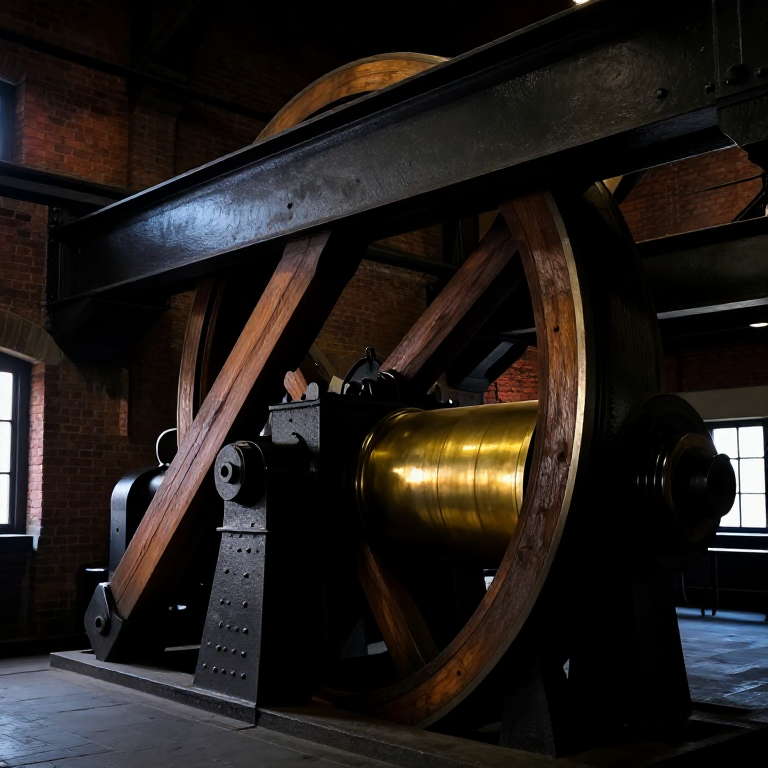


Building a Newcomen Atmospheric Engine — The First Engine to Do Real Work
In 1712 Thomas Newcomen built a machine that changed the world quietly, by pumping water out of coal mines. It was the first engine to turn the heat of a fire into useful mechanical work on a large scale, and every steam engine and motor that followed descends from it.
Its genius is counter-intuitive: the steam does not push the piston. Newcomen's engine fills a cylinder with low-pressure steam, then sprays in cold water to condense that steam into a few drops, leaving a vacuum. The ordinary pressure of the atmosphere — about a tonne on a large piston — then shoves the piston down into the vacuum. That downward stroke rocks a great wooden beam whose far end lifts the mine pump. Because air pressure does the work, it is called an atmospheric engine.
It was thirsty and wasteful, reheating its whole cylinder every stroke, but it was tireless and it worked. For sixty years Newcomen engines drained the mines that supplied the coal that fed the Industrial Revolution — until James Watt's separate condenser made the steam engine efficient enough to drive factories and locomotives.
Maagizo
Grasp the atmospheric principle
Grasp the atmospheric principle
Build the boiler
Build the boiler
Vifaa kwa hatua hii:
 Bamba la Shaba40 kg
 Matofali yanayostahimili moto120 vipande
Cast and bore the cylinder
Cast and bore the cylinder
Vifaa kwa hatua hii:
 Kitofali cha shaba nyeupe1 kipande
 Ngozi2 sqm
Erect the great beam
Erect the great beam
Vifaa kwa hatua hii:
 Boriti ya ujenzi ya msonobari wa Douglas1 kipande
Plumb the steam and water pipes
Plumb the steam and water pipes
Vifaa kwa hatua hii:
 Mrija wa shaba-njekundu6 mita
Zana zinazohitajika:
 Koleo la mabomba
Raise steam
Raise steam
Vifaa kwa hatua hii:
 Makaa ya mawe ya bitumeni50 kg
Admit steam and let the piston rise
Admit steam and let the piston rise
Zana zinazohitajika:
 Vali ya mvuke
Inject cold water to make the vacuum
Inject cold water to make the vacuum
Zana zinazohitajika:
Vali ya mvukeTake the power stroke
Take the power stroke
Vifaa kwa hatua hii:
 Maji30 lita
Drain and repeat
Drain and repeat
Zana zinazohitajika:
Vali ya mvukeMake it self-acting
Make it self-acting
Zana zinazohitajika:
Koleo la mabombaKnow its power and its flaw
Know its power and its flaw
Vifaa
8- 40 kgKishikilia Nafasi
- 120 vipandeKishikilia Nafasi
- 1 kipandeKishikilia Nafasi
- 2 sqmKishikilia Nafasi
- Kishikilia Nafasi
- 6 mitaKishikilia Nafasi
- Kishikilia Nafasi
- 30 litaKishikilia Nafasi
Mchoro huu unatengeneza
Blueprint zinazohusiana
Blueprint hizi zinashiriki maarifa — mbinu, vifaa au kanuni


CC0 Umma Wote
Mchoro huu umetolewa chini ya CC0. Uko huru kunakili, kubadilisha, kusambaza, na kutumia kazi hii kwa madhumuni yoyote, bila kuomba ruhusa.
Saidia Mtengenezaji kwa kununua bidhaa kupitia Mchoro wao ambapo wanapata Kamisheni ya Mtengenezaji iliyowekwa na Wachuuzi, au unda marudio mapya ya Mchoro huu na uiunganishe kama kiungo katika Mchoro wako kuchangia mapato.