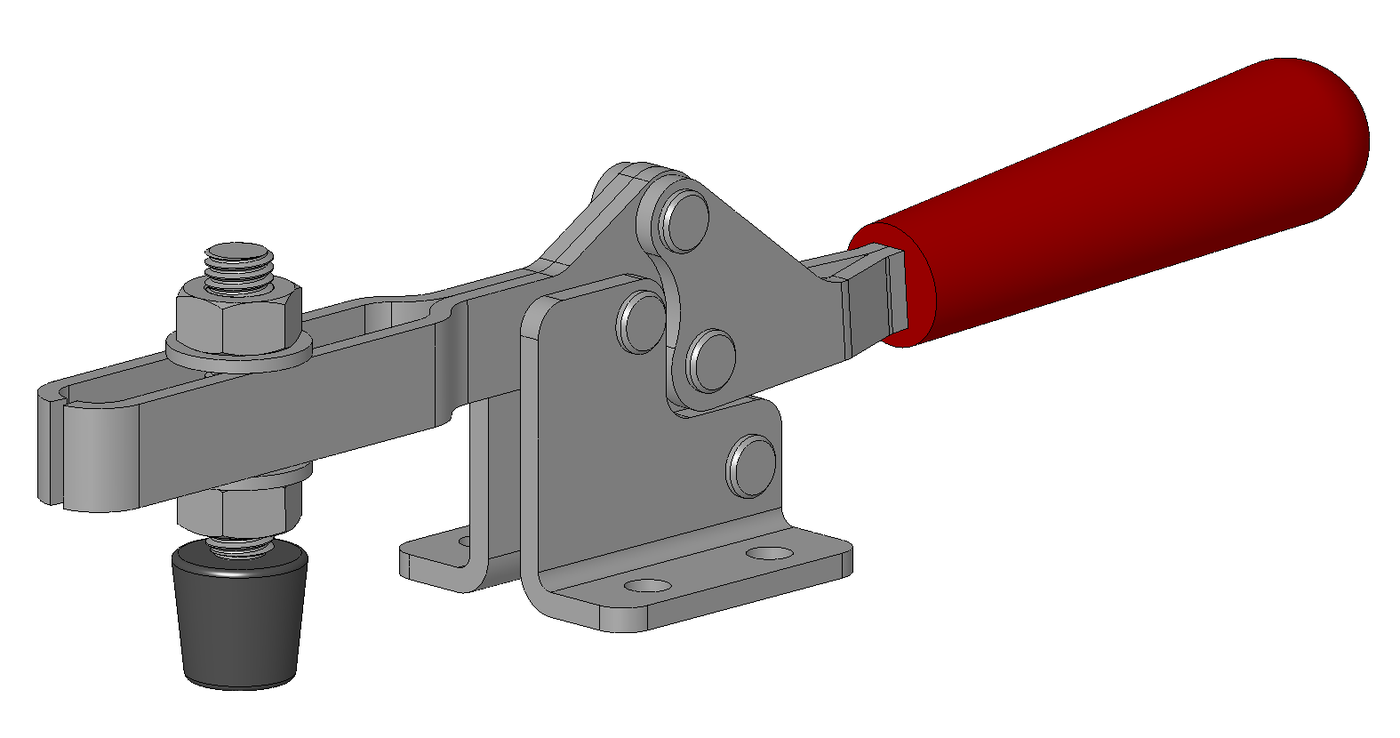


Toggle Clamp
Maagizo
Cut the three links
Cut the three links
A handle, a hold-down arm and a short connecting link. The link's length sets the geometry.
- From 6 mm aluminium flat bar, cut a handle 140 mm, a hold-down arm 110 mm and a connecting link 45 mm, all between hole centres.
- Cut a base bracket 90 × 40 mm from the same stock.
- Drill every pivot hole 5.1 mm.
- Round all the bar ends so nothing fouls through the full swing.
Modern build spec (derived). The 45 mm link with these arm lengths gives a comfortable handle throw and an obvious over-centre snap. Commercial clamps use pressed steel arms and riveted pivots; bar and screws let you change one link and see what happens, which a riveted clamp cannot.
Cut the connecting link last and make a spare 2 mm longer. You will want to compare them in step 4, and it is the one dimension worth experimenting with.Vifaa kwa hatua hii:
 Ubao bapa wa alumini1 kipande
Zana zinazohitajika:
 Fremu ya msumeno wa chuma na mabapa
 Kibano cha meza ya kazi
 Kekee cha Betri
 Seti ya vichimbuzi
 Seti ya tupa
 Kigwe cha Katikati
 Kipima-unene cha dijitali cha inchi 6
Mount the base and assemble the linkage
Mount the base and assemble the linkage
Order matters — the inner pivots become unreachable once the handle is on.
- Fix the base bracket to an 18 mm ply baseplate with M5 × 30 socket head cap screws × 2, M5 flat washers × 4 and M5 hex nuts × 2.
- Pivot the hold-down arm to the bracket first.
- Pivot the connecting link to the hold-down arm second.
- Pivot the handle to both the bracket and the link last.
- Use M5 × 20 socket head cap screws × 4 as pivots, each with M5 flat washers × 2 and an M5 nylon insert lock nut.
Lock nuts on every pivot. A toggle clamp is operated hundreds of times and each cycle works the pivots back and forth under load. Plain nuts loosen, and a loose pivot changes the geometry — which means the clamp stops locking, quietly, at some point you will not notice until the work moves.
Set each pivot to swing freely with no side rock before moving to the next. A tight pivot deep in the linkage cannot be reached later without dismantling everything above it.Vifaa kwa hatua hii:
 Bati la mbao za kubandika1 karatasi
 Washa bapa12 vipande
 Nati ya pembe sita2 vipande
 Nati ya Kufungasha yenye Nailoni4 vipande
Zana zinazohitajika:
Kekee cha BetriSeti ya vichimbuzi Seti ya funguo za pembe sita
 Skwea ya mchanganyiko
Add the adjustable pressure spindle
Add the adjustable pressure spindle
The linkage sets the FORCE; this screw sets the HEIGHT it acts at.
- Drill and tap the hold-down arm's free end M6, or fix an M6 hex nut to it as the thread.
- Fit an M6 × 50 hex bolt through it as the pressure spindle, with a lock nut above to hold the setting.
- Fit a rubber or nylon pad on the spindle end.
- Set the spindle so the linkage goes over-centre with the work in place.
Vifaa kwa hatua hii:
Nati ya Kufungasha yenye Nailoni1 kipande Seti ya springi za kubana1 seti
Zana zinazohitajika:
Kekee cha BetriSeti ya vichimbuziSeti ya funguo za pembe sitaSeti ya tupaFind the over-centre distance
Find the over-centre distance
The whole behaviour lives in a couple of millimetres. Measure them.
- Close the clamp slowly and watch the two pivots of the connecting link relative to the line between the outer pivots.
- Mark the handle position where the three pivots are exactly in line — this is dead centre, maximum force, zero lock.
- Continue closing to the stop and measure how far past that line the middle pivot has travelled.
- Now try to open the clamp by pulling on the hold-down arm alone.
Zana zinazohitajika:
Kipima-unene cha dijitali cha inchi 6Skwea ya mchanganyikoWhere else it hides, and history
Where else it hides, and history
Once you can recognise an over-centre linkage you find it everywhere: the latch on a Kilner jar, the lever on a bicycle quick-release hub, the buckle on a ski boot, the catch on a flight case, the clamp on a machine vice. All the same geometry, all locking for the same reason, all released by the same single movement.
Why the force is repeatable. With a screw clamp the force depends entirely on how hard the operator turns it, so no two setups match. A toggle clamp closes to a mechanical stop, so the deflection — and therefore the force — is the same every cycle. In production work that repeatability matters more than the absolute figure, because it means every part is held identically.
The theoretical infinity, and why it is not real. At exactly dead centre the mechanical advantage is unbounded on paper. In practice the links deflect, the pivots have clearance, and the force is limited by the stiffness of the parts. This is a good example of a mechanism whose idealised mathematics says something that a real build quietly corrects.
Its siblings: the toolmaker's clamp gives parallel jaws and fine control but is slow. A screw jack gives enormous force and holds by friction. A toggle gives instant, repeatable, self-locking action within a fixed opening. Speed, force, precision — the same three-way trade as the rest of this batch, resolved differently.
Vifaa
6- 1 kipandeKishikilia Nafasi
- 1 karatasiKishikilia Nafasi
- 12 vipandeKishikilia Nafasi
- 2 vipandeKishikilia Nafasi
- 5 vipandeKishikilia Nafasi
- Kishikilia Nafasi
Zana Zinazohitajika
9- Kishikilia Nafasi
- Kishikilia Nafasi
- 1 vendor sell this, none ship to you yetKishikilia Nafasi
- Kishikilia Nafasi
- Kishikilia Nafasi
- Kishikilia Nafasi
- Kishikilia Nafasi
- Kishikilia Nafasi
- Kishikilia Nafasi
Mchoro huu unatengeneza
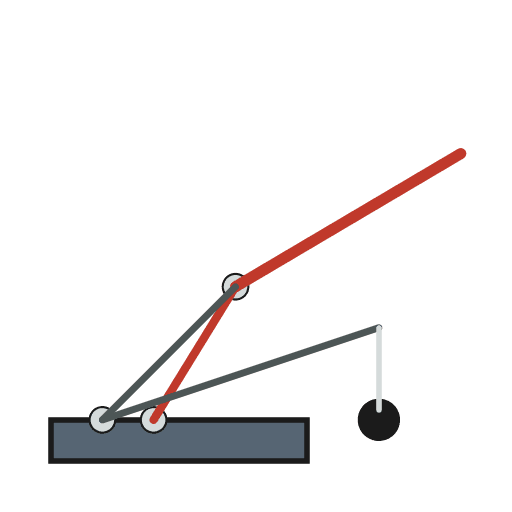
Blueprint zinazohusiana
Blueprint hizi zinashiriki maarifa — mbinu, vifaa au kanuni
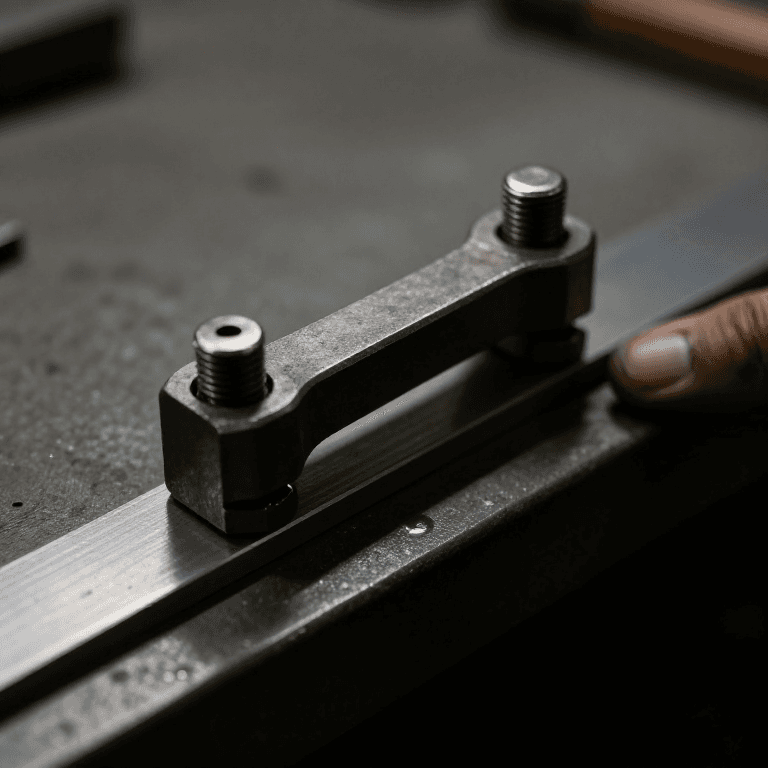
CC0 Umma Wote
Mchoro huu umetolewa chini ya CC0. Uko huru kunakili, kubadilisha, kusambaza, na kutumia kazi hii kwa madhumuni yoyote, bila kuomba ruhusa.
Saidia Mtengenezaji kwa kununua bidhaa kupitia Mchoro wao ambapo wanapata Kamisheni ya Mtengenezaji iliyowekwa na Wachuuzi, au unda marudio mapya ya Mchoro huu na uiunganishe kama kiungo katika Mchoro wako kuchangia mapato.