
Panning Gold from Alluvial Deposits — Gravity Separation of the Noble Metal
Gold (Au, element 79) is one of the few elements found in nature as a pure, uncombined metal. Its extraordinary density — 19.32 g/cm³, over seven times heavier than quartz sand — made it one of the first metals recognized by humans. The oldest known gold artifacts, from the Varna Necropolis in Bulgaria, date to approximately 4600 BCE. Egyptian pharaohs organized large-scale mining operations in Nubia by 3100 BCE, and the Lydians struck the first gold coins around 600 BCE.
Gold occurs in two geological settings: primary (lode) deposits, where it forms in hydrothermal quartz veins, and secondary (placer) deposits, where weathering and water transport concentrate gold particles in stream gravels. Because gold is chemically inert — it does not oxidize, tarnish, or dissolve in any single acid — it survives transport intact while lighter minerals wash away.
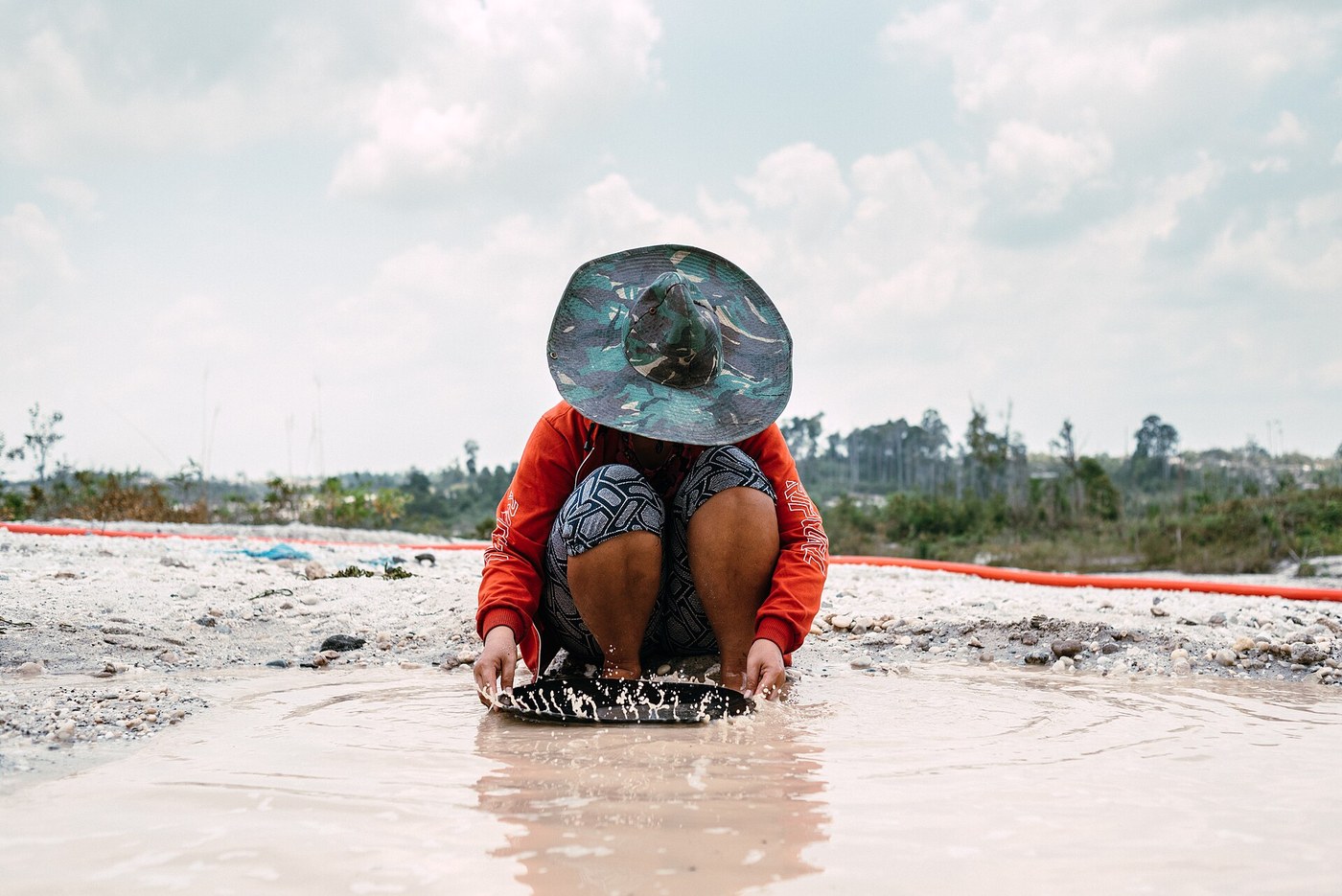
This blueprint teaches the original and most fundamental method of gold extraction: gravity separation by panning. The technique exploits the extreme density differential between gold (19.32 g/cm³) and surrounding sediment (2.5–2.8 g/cm³). By agitating gravel in water and tilting the pan, lighter particles wash over the rim while dense gold particles sink and remain. No chemicals, heat, or industrial equipment are required — just a pan, flowing water, and patience. This is how humanity first obtained gold, and the physics has not changed in 6,000 years.
Maagizo
Understand gold chemistry and physical properties
Gold (Au, from Latin aurum, meaning 'shining dawn') is element 79, a transition metal in Group 11, Period 6 of the periodic table. It is one of the least reactive chemical elements: it does not oxidize in air or water, does not dissolve in hydrochloric acid, nitric acid, or sulfuric acid individually, and resists attack by all single acids. Only aqua regia (a 3:1 mixture of hydrochloric and nitric acid) and a few specialized reagents such as alkaline cyanide solutions will dissolve it.
Key physical properties: density 19.32 g/cm³ (nearly twice as dense as lead), melting point 1064.18 °C, Mohs hardness 2.5–3 (softer than copper), face-centered cubic crystal structure, and distinctive yellow metallic luster. Gold is the most malleable and ductile of all metals — one gram can be beaten into a sheet of one square meter, and a single ounce drawn into a wire 80 km long.
Gold's extreme density is the physical principle that makes panning work: at 19.32 g/cm³, gold is approximately 7.3 times denser than quartz sand (2.65 g/cm³), so gold particles sink rapidly in agitated water while lighter sediments wash away.
Learn how gold forms in nature
Gold forms in hydrothermal processes deep in the Earth's crust. Superheated water (200–400 °C) circulating through rock dissolves trace amounts of gold as chloride or bisulfide complexes. When this fluid cools, decompresses, or encounters chemically reactive rock, gold precipitates out as native metal, typically within quartz veins. These are called primary (lode) deposits.
Over geological time, weathering and erosion break down gold-bearing rock. Because gold is chemically inert and extremely dense, it survives transport by rivers while lighter minerals are carried away. Gold accumulates in locations where water velocity decreases — inside bends of rivers, behind large boulders, in bedrock crevices, and at the confluence of tributaries. These are secondary (placer) deposits, and they are the target of this blueprint.
Placer gold ranges from microscopic flour gold (under 0.1 mm) to rare nuggets weighing kilograms. Most alluvial gold occurs as flakes and fine particles between 0.1 and 2 mm. The gold content of a stream depends on the geology upstream: look for regions with known quartz-vein mineralization, historic mining activity, or geological maps showing Archean or Mesozoic intrusive rocks.
Research regulations and obtain permits
Before prospecting, research the legal requirements in your jurisdiction. Gold panning regulations vary enormously by country, state, and even individual waterways. In many countries, all minerals belong to the state by default, and extracting them without permission is illegal regardless of the amount. In others, recreational panning is permitted on public land with no permit, while others require a low-cost prospecting license.
Key considerations: land ownership (public vs. private — never pan on private land without written permission), existing mining claims (in countries with claim systems, panning on someone else's claim is trespassing), environmental regulations (many jurisdictions prohibit disturbing streambeds during fish spawning seasons), and protected areas (national parks, nature reserves, and heritage sites are almost universally off-limits). In the United States, the Bureau of Land Management (BLM) administers recreational panning on federal land; in the UK, all gold belongs to the Crown.
Contact your local mining authority, geological survey, or land management agency before you begin. Ignorance of the law is not a defense, and penalties for illegal mining can be severe.
Select a promising panning site
Gold concentrates where water velocity drops. The best panning locations are: inside bends of rivers and streams (where the current slows and deposits heavy material on the inside bank), downstream of large boulders (the eddy zone behind a rock traps dense particles), bedrock crevices (gold lodges in cracks and depressions in exposed bedrock), the head of gravel bars (where fast-flowing water meets an obstruction), and confluences (where a tributary joins a larger stream).
Avoid panning in the fastest current — gold has already been swept away. Look for spots where coarse, dark gravel has accumulated. Black sand (magnetite and ilmenite) is a reliable indicator: if you see dark, heavy sand, the same hydraulic conditions that concentrated it also concentrated any gold present.
Check geological maps for known gold occurrences upstream. Historic mining records, available from geological surveys, are invaluable — if gold was found upstream, it was also deposited downstream. Water depth between ankle and knee is ideal for panning comfort and safety.
Prepare tools and equipment
The essential tool is a gold pan — a wide, shallow, circular dish with sloped sides and textured riffles along the inner wall. The standard size is 14 inches (35 cm) in diameter. Black or dark green pans are preferred because gold's yellow color is most visible against a dark background. New pans must be 'seasoned' by scrubbing with sand and water to remove any manufacturing oils — oil causes fine gold to float away instead of sinking.
A classifier (sieve) with approximately 1/4-inch (6 mm) mesh fits over the pan and screens out large rocks and debris before panning, which speeds the process and prevents large stones from bouncing gold out of the pan. A snuffer bottle — a small squeeze bottle with a narrow tip — is used to suck up individual gold flakes from the pan without touching them. A glass specimen vial with a watertight cap stores recovered gold safely.
Bring a 5-gallon bucket for pre-classifying material, a small garden trowel or spoon for digging, and a pair of tweezers for handling larger flakes. Wear rubber boots or waders, sun protection, and bring drinking water. No chemicals or machinery are needed.
Vifaa kwa hatua hii:
Gold Pan (14-inch)1 kipande
Classifier Sieve (1/4-inch mesh)1 kipandeZana zinazohitajika:
Snuffer Bottle
Glass Sample Vial (50ml)
Garden Trowel
Bucket (5-gallon)
Fine-Tip Tweezers
Rubber BootsCollect sample material from the streambed
Collect sample material from the streambed
The richest material lies at the bottom of the gravel layer, directly on top of bedrock or compacted clay. Dig down through the loose surface gravel — the top layer is mostly recent, low-grade material. Gold, being the densest component, migrates downward over time and concentrates at the gravel-bedrock interface, a layer prospectors call the pay streak.
Use a trowel to scrape material from bedrock crevices — gold lodges tightly in cracks and depressions, and may have accumulated there for centuries. Behind and downstream of large boulders, dig into the accumulated gravel on the lee side. Fill your bucket about two-thirds full with this bottom-layer material.
If bedrock is not reachable (too deep), sample from the lowest accessible gravel layer. Avoid surface sand — it contains very little gold. Each panful of material represents roughly 1–2 kg of raw gravel; you will process many pans in a session.
Zana zinazohitajika:
Garden Trowel
Bucket (5-gallon)Classify the material through the sieve
Classify the material through the sieve
Place the classifier sieve on top of your gold pan. Scoop material from the bucket onto the sieve and shake it gently while submerged in stream water. Fine sediment and small particles pass through the mesh into the pan below. Rocks and debris larger than 1/4 inch remain on the screen.
Inspect the oversize material briefly — check for visible nuggets caught on the screen (rare but worth looking). Pick out any large pieces of organic matter (roots, leaves). Discard the screened rocks to one side, not back into the stream where you're working.
Fill the pan approximately half to two-thirds full with classified material. Overfilling makes panning difficult and increases the risk of losing fine gold over the rim. The classified material should be roughly uniform in grain size — no large rocks to interfere with the swirling motion.
Zana zinazohitajika:
Classifier Sieve (1/4-inch mesh)
Gold Pan (14-inch)Submerge the pan and break up clay
Submerge the pan and break up clay
Submerge the pan fully in stream water — the water level should be a few centimeters above the rim. Using your fingers, knead and break apart any clay lumps in the material. Clay traps fine gold particles inside it; if you don't break it up, you will lose that gold. Work the material thoroughly until no intact clay remains and the water above the pan turns muddy.
Gold can also adhere to the surface of clay-coated pebbles. Rub each larger pebble between your fingers underwater before discarding it to release any attached gold. This step is tedious but critical — clay is the single largest cause of gold loss for beginners.
Once all clay is dissolved, let the pan sit submerged for a moment. The heavy materials (gold, black sand, lead shot, garnets) will begin to settle to the bottom immediately due to their higher density.
Zana zinazohitajika:
Gold Pan (14-inch)Perform the initial rough wash
Perform the initial rough wash
Hold the pan level, submerged just below the water surface. Shake it vigorously side to side with a flat, horizontal motion — do NOT tilt the pan during this phase. The shaking action stratifies the material by density: heavy particles (gold, magnetite, ilmenite) sink to the bottom of the pan, while lighter particles (quartz, feldspar, mica) rise to the top.
After 15–20 seconds of vigorous shaking, tilt the pan slightly away from you (approximately 10–15 degrees) and let water wash gently over the rim, carrying away the top layer of light material. Dip the pan into the stream to let water flow across the surface, then return to the flat shaking motion. Repeat this cycle: shake flat to stratify, tilt to wash off the light material.
This rough wash removes approximately 80–90% of the material in the first 2–3 minutes. Work quickly but not carelessly — the gold is at the bottom and is not leaving, provided you shook it flat first before each tilt.
Zana zinazohitajika:
Gold Pan (14-inch)Continue concentrating to heavy sands
Continue concentrating to heavy sands
As the material volume decreases, reduce the aggression of your washing. You should now have roughly a cup of material remaining — mostly dark, heavy minerals (black sand). Continue the shake-and-tilt cycle with gentler tilting angles. The riffles along the inside wall of the pan trap heavy particles and prevent them from sliding out during the tilt phase.
When you are down to approximately two tablespoons of material, stop the aggressive washing. Tilt the pan toward you at a shallow angle (about 5 degrees) and let a thin film of water flow across the remaining concentrate. Gently swirl the water in a circular motion — the lighter black sand will separate from the denser gold, and you will begin to see gold's distinctive yellow color against the dark background of magnetite.
Patience is critical at this stage. Fine flour gold is easy to wash away with one careless swirl. If in doubt, do one less wash rather than one too many.
Zana zinazohitajika:
Gold Pan (14-inch)Identify gold in the concentrate
Identify gold in the concentrate
Gold in the pan has a distinctive bright, metallic yellow color that does not change when the viewing angle shifts — unlike pyrite ('fool's gold'), which appears darker or greenish at certain angles. Gold is soft (Mohs 2.5–3) and malleable: a gold flake pressed with a pin will deform without breaking, while pyrite shatters. Gold flakes are flat and irregularly shaped from being hammered by stream transport.
Common minerals confused with gold: pyrite (FeS₂, pale brass-yellow, cubic crystals, brittle, shatters to black powder), chalcopyrite (CuFeS₂, greenish-yellow, softer than pyrite but harder than gold), and mica (thin, transparent, floats in water — gold never floats). If a particle floats, it is not gold.
Use your hand lens to examine suspect particles. Real gold will show a smooth, warm yellow metallic surface under magnification. Very fine flour gold appears as tiny bright points against the dark sand — these particles may be only 0.1–0.3 mm across.
Zana zinazohitajika:
Hand Lens (10x)
Gold Pan (14-inch)Recover gold using the snuffer bottle
Recover gold using the snuffer bottle
With a small amount of water still in the pan, use the snuffer bottle to individually pick up gold flakes. Squeeze the bulb, place the tip directly onto the gold particle, and release — the suction draws the flake and a small amount of water into the bottle. For very fine gold, this is far more effective than tweezers, which can flick tiny particles out of the pan.
For larger flakes (over 2 mm), fine-tip tweezers work well. Wet the tweezers first to reduce static effects. Pick up the flake and place it into your specimen vial, which should contain a small amount of clean water to prevent the gold from blowing away in wind.
Work methodically across the remaining concentrate. After recovering all visible gold, add a little more water to the pan and swirl again — additional fine gold often becomes visible once the first pass of black sand is disturbed. Repeat until no more gold appears.
Zana zinazohitajika:
Snuffer Bottle
Fine-Tip Tweezers
Glass Sample Vial (50ml)Process additional pans from the same site
Process additional pans from the same site
A single pan of material typically yields very little gold — often just a few specks of flour gold, sometimes nothing visible at all. Productive prospecting requires processing many pans. An experienced panner can process one pan every 5–10 minutes; a beginner should expect 15–20 minutes per pan.
If your first pan produces any gold at all, you are in a promising location. Sample systematically: take material from upstream and downstream of your initial spot, from different sides of the stream, and from varying depths in the gravel. Keep notes on which locations produce the most color (prospector's term for gold in the pan). This information helps you locate the richest part of the pay streak.
If several pans produce no gold, move to a different type of location — try inside bends, bedrock crevices, or downstream of large boulders. Not every stream contains gold, and even productive streams have rich zones and barren zones.
Zana zinazohitajika:
Gold Pan (14-inch)
Garden TrowelClean and separate the recovered gold
Clean and separate the recovered gold
Transfer the contents of your snuffer bottle into a small dish or the cap of your specimen vial. The snuffer bottle contains gold mixed with water and fine black sand. Let the water evaporate in the sun, or carefully pour off excess water while the gold settles to the bottom.
To separate gold from remaining black sand, you can use a small magnet wrapped in plastic film: pass it over the dried concentrate, and the magnetite (iron oxide) will cling to the magnet while non-magnetic gold stays behind. Unwrap the magnet over a separate container to release the magnetite. This is a clean, chemical-free separation that exploits the fact that gold is non-magnetic (diamagnetic) while magnetite is strongly ferromagnetic.
Transfer the cleaned gold into your specimen vial with clean water. Gold in water is easier to transport without losing fine particles to static or wind. Label the vial with the date and location.
Vifaa kwa hatua hii:
Small Magnet1 kipandeZana zinazohitajika:
Glass Sample Vial (50ml)
Fine-Tip TweezersRestore the site and minimize environmental impact
Restore the site and minimize environmental impact
Responsible prospecting leaves no lasting trace. Return all displaced rocks and gravel to their original positions. Fill any holes you dug in the streambed. Scatter discarded oversize material — do not leave piles of sorted gravel. Remove all trash, including your own, and carry out any litter left by others.
Minimize disturbance to aquatic habitat: avoid panning during fish spawning seasons (typically spring in temperate climates), do not trample or disturb streamside vegetation, and never dam or divert the stream flow. Do not wash any chemicals, sunscreen, or insect repellent into the water. Even biodegradable soap is harmful to aquatic invertebrates.
Gold panning, done responsibly, is one of the lowest-impact forms of mineral extraction. You are moving small amounts of gravel, using no chemicals, and generating no waste. Leave the site as you found it — or better.
Document your findings and understand yield expectations
Record the date, GPS coordinates or location description, number of pans processed, and approximate yield (count of visible flakes, estimated total weight if possible). This data is valuable for return visits and for understanding the local geology. A jeweler's scale measuring to 0.01 grams is useful for weighing fine gold; the traditional unit of gold weight is the troy ounce (31.1035 grams).
Realistic expectations: recreational panning in moderately productive streams typically yields 0.01–0.5 grams per day. A few flakes of flour gold in a day of panning is a normal, successful outing. Finding a visible nugget (over 1 gram) is uncommon; nuggets over 10 grams are genuinely rare events. The value of recreational gold panning lies in the geological education, outdoor experience, and connection to humanity's oldest metallurgical tradition — not in the monetary value of the recovered gold.
If you find significant gold, re-read the legal requirements in Step 3. In many jurisdictions, discovery of economic quantities triggers reporting obligations and claim-registration requirements.
Vifaa
3- 1 kipandeKishikilia Nafasi
- 1 kipandeKishikilia Nafasi
Zana Zinazohitajika
9- Kishikilia Nafasi
- Kishikilia Nafasi
- Kishikilia Nafasi
- Kishikilia Nafasi
- Kishikilia Nafasi
- Kishikilia Nafasi
- Kishikilia Nafasi
- Kishikilia Nafasi
- Kishikilia Nafasi
CC0 Umma Wote
Mchoro huu umetolewa chini ya CC0. Uko huru kunakili, kubadilisha, kusambaza, na kutumia kazi hii kwa madhumuni yoyote, bila kuomba ruhusa.
Saidia Mtengenezaji kwa kununua bidhaa kupitia Mchoro wao ambapo wanapata Kamisheni ya Mtengenezaji iliyowekwa na Wachuuzi, au unda marudio mapya ya Mchoro huu na uiunganishe kama kiungo katika Mchoro wako kuchangia mapato.