SANAA
UREMBO NA USTAWI
UJANJA
UTAMADUNI NA HISTORIA
BURUDANI
MAZINGIRA
CHAKULA NA VINYWAJI
UHANDISI WA KINYUME
SAYANSI
MICHEZO
TEKNOLOJIA
VAZI


Passive Autofocus (Two-Array Comparison)
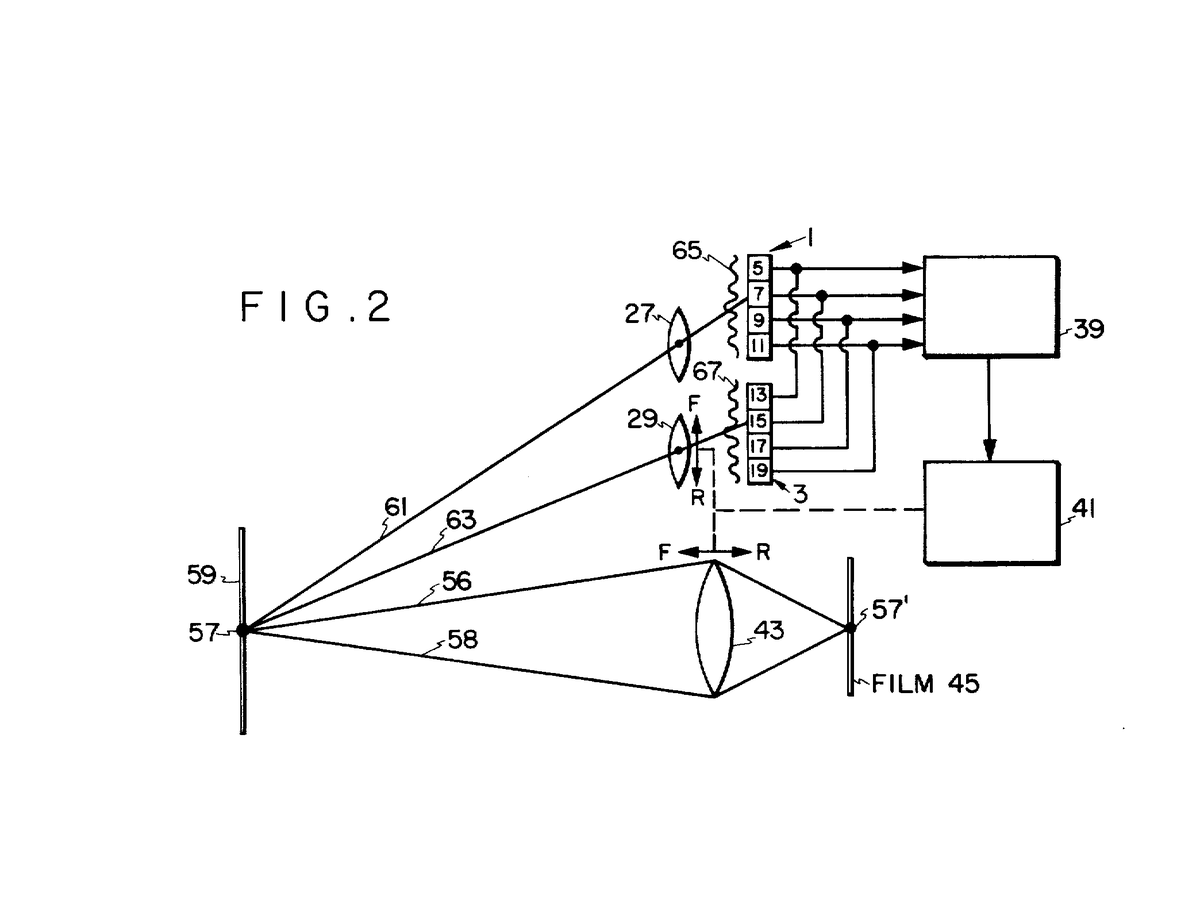
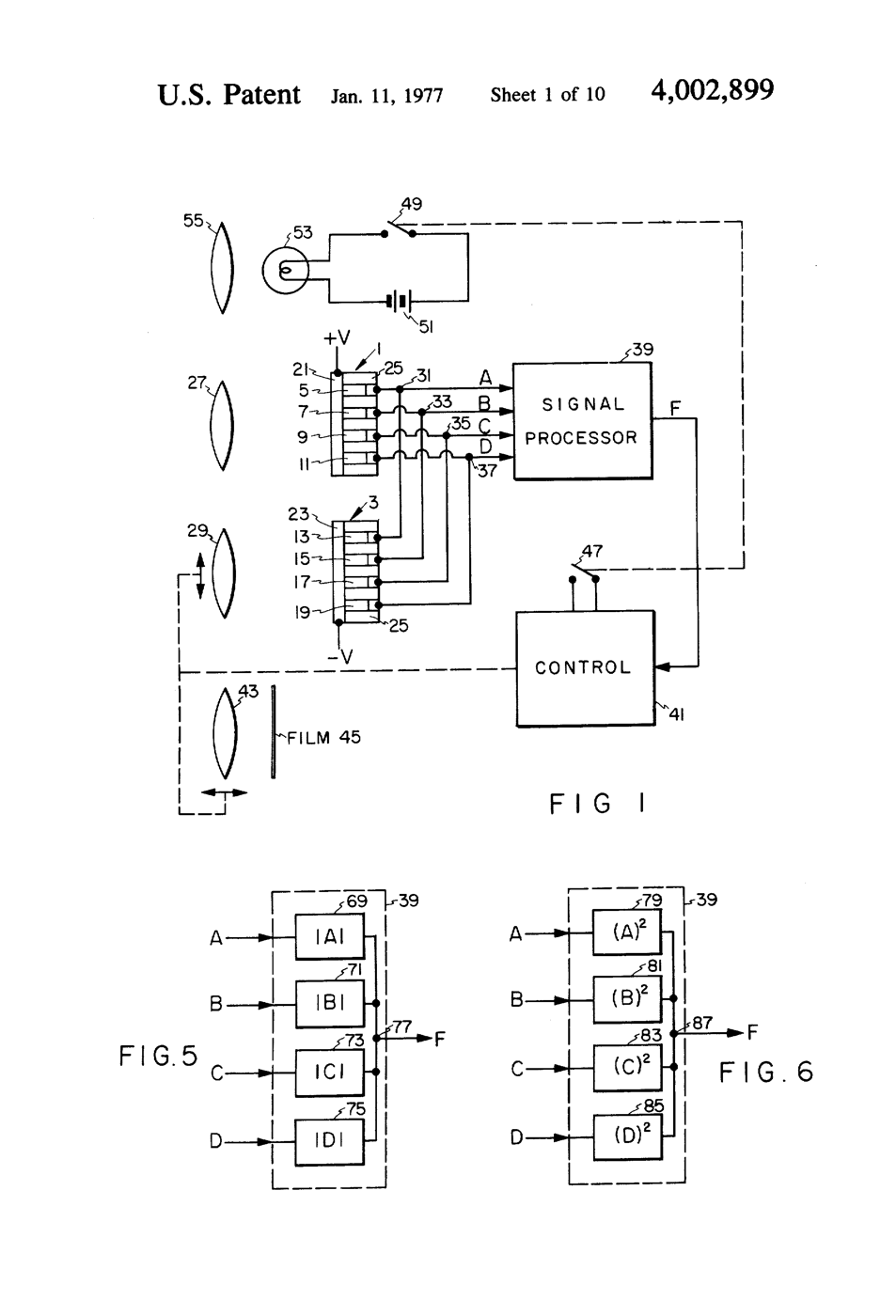
Norman Stauffer at Honeywell built a focus detector from two rows of tiny light sensors side by side on one chip. In his FIGURE 2 each row views the subject through its own small lens, a short distance from the other - like the two windows of a rangefinder. How far one row's picture is shifted against the other's gives the subject's distance, and the camera sets the taking lens to match, without trial and error. Compact cameras from 1977 used it; later SLRs moved the same comparison behind the taking lens itself (phase detection).
**US 4,002,899**, "Focus detecting apparatus", Stauffer, assigned to Honeywell, filed 31. October 1975, granted 11. January 1977: "radiation responsive elements formed on a single planar substrate and divided into two similar coplanar detector arrays lying immediately adjacent each other".
**You see the principle with a card**: a two-hole mask gives a lens two viewpoints, just as Stauffer's two lenses do; out of focus the point splits in two, and which spot vanishes when you cover one hole tells you which way to focus.
Kati
90 minutes
Maagizo
1
1
Make the two-hole mask
Make the two-hole mask
Cut a card disc to fit a lens holder. Punch two 3 mm holes 20 mm apart, symmetric about the centre.
Vifaa kwa hatua hii:
 Kadi nzito nyeusi1 karatasi
Zana zinazohitajika:
 Kisu cha kazi za mikono
 Rula
Rula2
2
A point of light
A point of light
Cover the torch with foil pierced by one pin-sized hole. Put it 2 m from the bench in a dim room.
Vifaa kwa hatua hii:
 Karatasi ya Alumini1 karatasi
Zana zinazohitajika:
 Tochi ya LED ya ukaguzi
 Tepi ya kupimia
 Utepe wa kufunika
3
3
Split and join
Split and join
Mount a 100 mm convex lens with the mask right in front of it, and a tracing-paper screen behind. Slide the screen: two spots merge into one exactly at focus. Measure their separation 5 and 10 mm either side of focus.
Vifaa kwa hatua hii:
 Seti ya lenzi mbonyeo1 seti
 Roli ya karatasi ya kufuatilia mifano1 karatasi
Zana zinazohitajika:
 Meza ya macho na reli
 Seti ya vishikio vya lenziRula
4
4
Which way?
Which way?
With the screen too close, cover the left hole and note which spot disappears. Repeat with the screen too far. The answer flips: that is the direction signal phase detection gives for free.
5
5
Triangles and correlation
Triangles and correlation
Inapakia daftari la Jupyter…
6
6
History & Context
History & Context
**What the patent specifies:** two similar, adjacent, coplanar arrays of radiation-sensitive elements on one substrate, whose outputs are compared to measure distance or focus. **Modern build (derived):** a Scheiner two-hole mask - two viewpoints and an image shift, made visible.
Christoph Scheiner described the two-hole experiment in 1619 to study the eye's focusing. Honeywell's chips put it into cameras; today's phones put phase-detection pixels directly into the image sensor. Its limits: it needs contrast (a blank wall defeats it) and precise alignment between the detector and the lens.
Vifaa
4- 1 karatasiKishikilia Nafasi
- 1 karatasiKishikilia Nafasi
- 1 setiKishikilia Nafasi
- 1 karatasiKishikilia Nafasi
Zana Zinazohitajika
7- Kishikilia Nafasi
- Kishikilia Nafasi
- Kishikilia Nafasi
- 1 vendor sell this, none ship to you yetKishikilia Nafasi
- Kishikilia Nafasi
- Kishikilia Nafasi
- Kishikilia Nafasi
Blueprint zinazohusiana
Blueprint hizi zinashiriki maarifa — mbinu, vifaa au kanuni

CC0 Umma Wote
Mchoro huu umetolewa chini ya CC0. Uko huru kunakili, kubadilisha, kusambaza, na kutumia kazi hii kwa madhumuni yoyote, bila kuomba ruhusa.
Saidia Mtengenezaji kwa kununua bidhaa kupitia Mchoro wao ambapo wanapata Kamisheni ya Mtengenezaji iliyowekwa na Wachuuzi, au unda marudio mapya ya Mchoro huu na uiunganishe kama kiungo katika Mchoro wako kuchangia mapato.