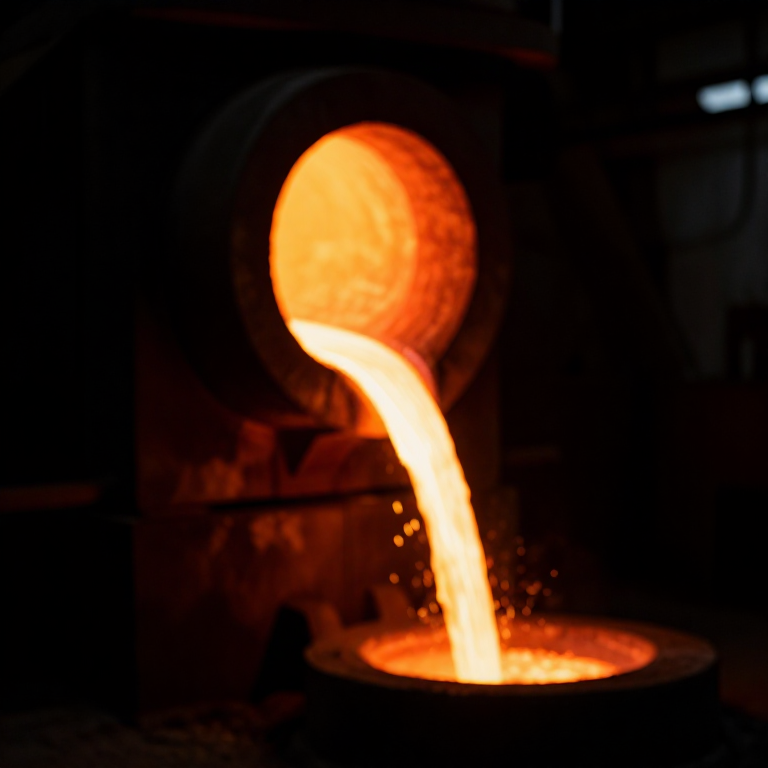


Smelting Pig Iron in a Coke Blast Furnace — Molten Iron at Industrial Scale
The bloomery gave the ancient world iron, but only in small spongy lumps, one slow batch at a time. The blast furnace changed everything: a tall shaft kept continuously charged and blown produces a steady river of molten iron. Where a bloomery never melts its metal, a blast furnace runs hot enough to liquefy iron entirely, letting it pool at the hearth and be tapped out by the tonne.
The key is heat and chemistry working together. A powerful air blast burns coke to carbon monoxide, which strips the oxygen from iron ore; meanwhile the descending iron soaks up carbon until it melts. Limestone added as flux carries off the stony impurities as a floating slag. What runs out of the tap hole is pig iron — iron saturated with about four percent carbon: hard, brittle, and perfect for casting or for refining into wrought iron and steel.
When coke replaced charcoal as the blast-furnace fuel in the early 1700s, iron could finally be made in unlimited quantity without consuming whole forests. Cheap pig iron became the raw material of the Industrial Revolution — the metal behind rails, bridges, engines, and machines.
Maagizo
Understand pig iron
Understand pig iron
Build the shaft furnace
Build the shaft furnace
Vifaa kwa hatua hii:
 Matofali yanayostahimili moto80 vipande
Zana zinazohitajika:
 Kijiko cha Bustani
Crush the ore and flux
Crush the ore and flux
Vifaa kwa hatua hii:
 Madini ya chuma ya bwawani yaliyokaushwa30 kg
 Bamba la chokaa-mwamba8 kg
Zana zinazohitajika:
 Nyundo
Set up the air blast
Set up the air blast
Zana zinazohitajika:
 Mivuo
MivuoLight the coke bed
Light the coke bed
Vifaa kwa hatua hii:
 Kokoo ya kutengeneza chuma40 kg
Charge in layers
Charge in layers
Vifaa kwa hatua hii:
Kokoo ya kutengeneza chuma40 kgReduce the ore
Reduce the ore
Melt and carburize
Melt and carburize
Form and tap the slag
Form and tap the slag
Zana zinazohitajika:
 Fimbo ya kutoboa tanuru
Tap the molten iron
Tap the molten iron
Zana zinazohitajika:
Fimbo ya kutoboa tanuruCast the pigs
Cast the pigs
Vifaa kwa hatua hii:
 Mchanga wa kusubu50 kg
Cool, break, and identify
Cool, break, and identify
Zana zinazohitajika:
NyundoVifaa
5- 80 vipandeKishikilia Nafasi
- Kishikilia Nafasi
- Kishikilia Nafasi
- Kishikilia Nafasi
- 50 kgKishikilia Nafasi
Vifaa vya Michoro Iliyounganishwa

Blueprint zinazohusiana
Blueprint hizi zinashiriki maarifa — mbinu, vifaa au kanuni


CC0 Umma Wote
Mchoro huu umetolewa chini ya CC0. Uko huru kunakili, kubadilisha, kusambaza, na kutumia kazi hii kwa madhumuni yoyote, bila kuomba ruhusa.
Saidia Mtengenezaji kwa kununua bidhaa kupitia Mchoro wao ambapo wanapata Kamisheni ya Mtengenezaji iliyowekwa na Wachuuzi, au unda marudio mapya ya Mchoro huu na uiunganishe kama kiungo katika Mchoro wako kuchangia mapato.