SANAA
UREMBO NA USTAWI
UJANJA
UTAMADUNI NA HISTORIA
BURUDANI
MAZINGIRA
CHAKULA NA VINYWAJI
UHANDISI WA KINYUME
SAYANSI
MICHEZO
TEKNOLOJIA
VAZI
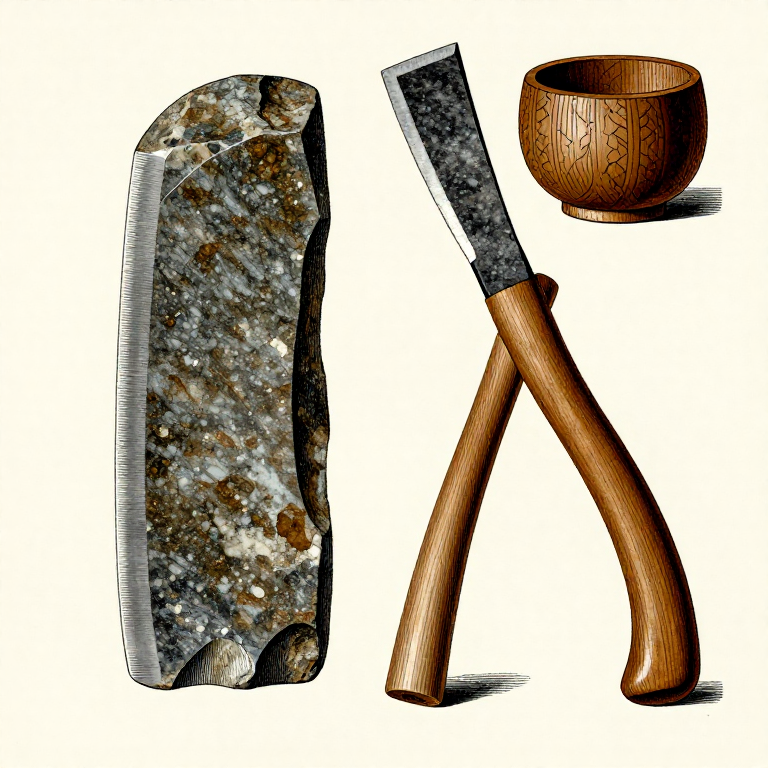


Making a Stone Adze — The Woodworking Tool That Shaped Canoes and Beams
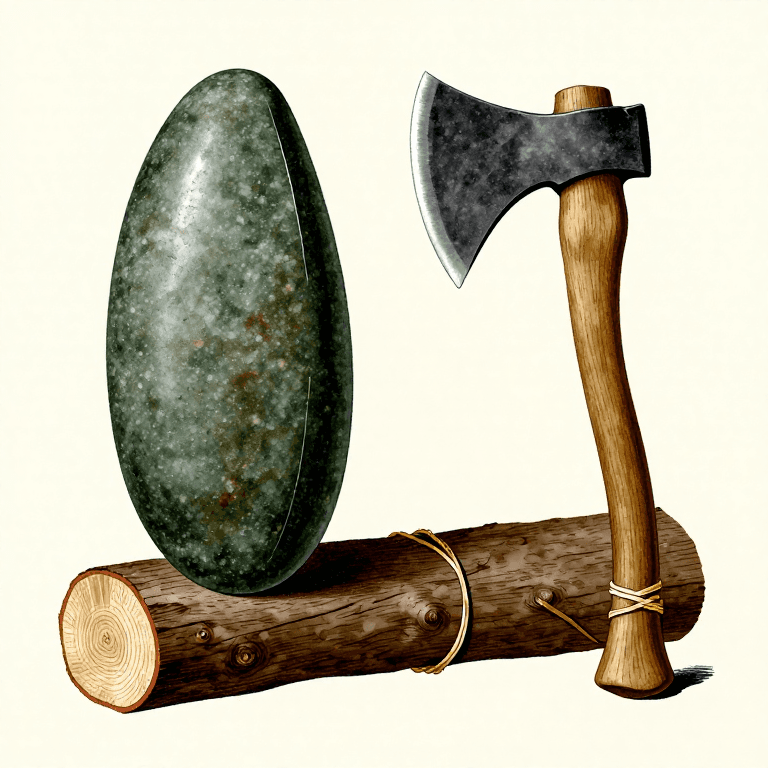
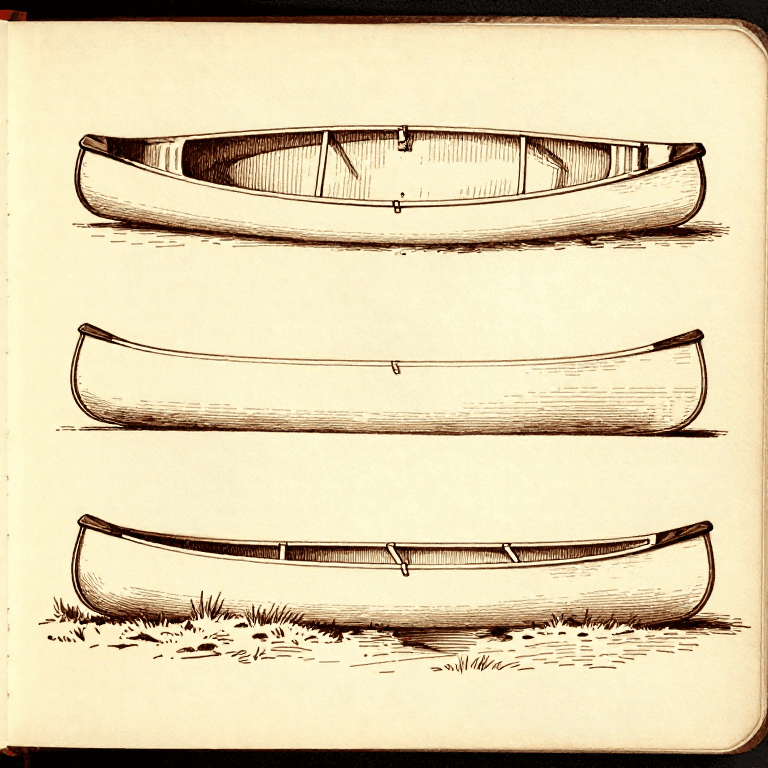
The adze is an axe-like tool with its cutting edge set perpendicular to the handle rather than parallel. This seemingly small difference produces a completely different tool: while an axe chops across wood grain to fell trees, an adze planes along the grain to shape timber — hollowing canoe hulls, smoothing beams, flattening planks, and carving bowls. The stone adze was the primary woodworking tool from the Neolithic period (around 8000 BCE) until metal adzes replaced it, and it remains in use in parts of Oceania today. Pacific Island cultures developed stone adze making to a remarkable art, with precisely ground basalt and nephrite adze heads that rival modern steel tools in shaping hardwood. This blueprint teaches how to make a basic D-shaped stone adze head and mount it on an elbow haft — the configuration used worldwide for thousands of years.
Kati
3-6 hours
Maagizo
1
1
Select a Dense Stone Blank
Select a Dense Stone Blank
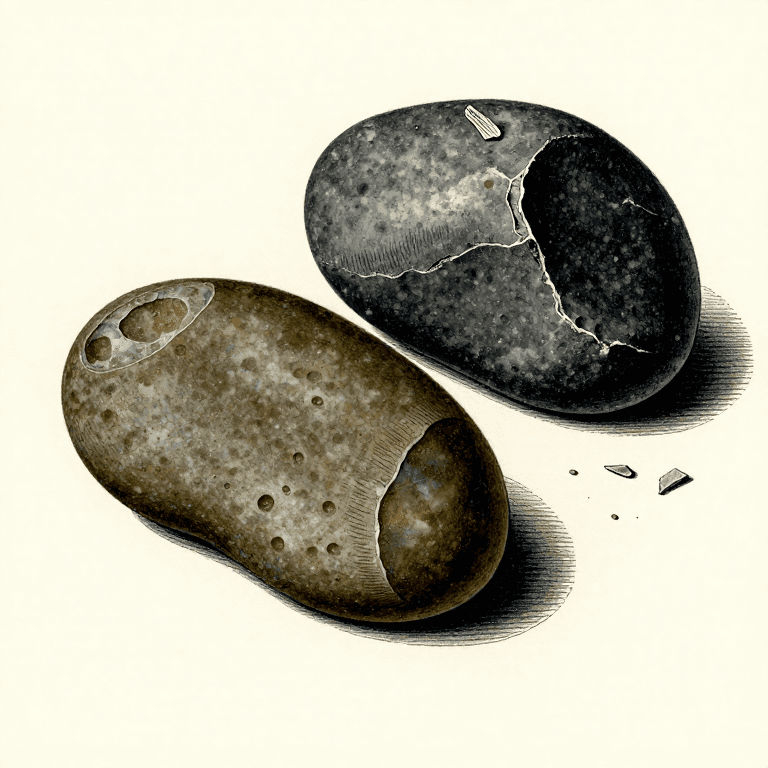
Find a fine-grained basalt, diorite, or greenstone cobble approximately 10 to 15 cm long, 5 to 8 cm wide, and 3 to 5 cm thick. An adze head is asymmetrical — flat on one face and convex on the other — so a naturally D-shaped cobble saves significant shaping time. Avoid stones with visible cracks or layered structure.
Vifaa kwa hatua hii:
 Bonge la jiwe1 kipande
2
2
Peck the Flat Face
Peck the Flat Face
Using a hammerstone, peck one face of the blank completely flat. This flat face is the critical working surface — it faces the wood during use and must be true. Check flatness by laying the stone on a flat surface; it should not rock. The flat face creates a controlled cutting geometry that prevents the adze from diving too deep into the wood.
Zana zinazohitajika:
 Jiwe la kugongea
3
3
Shape the Convex Back
Shape the Convex Back
Peck the opposite face into a smooth convex curve. The back of the adze head should be gently domed, reaching maximum thickness at the centre. This dome shape gives the head structural strength and distributes impact force through the binding and into the haft. The cross-section should be a plano-convex D shape.
Zana zinazohitajika:
Jiwe la kugongea4
4
Define the Cutting Edge
Define the Cutting Edge
The cutting edge is ground only on the flat face side, creating a single-bevel edge (like a chisel, not like an axe which is double-bevel). Peck the bit end to a gentle convex arc. The single bevel is what makes the adze plane rather than chop — the flat face rides along the wood surface while the bevel lifts curls of wood.
Zana zinazohitajika:
Jiwe la kugongea5
5
Grind the Flat Face on a Sandstone Slab
Grind the Flat Face on a Sandstone Slab
Wet a flat sandstone slab and grind the flat face in long, even strokes. The entire flat face must be uniformly smooth — any high spots will cause the adze to chatter and gouge the work. Check progress frequently by holding the stone at eye level and looking for light gaps when placed on a flat surface.
Zana zinazohitajika:
 Jiwe la mchanga (la kusugua)
6
6
Grind and Polish the Cutting Edge
Grind and Polish the Cutting Edge
Grind the cutting edge at 20 to 25 degrees on the flat face only. Hold the head at a consistent angle and push it across the wet sandstone in smooth strokes. The bevel should be 2 to 3 cm deep for a working adze. Finish with a fine-grained stone until the edge is polished and can catch a fingernail when drawn across it.
Zana zinazohitajika:
Jiwe la mchanga (la kusugua) Jiwe la Kunolea
7
7
Smooth the Back and Sides
Smooth the Back and Sides
Grind the convex back and both sides to remove all pecking marks. The sides especially need to be smooth — during use, the adze head slides in its lashing and any rough patches abrade and weaken the binding. The back does not need to be mirror-polished but should be uniformly smooth to the touch.
Zana zinazohitajika:
Jiwe la mchanga (la kusugua)8
8
Find a Natural Elbow Branch for the Haft
Find a Natural Elbow Branch for the Haft
The ideal adze haft is a hardwood branch with a natural 60 to 70 degree bend — where a side branch meets the main trunk. Cut the main trunk section 40 to 50 cm long (the handle) and the side branch section 8 to 12 cm long (the head platform). The natural wood grain follows the bend, making it far stronger than a joint cut from straight wood.
Vifaa kwa hatua hii:
 Mche wa mbao ngumu1 kipande
9
9
Flatten the Head Platform
Flatten the Head Platform
Flatten the top of the short branch (the head platform) using a stone scraper or by grinding it on a sandstone slab. The adze head sits on this flat surface with its flat face facing the wood and its convex back against the platform. The platform must be flat and slightly concave to cradle the adze head securely.
10
10
Lash the Adze Head to the Haft
Lash the Adze Head to the Haft
Place the adze head on the platform with the cutting edge facing the handle (toward the user). Bind it firmly with wet rawhide or coconut fibre cord, wrapping in a figure-eight pattern around the head and the branch platform. Pull each wrap as tight as possible. The binding must prevent the head from rocking side to side or sliding forward during use.
Vifaa kwa hatua hii:
 Ngozi Mbichi2 vipande
11
11
Test the Adze on Softwood
Test the Adze on Softwood
Secure a softwood log horizontally and swing the adze in short, controlled arcs, letting the cutting edge skim the surface and lift curls of wood. The flat face should ride along the surface, controlling the depth of cut. If the adze digs in too deep, reduce the swing arc. If it bounces off, the angle of the haft relative to the cutting edge needs adjustment.
12
12
Hollow a Concave Surface
Hollow a Concave Surface
The adze excels at hollowing — carving bowls, troughs, and canoe interiors. Swing in short strokes across the grain, removing thin chips with each pass. Rotate the workpiece frequently and work from the edges toward the centre to avoid splitting. The single-bevel edge naturally follows concave curves, making the adze self-guiding in hollowing work.
13
13
Resharpen and Maintain the Binding
Resharpen and Maintain the Binding
Resharpen the adze on a wet sandstone slab whenever the edge stops lifting clean curls and begins crushing the wood fibres. Check the binding before every use session — rewet rawhide bindings that have dried and loosened, or re-wrap entirely if the head shows any play. A loose adze head is dangerous and damages the work.
Zana zinazohitajika:
Jiwe la mchanga (la kusugua)Vifaa
3- 1 kipandeKishikilia Nafasi
- 1 kipandeKishikilia Nafasi
- 2 vipandeKishikilia Nafasi
Vifaa vya Michoro Iliyounganishwa

Blueprint zinazohusiana
Blueprint hizi zinashiriki maarifa — mbinu, vifaa au kanuni
CC0 Umma Wote
Mchoro huu umetolewa chini ya CC0. Uko huru kunakili, kubadilisha, kusambaza, na kutumia kazi hii kwa madhumuni yoyote, bila kuomba ruhusa.
Saidia Mtengenezaji kwa kununua bidhaa kupitia Mchoro wao ambapo wanapata Kamisheni ya Mtengenezaji iliyowekwa na Wachuuzi, au unda marudio mapya ya Mchoro huu na uiunganishe kama kiungo katika Mchoro wako kuchangia mapato.