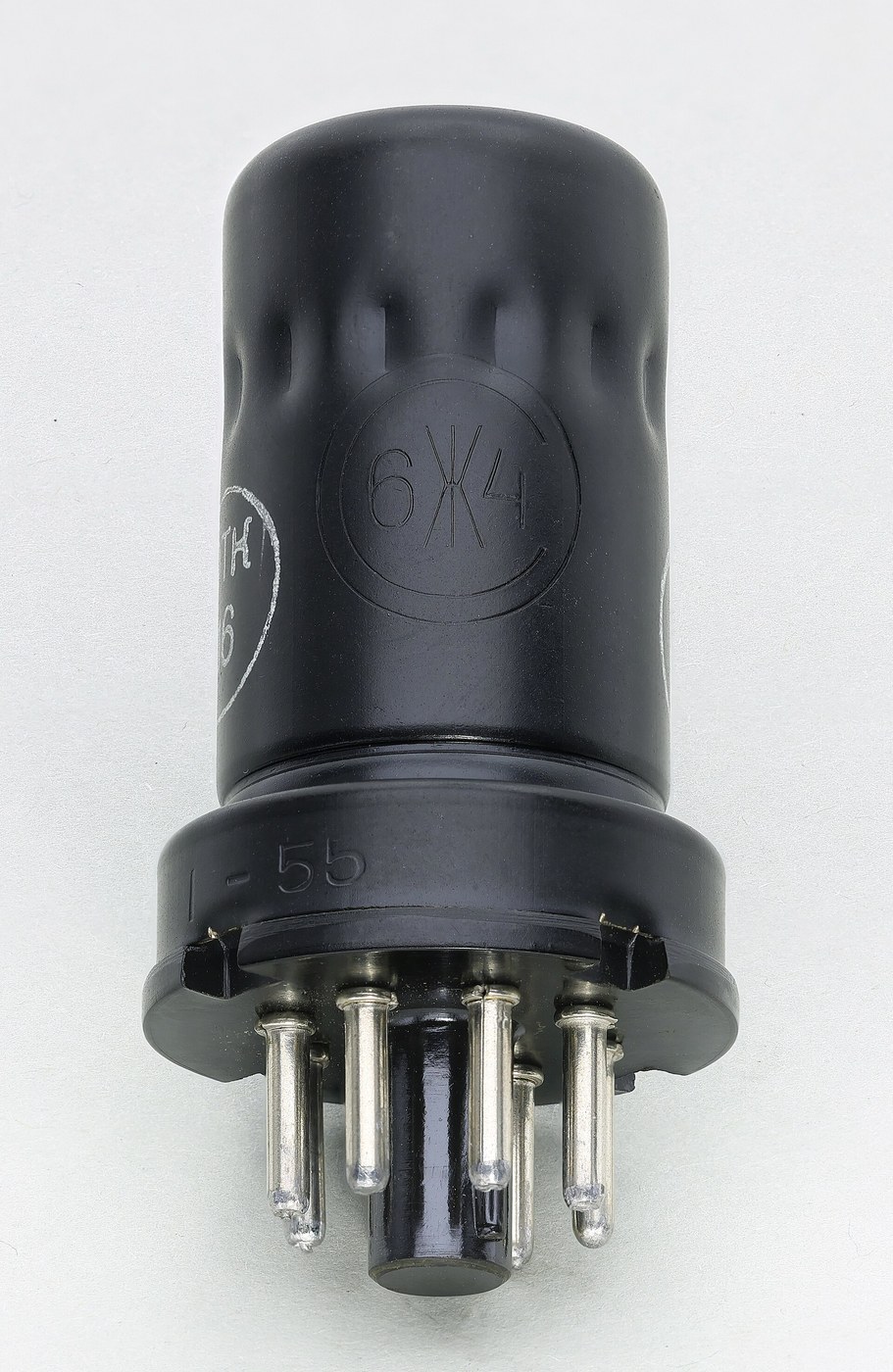


The Screen Grid and the Pentode
Maagizo
Measure the capacitance that causes the trouble
Measure the capacitance that causes the trouble
Find the offending component, which is not a component at all.
- With a triode valve out of circuit and cold, measure the capacitance between anode and grid with an LCR meter.
- Record it — it will be a few picofarads.
- Now compute what that capacitance appears as at the input, multiplied by the stage gain plus one.
A few picofarads of anode-grid capacitance behaves like tens or hundreds of picofarads across the input, because the anode swings in the opposite direction to the grid and by a much larger amount. This multiplication is the Miller effect, and it means the input capacitance of an amplifier depends on its own gain.
Two consequences follow immediately, and both were serious. The huge effective input capacitance detunes and damps the tuned circuit feeding the stage. And because the feedback path exists at all, with the right phase shift the stage will oscillate on its own.
Neutralisation was the pre-1926 workaround: deliberately feed back an equal and opposite signal through a small adjustable capacitor to cancel the unwanted path. It works, and it must be re-trimmed for every valve, every frequency and every replacement. That fragility is what made the screen grid worth inventing.Vifaa kwa hatua hii:
 Soketi ya valvu1 seti
 Seti ya Kapasita1 kifaa
Zana zinazohitajika:
 Kipima LCR cha mezani
 Mita-nyingi ya dijitali ya maabara
 Kipima-unene cha dijitali cha inchi 6
 Miwani ya usalama iliyo wazi
 Valvu ya triodi
Add a screen grid and shield the anode from the grid
Add a screen grid and shield the anode from the grid
Fit a tetrode and repeat every measurement.
- Build the same amplifier stage using a tetrode, with the screen grid connected to a steady positive supply and bypassed to earth by a good capacitor.
- Measure anode-to-control-grid capacitance again.
- Measure the stage gain.
- Try to make it oscillate by increasing the load impedance.
Anode-grid capacitance falls by a factor of hundreds, gain rises by a factor of tens, and the stage is far harder to provoke into oscillating. The screen is doing two jobs at once: electrostatically it is an earthed shield between the two electrodes, and electrically it accelerates electrons past the control grid so the anode voltage barely influences the current at all.
The bypass capacitor is not optional. The screen must be at earth potential for signals even while sitting at a high DC voltage. Leave it unbypassed and the screen swings with the signal, the shielding evaporates, and you have an expensive triode.
This is a genuinely elegant kind of fix — the problem was geometric, so the solution is a piece of geometry rather than a compensating circuit. Compare it with neutralisation, which cancels a fault rather than removing it, and note which one survived.Vifaa kwa hatua hii:
 Vali ya tetrodi1 setiSoketi ya valvu1 setiSeti ya Kapasita1 kifaa
 Seti ya vizuizi vya umeme1 kifaa
 Ubao wa Kutobolewa / Ubao wa Mfano1 kipande
 Waya wa Lehemu1 reel
Zana zinazohitajika:
Kipima LCR cha mezani Osilosikopu
 Kitengeneza IsharaMita-nyingi ya dijitali ya maabara
 Chanzo cha Umeme cha Meza Kinachorekebishwa
 Kituo cha KulehemuMiwani ya usalama iliyo wazi
Find the kink, where the tetrode misbehaves
Find the kink, where the tetrode misbehaves
The tetrode introduced a new fault, and its shape on the curve tells you exactly what it is.
- Plot anode current against anode voltage at a fixed control-grid voltage, sweeping the anode from zero upward.
- Pay close attention to the region where anode voltage is below the screen voltage.
- Mark any region where current FALLS as voltage RISES.
There is a dip — a region of negative resistance — where increasing the anode voltage decreases the anode current. The cause is secondary emission: electrons arrive at the anode fast enough to knock further electrons out of its surface, and while the anode is at a lower potential than the screen, those knocked-out electrons are collected by the SCREEN instead of returning. Current that should have gone to the anode goes to the screen, so anode current falls.
A negative-resistance region is not merely untidy. It can sustain oscillation on its own — the dynatron oscillator was built deliberately on this effect — and it badly distorts an amplifier whose signal swings into that region.
So the tetrode traded one instability for another. Worth noting as a pattern: a fix that introduces a new mechanism usually introduces a new failure mode with it, and the second one is often discovered later and in service.Vifaa kwa hatua hii:
Seti ya vizuizi vya umeme1 kifaa Karatasi ya gridi1 pad
Zana zinazohitajika:
OsilosikopuMita-nyingi ya dijitali ya maabaraChanzo cha Umeme cha Meza KinachorekebishwaKitengeneza IsharaMiwani ya usalama iliyo waziAdd a suppressor grid and get the pentode
Add a suppressor grid and get the pentode
Fix the secondary-emission problem with a third grid, and understand why it is at earth.
- Build the same stage with a pentode, its suppressor grid connected to the cathode.
- Repeat the anode current against anode voltage sweep.
- Compare the curve with the tetrode’s.
The kink is gone; the curve rises and then flattens into a long horizontal plateau. The suppressor sits between screen and anode at cathode potential — negative relative to both — so it repels the slow secondary electrons knocked out of the anode and returns them to the anode, while the fast primary electrons from the cathode sail straight through.
The flat plateau is worth dwelling on: anode current is now almost independent of anode voltage. That is very nearly a constant-current source controlled by the grid, which is exactly what an amplifier wants — enormous voltage gain, and a stage whose behaviour barely depends on its load.
Reverse-engineering note: the beam tetrode reaches the same result differently, using beam-forming plates to create a dense space charge between screen and anode that repels secondaries without a third grid. Two mechanisms, one goal — and both are still in production for audio amplifiers, where their different distortion characters are argued over to this day.Vifaa kwa hatua hii:
 Vali ya pentodi1 setiSoketi ya valvu1 setiSeti ya vizuizi vya umeme1 kifaaSeti ya Kapasita1 kifaaKaratasi ya gridi1 pad
Zana zinazohitajika:
OsilosikopuMita-nyingi ya dijitali ya maabaraChanzo cha Umeme cha Meza KinachorekebishwaKitengeneza IsharaKituo cha KulehemuMiwani ya usalama iliyo waziBuild a stable RF amplifier and prove the point
Build a stable RF amplifier and prove the point
Put the pentode to work in the job the triode could not hold.
- Build a tuned RF amplifier stage using the pentode, with a high-Q tuned circuit as its anode load.
- Measure gain and check the tuned circuit’s Q with the stage running.
- Increase the load impedance progressively and see how far you can push gain before instability appears.
- Repeat the whole test with a triode in an equivalent circuit.
The pentode gives far more gain before oscillating, and it loads the tuned circuit far less, so selectivity survives. That combination is what made multi-stage IF strips practical — and therefore what made the superheterodyne buildable as a mass-market product rather than a laboratory curiosity.
Layout matters more than the schematic here. At radio frequencies a centimetre of wire is an inductor and two parallel wires are a capacitor, so a screen-grid valve carefully shielded internally can still oscillate if input and output wiring run side by side on the board. The metal cans, chassis partitions and short direct leads in old radios are not tidiness — they are the parts of the circuit that do not appear on the diagram.Vifaa kwa hatua hii:
 Waya wa shaba uliopakwa rangi10 mSeti ya Kapasita1 kifaaSeti ya vizuizi vya umeme1 kifaa
 Bamba la alumini1 karatasi
Zana zinazohitajika:
OsilosikopuKitengeneza Ishara Kichambuzi cha Wigo / Programu ya FFTKipima LCR cha mezaniMita-nyingi ya dijitali ya maabaraChanzo cha Umeme cha Meza KinachorekebishwaKituo cha Kulehemu
 Seti ya tupaMiwani ya usalama iliyo wazi
Vifaa
10- 1 setiKishikilia Nafasi
- 1 kifaaKishikilia Nafasi
- 1 setiKishikilia Nafasi
- Kishikilia Nafasi
- 1 kipandeKishikilia Nafasi
- 1 reelKishikilia Nafasi
- 1 padKishikilia Nafasi
- 1 setiKishikilia Nafasi
- Kishikilia Nafasi
- 1 karatasiKishikilia Nafasi
Zana Zinazohitajika
11- Kishikilia Nafasi
- Kishikilia Nafasi
- Kishikilia Nafasi
- Kishikilia Nafasi
- Kishikilia Nafasi
- Kishikilia Nafasi
- Kishikilia Nafasi
- Kishikilia Nafasi
- Kishikilia Nafasi
- Kishikilia Nafasi
- Kishikilia Nafasi
Blueprint zinazohusiana
Blueprint hizi zinashiriki maarifa — mbinu, vifaa au kanuni


CC0 Umma Wote
Mchoro huu umetolewa chini ya CC0. Uko huru kunakili, kubadilisha, kusambaza, na kutumia kazi hii kwa madhumuni yoyote, bila kuomba ruhusa.
Saidia Mtengenezaji kwa kununua bidhaa kupitia Mchoro wao ambapo wanapata Kamisheni ya Mtengenezaji iliyowekwa na Wachuuzi, au unda marudio mapya ya Mchoro huu na uiunganishe kama kiungo katika Mchoro wako kuchangia mapato.