SANAA
UREMBO NA USTAWI
UJANJA
UTAMADUNI NA HISTORIA
BURUDANI
MAZINGIRA
CHAKULA NA VINYWAJI
UHANDISI WA KINYUME
SAYANSI
MICHEZO
TEKNOLOJIA
VAZI
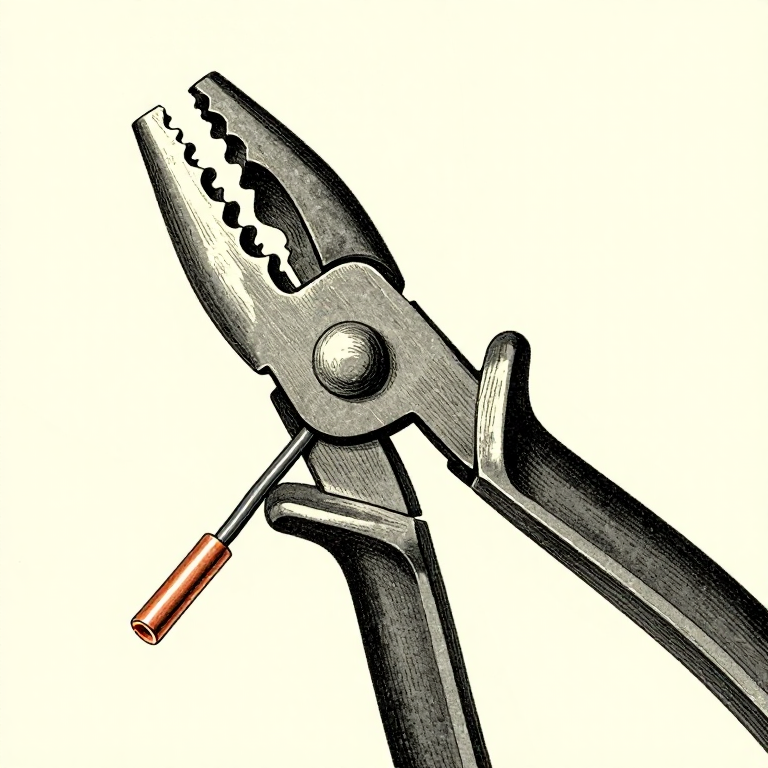


Stripping Insulation Without Nicking the Copper
A nicked conductor is a wire that will break later. The cut is a stress concentration, the wire flexes there, and it fails weeks after you finished — inside the insulation, where nothing shows.
On stranded wire the same mistake is quieter still: a few strands cut away and the wire carries less current than you think, runs warmer, and nothing looks wrong at all.
Getting this right is almost entirely about using the correct hole on the stripper and not using a knife. It takes a minute to learn and it removes a whole class of intermittent fault.
Mwanzo
2 hours
Maagizo
1
1
Use the hole marked for the gauge you are cutting
Use the hole marked for the gauge you are cutting
A wire stripper has a row of holes, each sized for one gauge. Put the wire in the hole with its own number on it, squeeze, and the blades close to exactly the conductor's diameter — cutting the insulation and stopping at the copper.
Using a hole one size too small cuts into the conductor. One size too large and the insulation tears instead of cutting, and you drag it off, stretching the wire behind it. Both are visible under a loupe and neither is visible to the naked eye.
If the gauge is unmarked or unknown, start with a hole that is definitely too large and work down until the insulation parts cleanly. That costs three seconds and one scrap end.
Vifaa kwa hatua hii:
 Waya wa kuunganishia1 kipande
Zana zinazohitajika:
 Koleo la kumenya waya
 Lupu ya Kukuza
2
2
Never strip with a knife — and why the rotation trick still fails
Never strip with a knife — and why the rotation trick still fails
A blade pressed hard enough to cut PVC is pressed hard enough to score copper, and the score is exactly where the wire will break.
The common workaround — rolling the wire under the blade to cut all round — produces a ring of small nicks instead of one, and a ring of nicks is a perfect fracture line. It is worse than a single cut, not better.
Where there is genuinely no stripper, the least bad method is to soften and pull: grip the insulation with pliers and draw it off, or for thick cable make a LENGTHWAYS slit well back from the end and fold the insulation open rather than cutting around the conductor. A lengthways cut does not create a break line.
Vifaa kwa hatua hii:
Waya wa kuunganishia1 kipandeZana zinazohitajika:
 Kisu cha ufundi chenye ncha za akibaKoleo la kumenya wayaLupu ya Kukuza
3
3
Strip the right LENGTH, and check it against the joint
Strip the right LENGTH, and check it against the joint
Too little and the conductor does not reach the bottom of the terminal; too much and bare copper stands proud of it, ready to touch its neighbour.
The right length is set by the joint, not by habit. For a screw terminal, just enough that no bare wire shows outside the clamp. For a crimp, exactly the length of the barrel. For a solder joint on a pin, enough to wrap or sit against it and no more.
Offer the stripped end up to the terminal before committing. A wire stripped too long can be trimmed; one stripped too short has to be cut back and redone, which shortens the wire every time and eventually costs you the whole run.
Vifaa kwa hatua hii:
Waya wa kuunganishia1 kipandeZana zinazohitajika:
Koleo la kumenya waya Kizuizi cha vizio vya skrubu
 Kiungio cha duara
4
4
Twist stranded wire — but do not tin it for a screw terminal
Twist stranded wire — but do not tin it for a screw terminal
Give stranded wire a light twist in the direction its strands already lie, just enough to keep them together. Heavy twisting distorts the bundle and makes it harder to seat.
Do NOT tin a stranded wire that is going into a SCREW terminal. Solder creeps under sustained pressure — it flows slowly away from the clamped point — so the screw gradually loosens over months and the joint heats up. This is a real documented failure mode and it is forbidden in professional practice for exactly that reason.
The correct answer for stranded wire into a screw terminal is a bootlace ferrule: a metal sleeve crimped onto the strands that presents a solid, non-creeping end to the screw. Tinning is fine where the joint is soldered anyway, and wrong wherever a screw is doing the clamping.
Vifaa kwa hatua hii:
 Ala ya ncha ya waya1 kipandeWaya wa kuunganishia1 kipande
Zana zinazohitajika:
 Koleo la kubana wayaKizuizi cha vizio vya skrubu
 Chuma cha kulehemia
Vifaa
2- 4 vipandeKishikilia Nafasi
- 1 kipandeKishikilia Nafasi
Zana Zinazohitajika
7- Kishikilia Nafasi
- Kishikilia Nafasi
- Kishikilia Nafasi
- 2 vendors sell this, none ship to you yetKishikilia Nafasi
- Kishikilia Nafasi
- Kishikilia Nafasi
- 2 vendors sell this, none ship to you yetKishikilia Nafasi
Blueprint zinazohusiana
Blueprint hizi zinashiriki maarifa — mbinu, vifaa au kanuni


CC0 Umma Wote
Mchoro huu umetolewa chini ya CC0. Uko huru kunakili, kubadilisha, kusambaza, na kutumia kazi hii kwa madhumuni yoyote, bila kuomba ruhusa.
Saidia Mtengenezaji kwa kununua bidhaa kupitia Mchoro wao ambapo wanapata Kamisheni ya Mtengenezaji iliyowekwa na Wachuuzi, au unda marudio mapya ya Mchoro huu na uiunganishe kama kiungo katika Mchoro wako kuchangia mapato.