SANAA
UREMBO NA USTAWI
UJANJA
UTAMADUNI NA HISTORIA
BURUDANI
MAZINGIRA
CHAKULA NA VINYWAJI
UHANDISI WA KINYUME
SAYANSI
MICHEZO
TEKNOLOJIA
VAZI
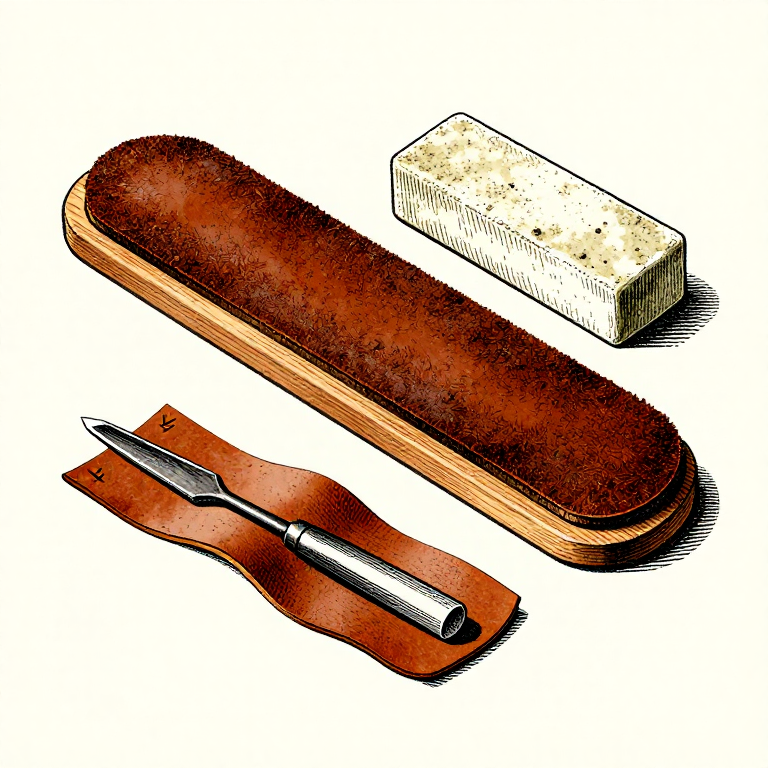


Stropping: A Strip of Leather That Outperforms Another Stone
A strop is leather charged with a fine abrasive compound, and it does two jobs no stone does well: it removes the last remnant of the wire edge without tearing it, and it brings a working edge back to sharp without removing measurable metal.
The second is what makes it valuable. A carver who strops every few minutes may go weeks between stones, because the edge never gets far enough from sharp to need one. The tool lasts decades longer for exactly the same reason.
This rung makes a strop — the whole thing is a board, a piece of leather and some compound — and covers the one rule that matters: strop AWAY from the edge, always.
Mwanzo
3 hours
Maagizo
1
1
Make the strop
Make the strop
Glue a strip of vegetable-tanned leather, rough side up, to a flat hardwood board about 300 x 60 mm. Press it flat under weights until the glue cures.
Rough side up because the nap holds the compound. Vegetable-tanned because chrome-tanned leather carries salts that will spot a carbon steel blade. The board matters as much as the leather — a strop that flexes is a strop that rounds your edge, which is the one thing stropping must not do.
Leave the other face bare. A clean, uncharged leather surface is useful for the final few passes once the compound has done its work.
Vifaa kwa hatua hii:
 Ngozi1 kipande
 Ubao wa Mti Mgumu1 kipande
 Gundi ya Mbao1 kipande
Zana zinazohitajika:
 Kitambaa cha Pamba
2
2
Charge it, and do not overdo it
Charge it, and do not overdo it
Rub the compound bar across the leather until the surface is evenly coloured, then work it in with a finger or a smooth offcut. A charged strop looks uniformly tinted, not caked.
Too much compound builds a soft layer that the edge sinks into, and that layer rounds the apex — the exact failure stropping is supposed to avoid. Recharge when the surface goes shiny and stops cutting, which on a hand-tool strop is every few months, not every session.
Compound grades run from coarse to fine; a single fine compound around one micrometre is enough for nearly all workshop tools. Keep one strop per grade if you use more than one, and never mix them on one surface.
Zana zinazohitajika:
 Ukanda wa ngozi wa kunoaKitambaa cha Pamba
 Dawa ya kung'arisha
3
3
Stroke away from the edge — every time, without exception
Stroke away from the edge — every time, without exception
Lay the bevel flat on the leather and draw the blade BACKWARDS, spine first, away from the cutting edge. Then turn it over and do the same on the other side. Light pressure, ten to twenty passes a side.
Pushing edge-first into leather does two things and both are bad: the edge digs in and cuts the strop, and the leather rolls up ahead of it and folds the apex over. A blade that came off the finish stone sharp will come off a wrongly-stropped strop blunt.
Keep the bevel flat. Lifting the spine as you draw back is the other common fault; it rounds the edge into a convex profile a little more with every pass, and after a few months the tool needs a full regrind to recover.
Zana zinazohitajika:
Ukanda wa ngozi wa kunoa Seti ya patasi - zenye ncha ya mteremko
 Kisu cha jikoni
4
4
Strop often, sharpen seldom
Strop often, sharpen seldom
Make stropping the thing you do between cuts rather than a stage of sharpening. Twenty passes takes fifteen seconds and restores an edge that has only just started to dull.
The economics are plain: a strop removes a fraction of a micrometre and a coarse stone removes tens of micrometres. Every trip to the stone shortens the tool. A chisel kept sharp by stropping will outlive the maker; one allowed to go blunt and then reground each time will be worn out in a career.
It stops working when the edge has real damage — a nick, a rolled section, a flat you can see under the lamp. At that point go back to the stone and follow the progression. Stropping maintains an edge; it does not create one.
Zana zinazohitajika:
Ukanda wa ngozi wa kunoa Ukanda wa Kunoa na Dawa ya Kunoa
 Lupu ya Kukuza
Vifaa
3- 1 kipandeKishikilia Nafasi
- 1 kipandeKishikilia Nafasi
- 1 kipandeKishikilia Nafasi
Zana Zinazohitajika
7- Kishikilia Nafasi
- Kishikilia Nafasi
- Kishikilia Nafasi
- Kishikilia Nafasi
- Kishikilia Nafasi
- Kishikilia Nafasi
- Kishikilia Nafasi
Blueprint zinazohusiana
Blueprint hizi zinashiriki maarifa — mbinu, vifaa au kanuni
CC0 Umma Wote
Mchoro huu umetolewa chini ya CC0. Uko huru kunakili, kubadilisha, kusambaza, na kutumia kazi hii kwa madhumuni yoyote, bila kuomba ruhusa.
Saidia Mtengenezaji kwa kununua bidhaa kupitia Mchoro wao ambapo wanapata Kamisheni ya Mtengenezaji iliyowekwa na Wachuuzi, au unda marudio mapya ya Mchoro huu na uiunganishe kama kiungo katika Mchoro wako kuchangia mapato.