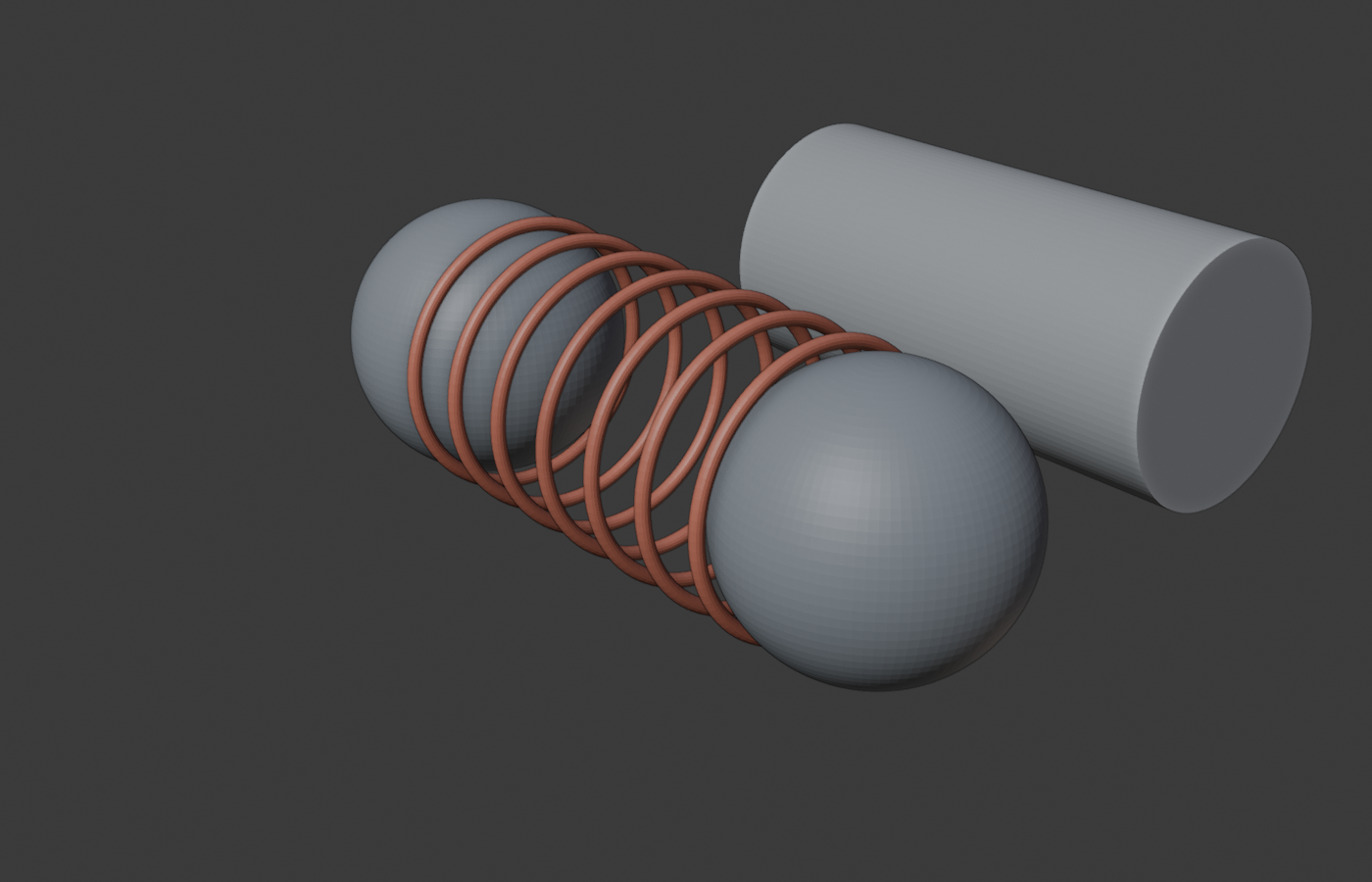


The Submarine Pressure Hull
Maagizo
Crush a can and feel why compression is different
Crush a can and feel why compression is different
Two minutes with a drinks can teaches what a page of theory does not.
- Stand an empty aluminium can upright and press straight down evenly. Note how much load it carries.
- Now press down again while a helper dents the side very slightly with a fingernail.
- Separately, put a little water in a can, heat it, then invert it into cold water and watch it implode.
Undamaged, the can carries a surprising load; with the tiniest dent it collapses immediately at a fraction of it. That sensitivity to imperfection is the signature of buckling, and it is why the strength of a compression structure depends on how ACCURATELY it was built, not merely on how thick it is.
This is the opposite of tension. A tension member with a small dent is essentially as strong as one without. A compression shell with a small dent may have lost half its capacity — which is why submarine hull plating is checked for out-of-roundness to millimetres over metres, and why a hull that has been dented is a hull that must be assessed rather than simply inspected.Vifaa kwa hatua hii:
 Makopo ya vinywaji ya alumini (matupu)4 vipande
Zana zinazohitajika:
 Simu Yenye Video ya Mwendo wa Taratibu
 Mizani ya Spring
 Miwani ya usalama iliyo wazi
 Ngao ya Uso
Compute collapse depth for sphere, cylinder and ring-framed cylinder
Compute collapse depth for sphere, cylinder and ring-framed cylinder
Zana zinazohitajika:
 Kompyuta ya mezani
Weld a test cylinder and pressure-test it to destruction
Weld a test cylinder and pressure-test it to destruction
Build small, test to failure, and see whether the arithmetic was honest.
- Roll and weld a thin steel cylinder, closed with domed ends, and make a second identical one with internal ring frames.
- Measure out-of-roundness at several stations — the deviation from a true circle — and record it.
- Pressure-test each externally, submerged in a shielded vessel, raising pressure until collapse.
- Compare collapse pressures with each other and with the notebook.
The framed cylinder will survive far higher pressure, and BOTH will collapse below the ideal theoretical value — by an amount that tracks their out-of-roundness. That gap between theory and reality is not experimental error; it is the imperfection sensitivity from step 1 showing up as a number.
An external pressure test is genuinely dangerous — implosion releases the stored energy of the surrounding water inward and then outward. Test remotely, behind a barrier, with the vessel fully submerged so the water absorbs the event. Never stand over a test in progress, and never test a vessel you have not calculated.Vifaa kwa hatua hii:
 Bati la chuma2 karatasi
 Bomba la chuma la milimita 121 kipande
Zana zinazohitajika:
 Mashine ya kulehemu ya TIG
 Kibanuzi hewa cha galoni 30
 Kipima Shinikizo
 Kipimadaira
 Kipima-unene cha dijitali cha inchi 6Ngao ya UsoMiwani ya usalama iliyo wazi
Every hole is a stress concentration
Every hole is a stress concentration
A perfect hull is useless. It needs hatches, shafts, torpedo tubes, periscopes and cable glands, and each one is a hole in the thing you just optimised.
- Cut a small circular hole in a test cylinder and re-run the collapse test.
- Repeat with the hole reinforced by a welded doubler ring around its edge.
- Compare both against the unpierced result.
An unreinforced penetration cuts collapse pressure sharply, because the load that was flowing smoothly through the shell must now divert around the hole and crowds at its edges. A doubler restores most of it by giving that crowded load somewhere to go.
This is why the number of hull penetrations is minimised so aggressively in submarine design, why they are round rather than square — a corner is a far worse concentrator than a curve — and why every one is a compensated opening with material added back around it.
The same reasoning appears in the aircraft batch: the de Havilland Comet failures traced to fatigue cracks originating at window corners. Round the corner and the concentration falls dramatically. Pressure vessels and pressurised cabins are the same problem with the sign flipped, and both learned it the expensive way.Vifaa kwa hatua hii:
Bati la chuma1 karatasiZana zinazohitajika:
Mashine ya kulehemu ya TIG Kekee cha Nguzo
 Seti ya tupaKipima ShinikizoNgao ya UsoMiwani ya usalama iliyo wazi
Vifaa
3- Kishikilia Nafasi
- Kishikilia Nafasi
- 1 kipandeKishikilia Nafasi
Zana Zinazohitajika
12- Kishikilia Nafasi
- Kishikilia Nafasi
- Kishikilia Nafasi
- Kishikilia Nafasi
- Kishikilia Nafasi
- Kishikilia Nafasi
- Kishikilia Nafasi
- Kishikilia Nafasi
- Kishikilia Nafasi
- Kishikilia Nafasi
- Kishikilia Nafasi
- Kishikilia Nafasi
Blueprint zinazohusiana
Blueprint hizi zinashiriki maarifa — mbinu, vifaa au kanuni



CC0 Umma Wote
Mchoro huu umetolewa chini ya CC0. Uko huru kunakili, kubadilisha, kusambaza, na kutumia kazi hii kwa madhumuni yoyote, bila kuomba ruhusa.
Saidia Mtengenezaji kwa kununua bidhaa kupitia Mchoro wao ambapo wanapata Kamisheni ya Mtengenezaji iliyowekwa na Wachuuzi, au unda marudio mapya ya Mchoro huu na uiunganishe kama kiungo katika Mchoro wako kuchangia mapato.