SANAA
UREMBO NA USTAWI
UJANJA
UTAMADUNI NA HISTORIA
BURUDANI
MAZINGIRA
CHAKULA NA VINYWAJI
UHANDISI WA KINYUME
SAYANSI
MICHEZO
TEKNOLOJIA
VAZI
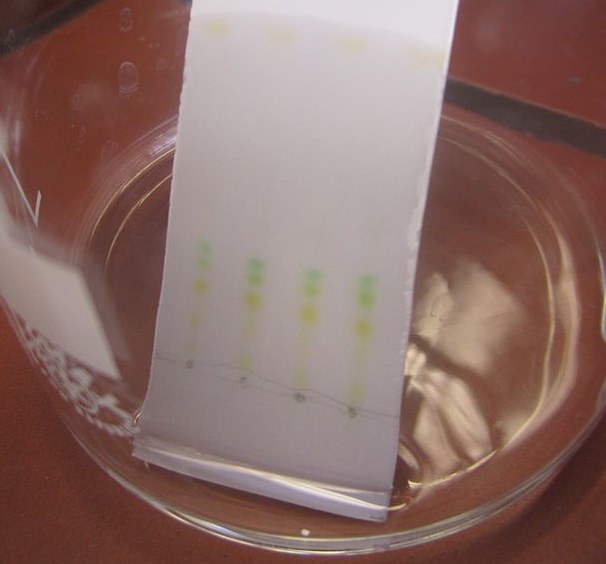


Thin-Layer Chromatography: Making Your Own Plates
Paper is cellulose, and cellulose is a mediocre stationary phase: its fibres are coarse, they run in one direction, and a spot spreads as it climbs. Egon Stahl's answer in 1956 was to throw the paper away and spread a thin layer of fine powder on a sheet of glass instead.
A silica layer a quarter of a millimetre thick, made of particles a few thousandths of a millimetre across, gives far less room for a spot to wander. Runs finish in fifteen minutes instead of hours, spots stay tight, and — because glass does not burn or dissolve — you can develop the plate with corrosive reagents or heat that would destroy paper.
Commercial plates are cheap and excellent. Make your own anyway, once: spreading the slurry is where you learn what an even layer is worth, and why the plate, not the chemistry, is usually what went wrong.
Kati
1 day
Maagizo
1
1
Clean the glass until water sheets off it
Clean the glass until water sheets off it
Wash microscope slides in hot detergent, rinse, and finish with a wipe of isopropyl alcohol. Handle them by the edges from now on.
Test them: water should spread into an unbroken film, not bead up. A bead means grease, and grease means the silica layer will lift away in a flake exactly there — usually halfway through a run, taking your sample with it. This is the least interesting step and the one that decides whether the plates work.
Vifaa kwa hatua hii:
 Vioo vya darubini na vifuniko20 vipande
Zana zinazohitajika:
 Glavu za Naitrili
 Alkoholi ya Isopropili 99%
2
2
Mix the slurry: silica, gypsum binder, water
Mix the slurry: silica, gypsum binder, water
Stir 3 parts chromatography-grade silica gel and 1 part gypsum into about 2 parts water by weight, to the consistency of thin cream. Use it within a few minutes.
The gypsum is calcium sulfate — plaster — and it is the only thing holding the silica to the glass; a layer made without it dusts off at a touch. This is exactly the composition sold as 'silica gel G', where the G stands for gypsum. Work fast, because plaster starts setting as soon as it is wet and a slurry that has begun to go off spreads in ridges.
Vifaa kwa hatua hii:
 Jeli ya silika (daraja la kromatografia)30 g
 Jipsamu (salfati ya kalsiamu)10 g
Zana zinazohitajika:
 Mizani ya dijitali
 Bikari ya Borosilikati
3
3
Coat the plates evenly
Coat the plates evenly
The simplest method that works: hold two slides back to back, dip them into the slurry, withdraw them smoothly and steadily, separate them and stand them on edge to dry.
Steadily is the whole instruction. Any hesitation leaves a horizontal line in the layer, and a solvent front reaching that line slows, stalls, or jumps it — giving you an Rf value that is a property of your dipping technique rather than of the compound. A uniform thin layer is worth more than a thick careful one.
Zana zinazohitajika:
Bikari ya BorosilikatiGlavu za Naitrili4
4
Activate the plates in an oven
Activate the plates in an oven
Air-dry the plates, then heat them at about 110 °C for half an hour and store them somewhere dry until use.
Silica holds water on its surface, and adsorbed water occupies exactly the sites your sample needs to stick to. A damp plate therefore behaves as a weaker stationary phase: everything runs faster and the separation compresses. This is the usual reason Rf values drift between a dry week and a humid one, and it is why published Rf figures always state the activation.
Zana zinazohitajika:
 Sahani ya Kupasha Joto
5
5
Spot, develop, and mark the front at once
Spot, develop, and mark the front at once
Mark a faint pencil origin line 1 cm from one end — press lightly, because a hard line scores through the layer. Spot as small as you can, then stand the plate in a closed jar with solvent below the origin line.
A thin layer develops fast: the front may reach the top in five to fifteen minutes. Take the plate out while the front is still a centimetre short of the top edge and mark it immediately with pencil, because it evaporates in seconds. A front that ran off the end means every Rf from that plate is unrecoverable.
Vifaa kwa hatua hii:
 Etanoli ya maabara, 95 %50 ml
 Asidi asetiki (safi kabisa)5 ml
 Mchicha wa Kizungu50 g
Zana zinazohitajika:
 Chupa ya Kioo
 Mrija mwembamba wa kioo
6
6
Visualise: iodine first, then heat
Visualise: iodine first, then heat
Stand the dry plate in a closed jar with a few iodine crystals. Most organic spots turn brown within minutes. Circle them in pencil while they show.
Then use what glass allows and paper does not: spray the plate with dilute sulfuric acid and heat it, and every organic compound chars to a permanent black spot. It is destructive and utterly general — nothing organic escapes it. That trick is the real reason Stahl's layers displaced paper, and it needs a fume extract and full protection, so treat it as an optional advanced finish rather than a routine step.
Vifaa kwa hatua hii:
 Fuwele za iodini2 g
Zana zinazohitajika:
Chupa ya KiooGlavu za Naitrili Miwani ya usalama iliyofungwa
7
7
Why a thin layer beats paper
Why a thin layer beats paper
Inapakia daftari la Jupyter…
Zana zinazohitajika:
 Rula
Rula Saa ya kupima muda
8
8
Use it the way a chemist actually uses it
Use it the way a chemist actually uses it
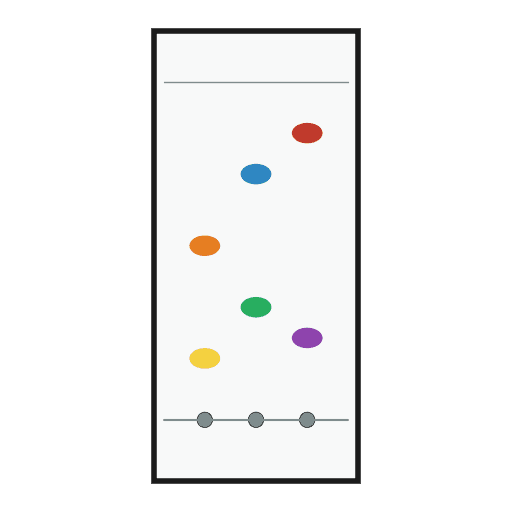
Spot three lanes on one plate: your unknown, a known reference compound, and a spot of BOTH together. Develop them side by side.
That third lane is the point. If the unknown and the reference are the same substance, the co-spot runs as a single round spot; if they merely have similar Rf values, it runs as an elongated or double spot that neither lane alone would have revealed. Matching Rf values is suggestive — a clean co-spot is evidence. This is how a bench chemist follows a reaction to completion, and it costs one extra capillary.
Zana zinazohitajika:
Mrija mwembamba wa kiooChupa ya KiooRulaVifaa
7- 20 vipandeKishikilia Nafasi
- Kishikilia Nafasi
- Kishikilia Nafasi
- Kishikilia Nafasi
- Kishikilia Nafasi
- Kishikilia Nafasi
- Kishikilia Nafasi
Zana Zinazohitajika
10- Kishikilia Nafasi
- Kishikilia Nafasi
- Kishikilia Nafasi
- Kishikilia Nafasi
- Kishikilia Nafasi
- Kishikilia Nafasi
- Kishikilia Nafasi
- Kishikilia Nafasi
- Kishikilia Nafasi
- Kishikilia Nafasi
Mchoro huu unatengeneza
Blueprint zinazohusiana
Blueprint hizi zinashiriki maarifa — mbinu, vifaa au kanuni

CC0 Umma Wote
Mchoro huu umetolewa chini ya CC0. Uko huru kunakili, kubadilisha, kusambaza, na kutumia kazi hii kwa madhumuni yoyote, bila kuomba ruhusa.
Saidia Mtengenezaji kwa kununua bidhaa kupitia Mchoro wao ambapo wanapata Kamisheni ya Mtengenezaji iliyowekwa na Wachuuzi, au unda marudio mapya ya Mchoro huu na uiunganishe kama kiungo katika Mchoro wako kuchangia mapato.