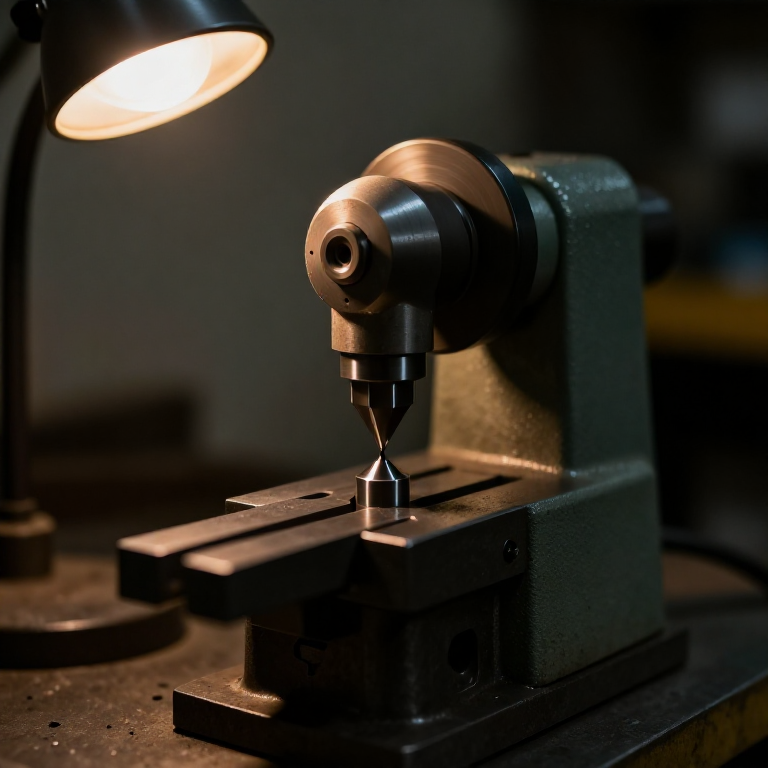


Tool and Cutter Grinder
Maagizo
Build the wheelhead
Build the wheelhead
A small wheel, running true, on a rigid spindle.
- Mount a spindle in two 608 bearings in a plywood head, taking a 100 mm grinding wheel.
- Fix the head to a column with M6 × 50 hex bolts × 4, M6 flat washers × 8 and M6 hex nuts × 4.
- Check wheel runout with a dial indicator and dress the wheel true before any grinding.
- Fit a guard covering the upper half of the wheel.
Dressing the wheel is not maintenance, it is setup. A grinding wheel that runs out grinds each tooth to a different depth as it passes, which reproduces exactly the unevenness the machine exists to remove. Dress first, and re-dress whenever the wheel loads or glazes.
Fit the guard before the first run, not afterwards. A grinding wheel that bursts does so without warning, and the fragments leave at the rim speed.Vifaa kwa hatua hii:
 Bati la mbao za kubandika1 karatasi
 Fani ya Mipira2 vipande
 Ufito wa mviringo wa alumini1 kipande
 Washa bapa8 vipande
 Nati ya pembe sita4 vipande
Zana zinazohitajika:
 Kekee cha Betri
 Seti ya vichimbuzi
 Msumeno wa Kupinda
 Seti ya funguo za pembe sita
 Kipima-unene cha dijitali cha inchi 6
 Seti ya tupa
Make the swivelling, tilting workhead
Make the swivelling, tilting workhead
The cutter must be presentable to the wheel at any angle in two planes.
- Build a workhead carrying a Morse-taper socket or a plain 16 mm arbor for mounting cutters.
- Mount it on a swivel base with a degree scale, clamped by two M6 × 40 hex bolts in curved slots.
- Add a tilting joint above the swivel, also scaled, with M6 flat washers × 4 and M6 hex nuts × 2.
- Check both scales read zero when the arbor is parallel to the table.
Two angles, two different jobs. The swivel sets the clearance angle ground behind each tooth. The tilt handles helical and angular cutters whose teeth do not lie in a plane. Between them, almost any cutter geometry can be presented to a flat wheel face — which is why the machine is called universal in the same sense as the milling machine.
Use the Morse taper from earlier in this batch to mount cutters. Its concentricity and repeatability matter here more than almost anywhere: a cutter that sits differently each time it is remounted cannot be reground consistently.Vifaa kwa hatua hii:
Ufito wa mviringo wa alumini1 kipande Bamba la Alumini1 kipandeWasha bapa8 vipandeNati ya pembe sita4 vipande
Zana zinazohitajika:
Kekee cha BetriSeti ya vichimbuziSeti ya tupa Skwea ya mchanganyiko
 Kigwe cha KatikatiKipima-unene cha dijitali cha inchi 6
Make the tooth rest — the part that does the real work
Make the tooth rest — the part that does the real work
A thin blade that each tooth rests against, so every tooth arrives in the same place.
- Cut a tooth rest blade from 1 mm spring steel or thin aluminium, with a rounded tip.
- Mount it on an adjustable post so its tip can be set at a chosen height relative to the wheel.
- Clamp the post with an M5 cup point set screw.
- Set the blade so the cutter, resting on it, presents one tooth to the wheel at the correct clearance.
The height of the tooth rest relative to the cutter centre IS the clearance angle. Raise it and the ground clearance increases; lower it and it decreases. That geometric relationship is the whole method: rather than measuring an angle on each tooth, you set one height once, and every tooth that touches the rest is ground identically.
Mount the rest on the WHEELHEAD, not the workhead, whenever the cutter will be rotated during grinding. If the rest moves with the cutter it cannot index the teeth at all — a subtle mistake that produces a cutter with a smooth spiral of varying tooth heights.Vifaa kwa hatua hii:
 Ubao bapa wa alumini1 kipande
 Skrubu ya kubana yenye ncha ya kikombe2 vipande
 Seti ya springi za kubana1 seti
Zana zinazohitajika:
Seti ya tupa Kibano cha meza ya kaziKekee cha BetriSeti ya vichimbuziSeti ya funguo za pembe sitaKipima-unene cha dijitali cha inchi 6
Grind a cutter and measure tooth-to-tooth consistency
Grind a cutter and measure tooth-to-tooth consistency
The result is judged by uniformity, not by sharpness.
- Mount a multi-tooth cutter and set the tooth rest.
- Grind each tooth in turn, taking the same pass on every one, indexing by hand against the rest.
- Go round twice with no infeed change on the second pass, to catch any tooth that was missed.
- Measure each tooth's radius from the arbor with a dial indicator and record all readings.
- Compute the spread.
Zana zinazohitajika:
Kipima-unene cha dijitali cha inchi 6Seti ya funguo za pembe sita Saa ya kupima muda
The machine that maintains the others, and history
The machine that maintains the others, and history
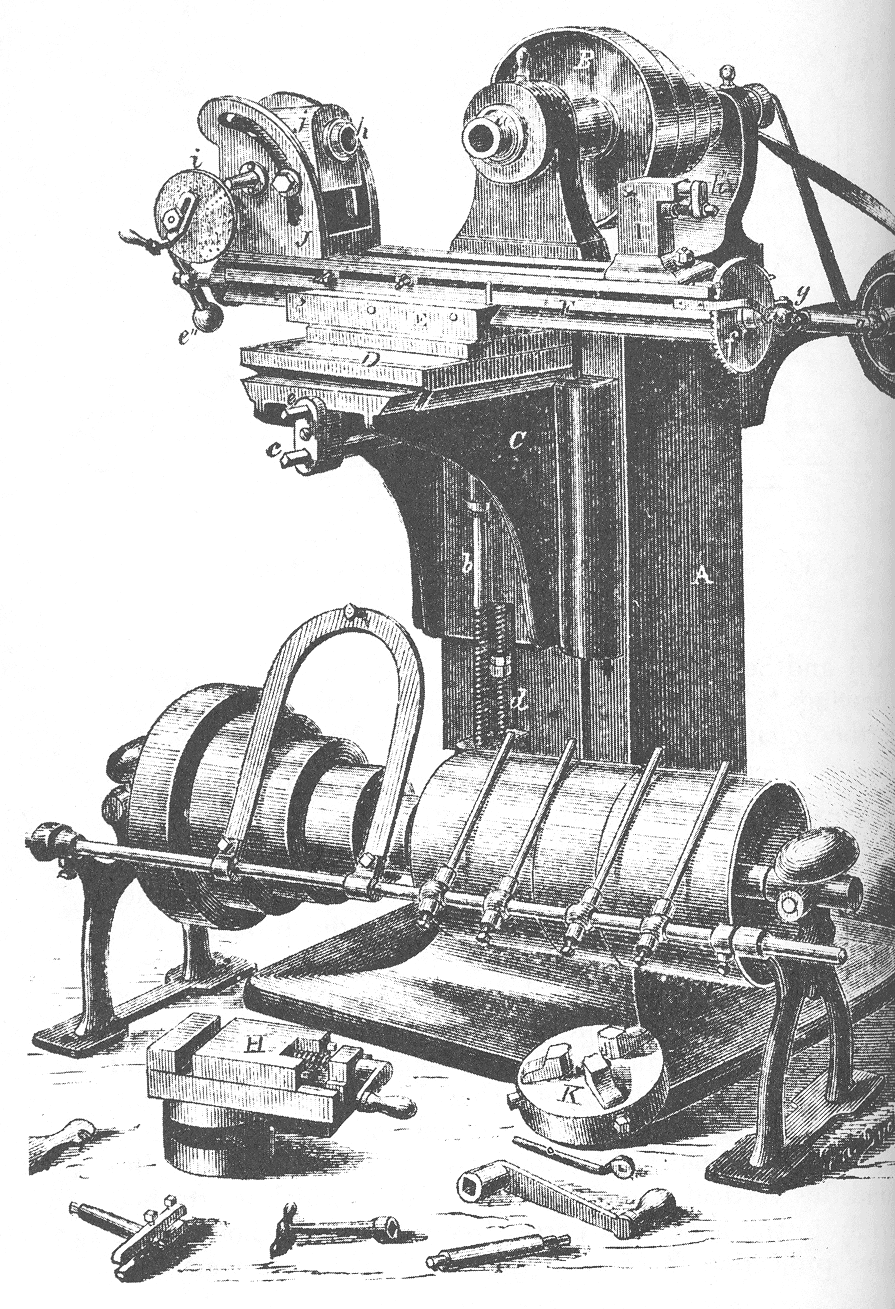
Tool and cutter grinders appear alongside milling machines from the 1860s, and Brown & Sharpe — the firm that built the universal miller in 1862 — was among the makers, for the obvious reason that they had created the demand. A workshop that buys a milling machine and no way to sharpen its cutters has bought a consumable, not a machine tool.
This is a category worth naming: the maintenance machine. It makes no products. Its entire output is keeping other machines capable, and its value is invisible in any count of parts produced. Saw doctors, wheel dressers, lapping plates and this machine all belong to it, and workshops that neglect the category slowly lose accuracy everywhere without any single failure to point at.
What it depends on from earlier in this chain: the milling machine created the cutters, the Morse taper mounts them repeatably, and the surface grinder later in this batch handles the flat work this machine cannot. The dependency runs both ways — the grinder needs the mill's cutters to exist, and the mill needs the grinder to keep working past its first hundred hours.
Its honest limit: regrinding changes a cutter's diameter, so a cutter that has been sharpened many times is measurably smaller than new. For slotting to a nominal width that matters, and the standard answer is to grind only the faces that do not set the size — which is why a good regrind is a geometry decision, not just a sharpening job.
Vifaa
9- 1 karatasiKishikilia Nafasi
- Kishikilia Nafasi
- 1 kipandeKishikilia Nafasi
- 8 vipandeKishikilia Nafasi
- 4 vipandeKishikilia Nafasi
- 1 kipandeKishikilia Nafasi
- 1 kipandeKishikilia Nafasi
- Kishikilia Nafasi
- Kishikilia Nafasi
Zana Zinazohitajika
10- 1 vendor sell this, none ship to you yetKishikilia Nafasi
- Kishikilia Nafasi
- 1 vendor sell this, none ship to you yetKishikilia Nafasi
- Kishikilia Nafasi
- Kishikilia Nafasi
- Kishikilia Nafasi
- Kishikilia Nafasi
- Kishikilia Nafasi
- Kishikilia Nafasi
- Kishikilia Nafasi
Blueprint zinazohusiana
Blueprint hizi zinashiriki maarifa — mbinu, vifaa au kanuni

CC0 Umma Wote
Mchoro huu umetolewa chini ya CC0. Uko huru kunakili, kubadilisha, kusambaza, na kutumia kazi hii kwa madhumuni yoyote, bila kuomba ruhusa.
Saidia Mtengenezaji kwa kununua bidhaa kupitia Mchoro wao ambapo wanapata Kamisheni ya Mtengenezaji iliyowekwa na Wachuuzi, au unda marudio mapya ya Mchoro huu na uiunganishe kama kiungo katika Mchoro wako kuchangia mapato.